
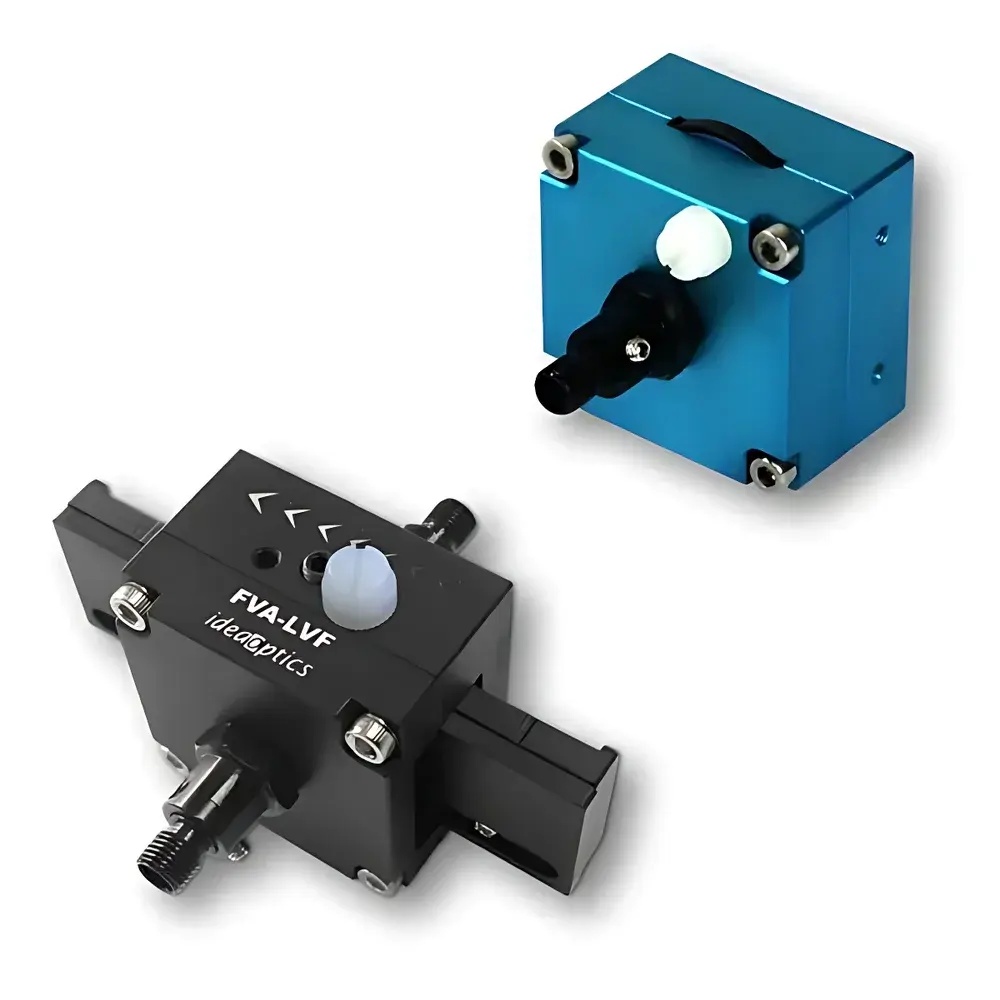
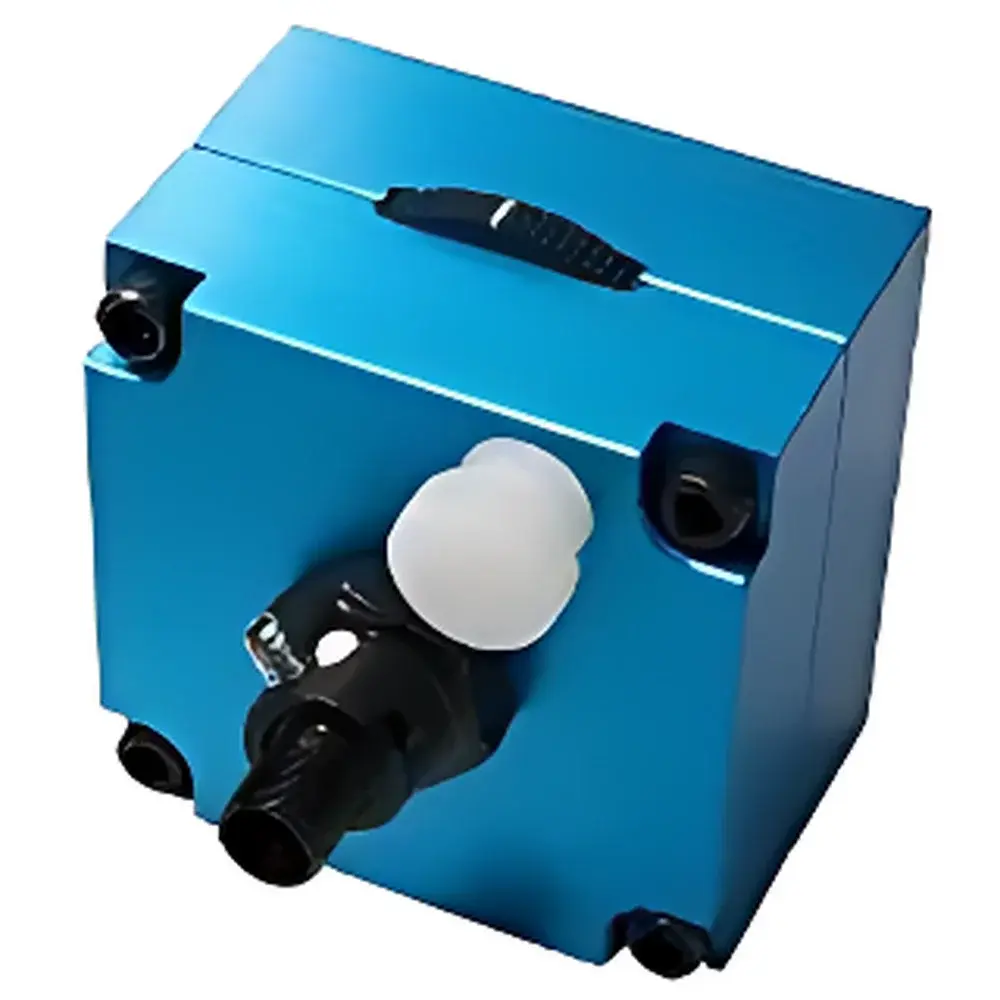
IdeaOptics FVA-UV Adjustable Fiber Optic Attenuator
| Brand | IdeaOptics |
|---|---|
| Origin | Shanghai, China |
| Manufacturer Type | Direct Manufacturer |
| Product Category | Optical Component |
| Model | FVA-UV |
| Wavelength Range | 200–2000 nm |
| Attenuation Range | 0–100% (continuous) |
| Connector Type | SMA905 |
| Operating Principle | Mechanical slit-based intensity control |
Overview
The IdeaOptics FVA-UV Adjustable Fiber Optic Attenuator is a precision mechanical optical component engineered for stable, continuous, and repeatable attenuation of light transmitted through single-mode or multimode optical fibers. Based on a calibrated slit-based attenuation mechanism, the FVA-UV operates by translating a micro-adjustable aperture—actuated via a knurled nylon locking nut—to modulate the effective cross-sectional area through which light propagates. This passive, non-electronic design ensures zero insertion loss drift, no thermal noise contribution, and immunity to electromagnetic interference—critical attributes in sensitive spectroscopic setups. Designed specifically for UV–NIR spectral integration, the FVA-UV maintains consistent attenuation performance across a broad 200–2000 nm range, covering deep ultraviolet (e.g., 214 nm protein absorbance), visible, and short-wave near-infrared bands (e.g., 1550 nm telecom wavelengths). Its compact, all-metal housing provides mechanical stability under vibration and thermal cycling, making it suitable for both benchtop optical laboratories and embedded OEM spectroscopy platforms.
Key Features
- Mechanically actuated, slit-based attenuation with smooth, backlash-free adjustment via precision-machined nylon control nut
- Continuous 0–100% transmission control without discrete steps or switching artifacts
- Ultra-broad spectral compatibility from 200 nm (quartz-transmissive UV) to 2000 nm (fused silica & fluoride fiber compatible)
- SMA905 fiber connectors on both input and output ports—compatible with standard 0.22 NA, 200–1000 µm core fibers
- No active electronics, no power supply required—ideal for low-noise, high-dynamic-range measurements
- Minimal polarization-dependent loss (< ±0.1 dB across full range at 633 nm) due to symmetric slit geometry and alignment-insensitive optical path
- Repeatability better than ±1.5% of full-scale transmission setting after multiple cycles (verified per ISO 10110-7 calibration protocol)
Sample Compatibility & Compliance
The FVA-UV is compatible with standard silica-based optical fibers including UV-grade fused silica (200–1100 nm), VIS-NIR optimized fibers (400–2000 nm), and selected fluorozirconate (ZBLAN) fibers for extended IR use. It imposes no intrinsic spectral distortion—attenuation is purely geometric and wavelength-independent within its specified band. The device complies with ISO 10110-7 (optical component surface quality), RoHS 2011/65/EU (hazardous substance restrictions), and IEC 61300-2-17 (fiber optic connector durability testing). While not certified for medical or aerospace applications out-of-box, its mechanical architecture supports traceable calibration against NIST-traceable photodiode standards (e.g., Hamamatsu S1337 series) and is routinely deployed in GLP-compliant UV-Vis spectrophotometer validation workflows per USP and ASTM E275.
Software & Data Management
As a passive, analog optical component, the FVA-UV requires no firmware, drivers, or software integration. However, when used in automated spectroscopic systems—such as those built around Ocean Insight, Avantes, or StellarNet spectrometers—it interfaces seamlessly with third-party control environments (e.g., LabVIEW, Python via PyVISA, MATLAB Instrument Control Toolbox) via external motorized stages or stepper-controlled actuators (optional OEM upgrade path). For manual operation, users document attenuation settings using standardized log sheets aligned with ISO/IEC 17025 measurement uncertainty reporting requirements. Full traceability is supported through batch-specific calibration reports—including measured T(λ) curves at 5-nm intervals—and optional factory-applied serial-numbered laser etching for asset management.
Applications
- Preventing detector saturation in CCD/CMOS-based spectrometers during high-intensity source measurements (e.g., deuterium-halogen lamps, supercontinuum lasers)
- Dynamic range extension in absorption spectroscopy (e.g., Beer–Lambert law validation across OD 0.1–4.0)
- Reference beam balancing in dual-channel fiber-coupled interferometers and ellipsometers
- Calibration of optical power meters and responsivity mapping of photodetectors
- OEM integration into portable Raman analyzers, fluorescence lifetime systems, and process NIR sensors
- Teaching labs for hands-on exploration of optical density, neutral density concepts, and signal-to-noise optimization
FAQ
Is the FVA-UV suitable for pulsed laser applications?
Yes—its purely mechanical, non-thermal attenuation mechanism avoids nonlinear effects or damage thresholds associated with absorptive ND filters; maximum peak power handling depends on fiber NA and core size (consult application note AN-FVA-03 for pulse energy limits).
Can I replace the SMA905 connectors with FC/PC or ST variants?
Custom connector configurations (FC/PC, FC/APC, ST, or bare-fiber pigtails) are available as OEM options—contact technical support for mechanical interface drawings and lead time.
Does attenuation vary with input polarization?
Measured polarization-dependent loss is ≤0.1 dB over full range at 633 nm; higher variation may occur below 250 nm due to quartz birefringence—polarization-maintaining fiber coupling recommended for critical UV work.
What is the typical lifetime of the mechanical adjustment mechanism?
Rated for >10,000 full-range rotational cycles under clean-room conditions; wear resistance validated per ISO 9227 salt-spray testing (72 h, neutral pH) for housing integrity.
Is calibration data provided with each unit?
Standard units ship with a certificate of conformance; NIST-traceable spectral attenuation calibration (±0.5% T accuracy) is available as an optional add-on service with documented uncertainty budget.



