
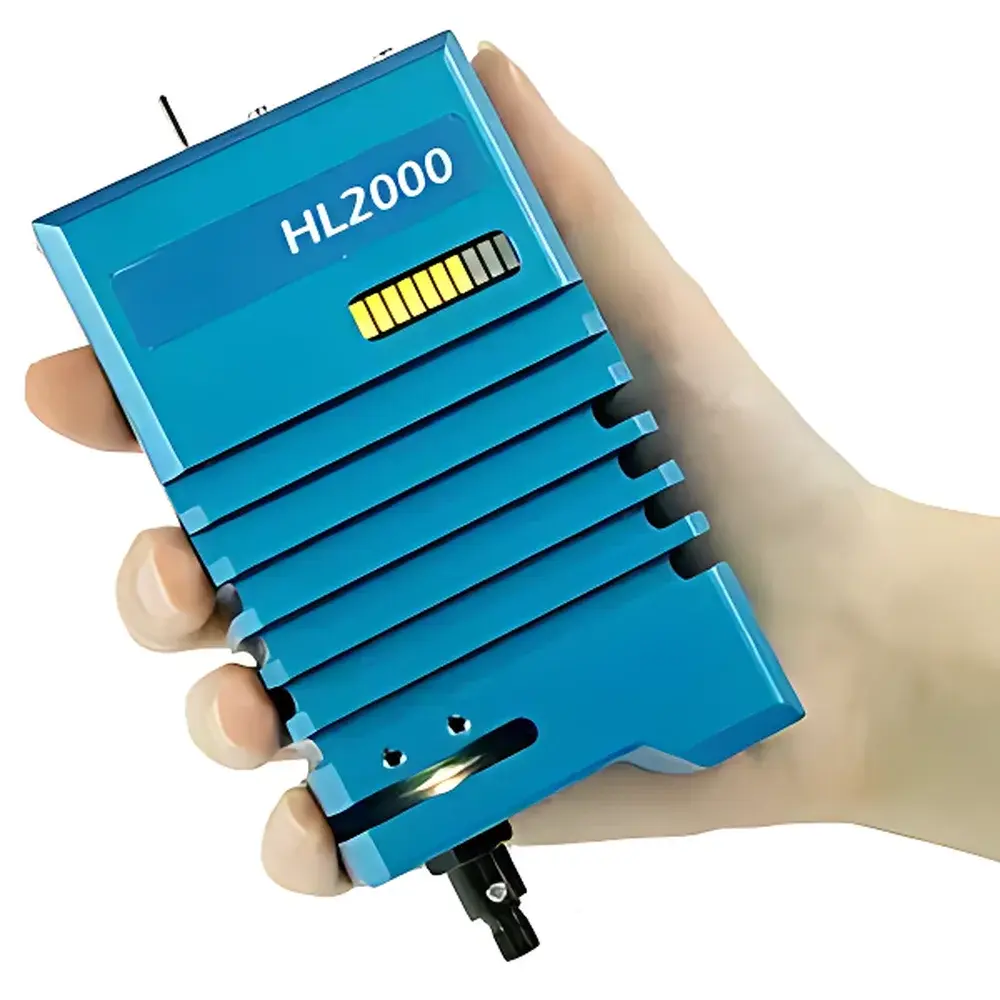
IdeaOptics HL2000 Halogen Light Source
| Brand | IdeaOptics |
|---|---|
| Origin | Shanghai, China |
| Manufacturer Type | Manufacturer |
| Regional Category | Domestic (China) |
| Model | HL2000 |
| Component Category | Light Source |
| Spectral Range | 360–2500 nm |
| Lifetime | >10,000 hours (typical) |
| Stability | ≤0.5% per hour (RMS drift) |
| Filament Positioning Accuracy | ±0.127 mm |
| Illumination Spot Size | Down to 1 µm (confocal-compatible) |
| Housing Material | Anodized Aluminum Alloy |
Overview
The IdeaOptics HL2000 Halogen Light Source is a compact, high-stability broadband illumination system engineered for precision optical measurement applications requiring consistent radiometric output across the ultraviolet–near-infrared spectrum (360–2500 nm). Designed specifically for confocal microscopy, spectrophotometry, and radiometric calibration workflows, the HL2000 employs a spectral-grade halogen lamp with optimized filament geometry and hermetic quartz envelope construction. Its operation follows Planckian blackbody radiation principles, delivering continuous spectral irradiance with predictable color temperature behavior (~3000–3400 K, depending on operating voltage). The source integrates a regulated DC power supply with active thermal compensation to minimize thermal drift—critical for long-duration measurements in GLP-compliant laboratories or automated optical test benches.
Key Features
- Ultra-stable radiometric output: ≤0.5% RMS intensity drift per hour under constant operating conditions, achieved via low-noise linear regulation and real-time thermal feedback control.
- Extended operational lifetime: Rated for >10,000 hours at nominal output—enabled by proprietary filament support design, inert gas fill optimization, and precise voltage ramping during startup/shutdown cycles.
- Confocal-grade spatial coherence: Achieves diffraction-limited illumination spots down to 1 µm when coupled with high-NA objectives and appropriate condenser optics; filament centering accuracy maintained within ±0.127 mm across production batches.
- Compact industrial form factor: Dimensions of 85 × 55 × 40 mm (L × W × H); CNC-machined anodized aluminum housing provides EMI shielding, mechanical rigidity, and efficient passive heat dissipation.
- Broadband spectral continuity: No discrete emission lines—ideal for reference-grade reflectance/transmittance measurements, UV-Vis-NIR spectroscopy, and spectral responsivity calibration of detectors and imaging sensors.
Sample Compatibility & Compliance
The HL2000 is compatible with standard fiber-coupled optical paths (SMA905 or FC/PC interface optional), free-space collimated beam configurations, and direct integration into OEM optical engines. It meets mechanical and electrical safety requirements per IEC 61010-1:2010 (Measurement, Control and Laboratory Equipment). While not certified as a primary standard, its stability, repeatability, and batch-to-batch filament positioning consistency support traceable use in secondary calibration protocols aligned with ISO/IEC 17025-accredited laboratories. When used with NIST-traceable photodiode-based radiometers, the HL2000 serves as a stable transfer standard for irradiance and radiance calibration in accordance with ASTM E275, ISO 9050, and CIE S 025/E:2015 guidelines.
Software & Data Management
The HL2000 operates as a standalone analog-controlled light source but supports digital integration via optional TTL-triggered intensity modulation (0–5 V input) and RS-232 serial interface for remote power cycling and status reporting. Firmware enables logging of cumulative operating hours and thermal history—data exportable in CSV format for audit trail compliance under FDA 21 CFR Part 11 (when deployed in regulated QC environments). No proprietary software is required; integration with LabVIEW, Python (PySerial), or MATLAB is straightforward using documented ASCII command sets. All firmware updates and calibration logs are stored internally with timestamped metadata.
Applications
- Confocal reflectance and transmission imaging—where sub-micron illumination uniformity and temporal stability directly impact signal-to-noise ratio and quantitative pixel intensity fidelity.
- UV-Vis-NIR spectrophotometer lamp replacement or auxiliary broadband source for baseline correction and stray-light characterization.
- Radiometric calibration of integrating spheres, CCD/CMOS sensors, and photometric receivers—leveraging its flat spectral roll-off above 800 nm and minimal short-term flicker.
- Material optical property characterization—including thin-film interference analysis, pigment dispersion studies, and polymer degradation monitoring under controlled broadband irradiation.
- OEM integration into automated inspection systems for semiconductor wafer metrology, pharmaceutical tablet coating analysis, and forensic document examination.
FAQ
What is the recommended operating voltage range for optimal lifetime and stability?
The HL2000 is designed for nominal 12 V DC ±5% input; operation outside this range accelerates filament evaporation and degrades spectral stability.
Can the HL2000 be used as a primary irradiance standard?
No—it is a secondary reference source. For primary calibration, users must perform absolute irradiance measurement using a NIST-traceable thermopile or silicon photodiode radiometer prior to deployment.
Is fan cooling required?
No. Passive convection cooling suffices under ambient temperatures ≤35°C and airflow ≥0.2 m/s; forced-air cooling is recommended only for continuous operation above 40°C ambient.
How often should the lamp be replaced in a GLP-compliant workflow?
Based on accumulated runtime and post-calibration verification, replacement is advised after 8,000–9,000 hours—or immediately upon observed spectral shift >2 nm at 550 nm or intensity drop >3% relative to baseline.
Does the HL2000 comply with RoHS and REACH directives?
Yes. All materials—including halogen fill gas, tungsten filament alloy, and aluminum housing—meet EU Directive 2011/65/EU (RoHS2) and Regulation (EC) No 1907/2006 (REACH) Annex XIV exemption criteria.



