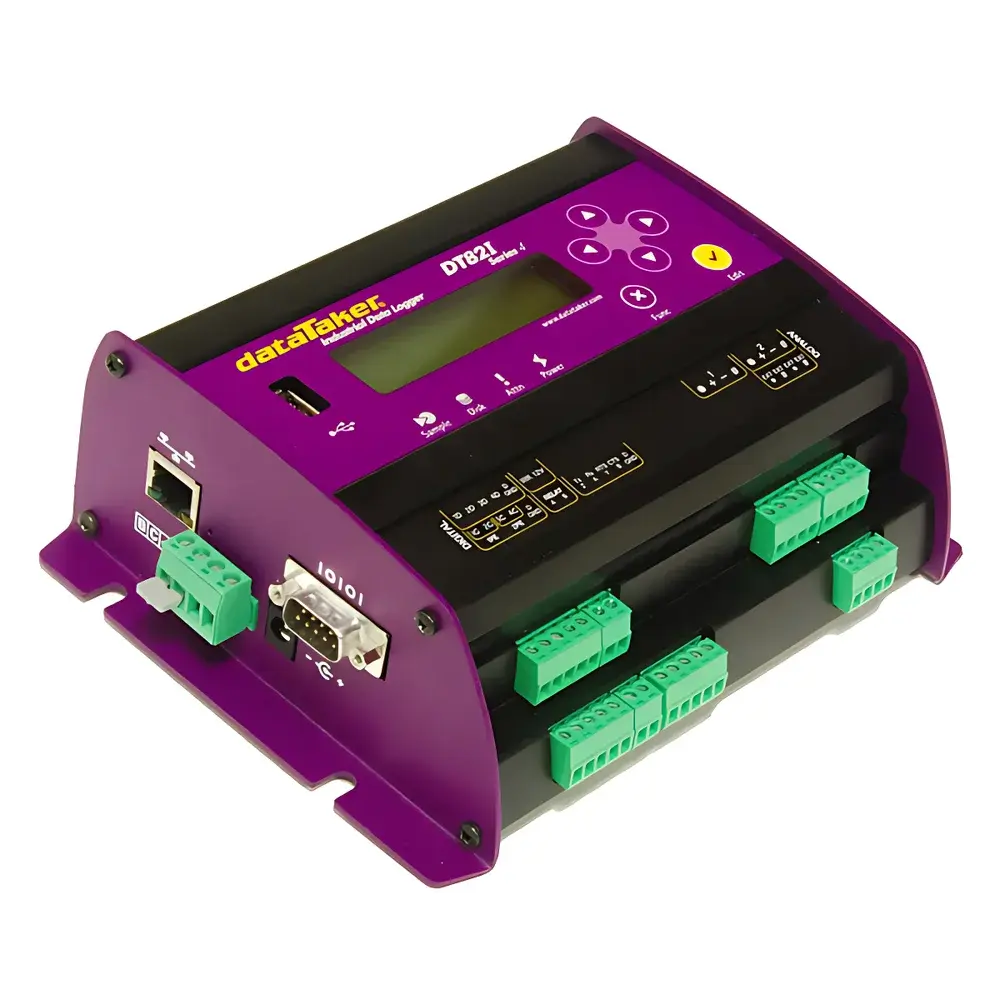
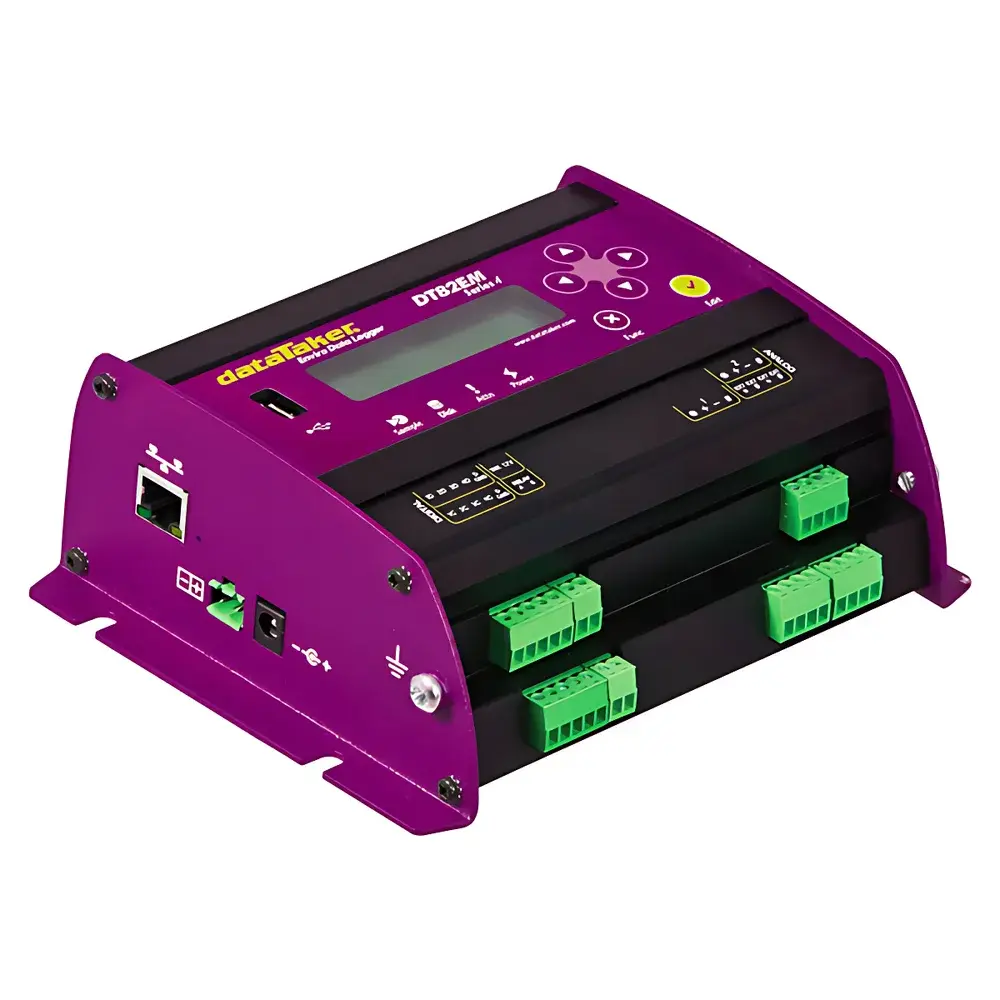
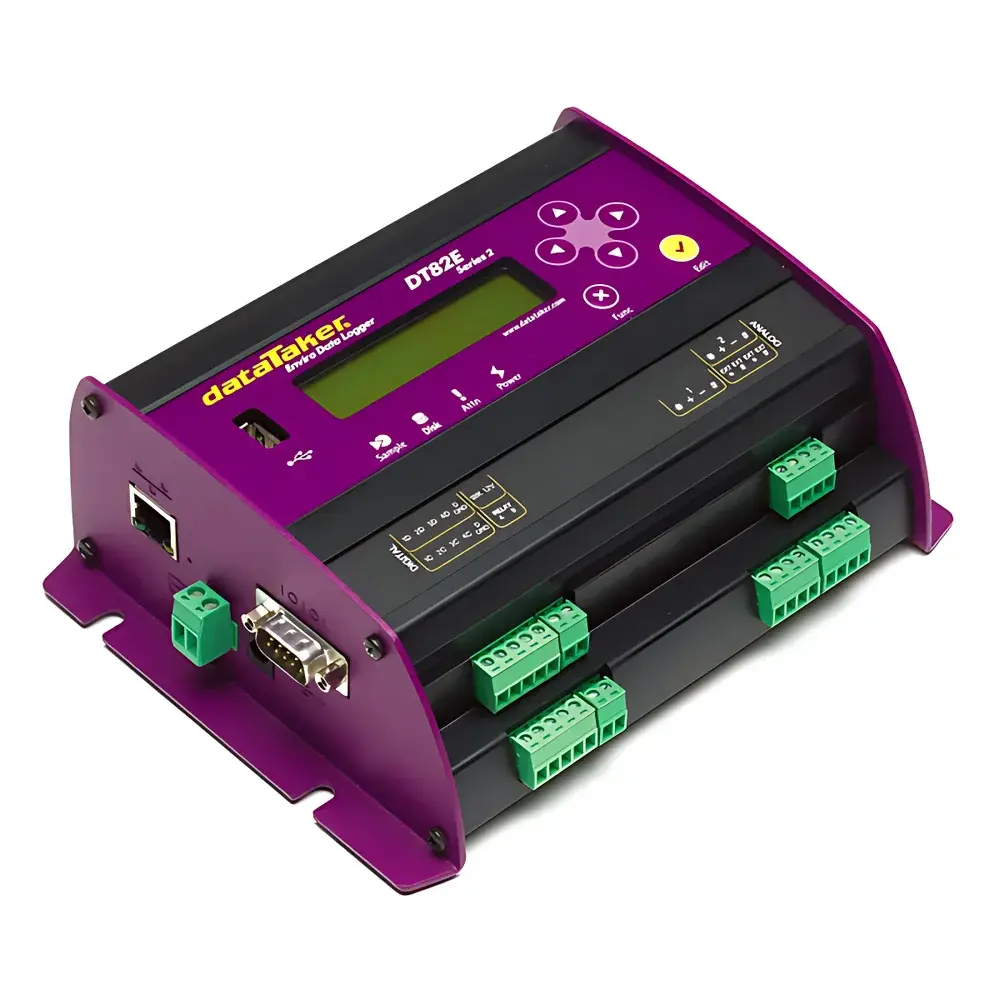
DataTaker DT82I Industrial Data Acquisition Unit
| Brand | dataTaker |
|---|---|
| Origin | Imported |
| Model | DT82I |
| Analog Inputs | 6 single-ended / 4 differential / 2 three- or four-wire |
| Resolution | 18-bit |
| Sampling Rate | up to 40 Hz |
| Analog Output | 16-bit DAC, 0–10 V or 0–20 mA |
| Excitation Outputs | 5 V / 12 V selectable, max. 150 mA |
| Digital I/O & Counter | 32-bit, up to 100 kHz |
| Communication Ports | RJ45, RS232 (host), RS232/RS485/RS422 |
| Protocols | MODBUS RTU (master/slave), MODBUS TCP/IP, ASCII, SDI12 |
| Power Supply | 10–30 VDC |
| Operating Temperature | −40 to +70 °C |
| Enclosure Rating | IP54 |
| Dimensions | 180 × 137 × 65 mm |
| Weight | 900 g |
| Internal Storage | 128 MB CompactFlash (upgradable to 4 GB), optional 8 GB USB storage |
| Real-Time Clock Accuracy | ±1 min/year (0–40 °C), ±4 min/year (−40–70 °C) |
| Built-in Battery | 6 V @ 1.2 Ah |
Overview
The DataTaker DT82I Industrial Data Acquisition Unit is a rugged, low-power, embedded measurement system engineered for continuous, unattended monitoring and control in industrial environments. It operates on the principle of high-fidelity analog-to-digital conversion coupled with deterministic real-time scheduling of sensor polling, alarm evaluation, and data logging. Unlike general-purpose DAQ systems, the DT82I integrates native support for industrial serial protocols—including ASCII command sets and MODBUS RTU/TCP—enabling direct interoperability with legacy and modern field devices such as PLCs, smart transmitters, flow meters, and programmable controllers. Its isolated 18-bit analog input architecture ensures signal integrity across electrically noisy plant floors, while its wide operating temperature range (−40 to +70 °C) and IP54-rated aluminum enclosure guarantee operational reliability in harsh conditions—from outdoor substations to manufacturing cleanrooms.
Key Features
- Protocol-native industrial connectivity: Dual-mode serial interface (RS232/RS485/RS422) with configurable baud rates and hardware flow control; supports MODBUS RTU master/slave mode and ASCII-based sensor interrogation without middleware or protocol converters.
- Signal-conditioned analog acquisition: Six single-ended or four differential analog inputs with software-selectable isolation, programmable gain, and excitation outputs (5 V or 12 V, up to 150 mA) for RTDs, strain gauges, bridge sensors, and 4–20 mA loops.
- Deterministic timing & local intelligence: Onboard real-time clock (RTC) with ±1 minute/year accuracy over 0–40 °C; user-defined scan intervals from 100 ms to 30 days; internal logic scripting enables conditional triggering, feedback control, and alarm state latching without host intervention.
- Robust embedded architecture: Aluminum chassis with conformal coating; no moving parts; CF card-based non-volatile storage (128 MB standard, up to 4 GB); optional USB mass storage expansion (8 GB); built-in 6 V / 1.2 Ah backup battery sustains RTC and memory during primary power loss.
- Secure, standards-aligned communications: Native HTTP server for web-based configuration; FTP client/server for scheduled data upload; SMTP client for email alerting; all network services support authentication and TLS-ready headers per IEC 62443-3-3 guidance.
Sample Compatibility & Compliance
The DT82I interfaces directly with a broad spectrum of industrial sensors and actuators—including thermocouples (J/K/T/E/R/S/B/N), Pt100/Pt1000 RTDs, 4–20 mA transmitters, potentiometric position sensors, frequency-output flowmeters, and digital encoders. Its MODBUS TCP/IP implementation complies with EN 50170 and Modbus Organization conformance requirements, facilitating integration into SCADA, DCS, and IIoT edge architectures. For regulated industries, the device supports audit-trail-capable logging (via dEX software), timestamped event records, and deterministic data retention—aligning with foundational expectations of FDA 21 CFR Part 11 (for electronic records) and ISO/IEC 17025 (for calibration traceability in test laboratories). The unit’s CE marking confirms compliance with EMC Directive 2014/30/EU and Low Voltage Directive 2014/35/EU.
Software & Data Management
Configuration, visualization, and post-processing are managed through dEX—a Windows-based engineering application certified for use under Windows 10/11 LTSB editions. dEX provides intuitive channel setup wizards, real-time trending with customizable Y-axis scaling (including engineering unit conversion), statistical summary reports (min/max/mean/stdev), and export to CSV, Excel, or XML formats compatible with MATLAB, Python (Pandas), and LabVIEW. All logged datasets include embedded metadata: UTC timestamps, channel identifiers, sensor calibration coefficients, and firmware revision. When deployed in GxP environments, dEX supports role-based access control, electronic signatures, and immutable log archives—meeting GLP and GMP documentation requirements for validation and audit readiness.
Applications
- Process parameter validation: Long-term recording of temperature profiles during thermal cycling tests, pressure decay in pneumatic systems, or voltage stability in power supply qualification.
- Remote asset monitoring: Integration into existing MODBUS networks to collect vibration, current draw, and ambient temperature from motors, pumps, and compressors—feeding predictive maintenance algorithms.
- Environmental compliance logging: Continuous capture of stack gas analyzer outputs (via ASCII serial), particulate monitor status, and HVAC duct static pressure—all synchronized to central SCADA via MODBUS TCP/IP.
- Energy metering aggregation: Consolidation of kWh, kVARh, and demand data from multiple utility-grade meters using MODBUS RTU polling, with local peak-demand detection and threshold-triggered notifications.
FAQ
Does the DT82I support MODBUS TCP/IP server functionality?
Yes—it operates as both MODBUS TCP/IP client and server, enabling bidirectional data exchange with HMIs, historians, and cloud platforms without requiring external gateways.
Can analog input channels be reconfigured in-field without firmware updates?
Yes—channel type (voltage/current/thermocouple/RTD), range, filtering, and scaling are fully software-configurable via dEX or HTTP interface; no hardware jumpers or DIP switches are required.
Is the internal 128 MB CompactFlash sufficient for multi-year deployments?
At a typical logging interval of 1 minute across 8 channels, the internal storage supports approximately 2.5 years of continuous data; larger CF cards or optional USB drives extend capacity to decades.
How is time synchronization maintained during extended power outages?
The integrated 6 V / 1.2 Ah rechargeable battery maintains RTC operation and volatile memory for up to 72 hours; time drift remains within ±4 minutes/year across the full −40 to +70 °C range.
Does the DT82I meet ATEX or IECEx certification for hazardous areas?
No—the DT82I is not intrinsically safe certified; it is intended for installation in non-hazardous zones or within explosion-proof enclosures compliant with IEC 60079-0.