
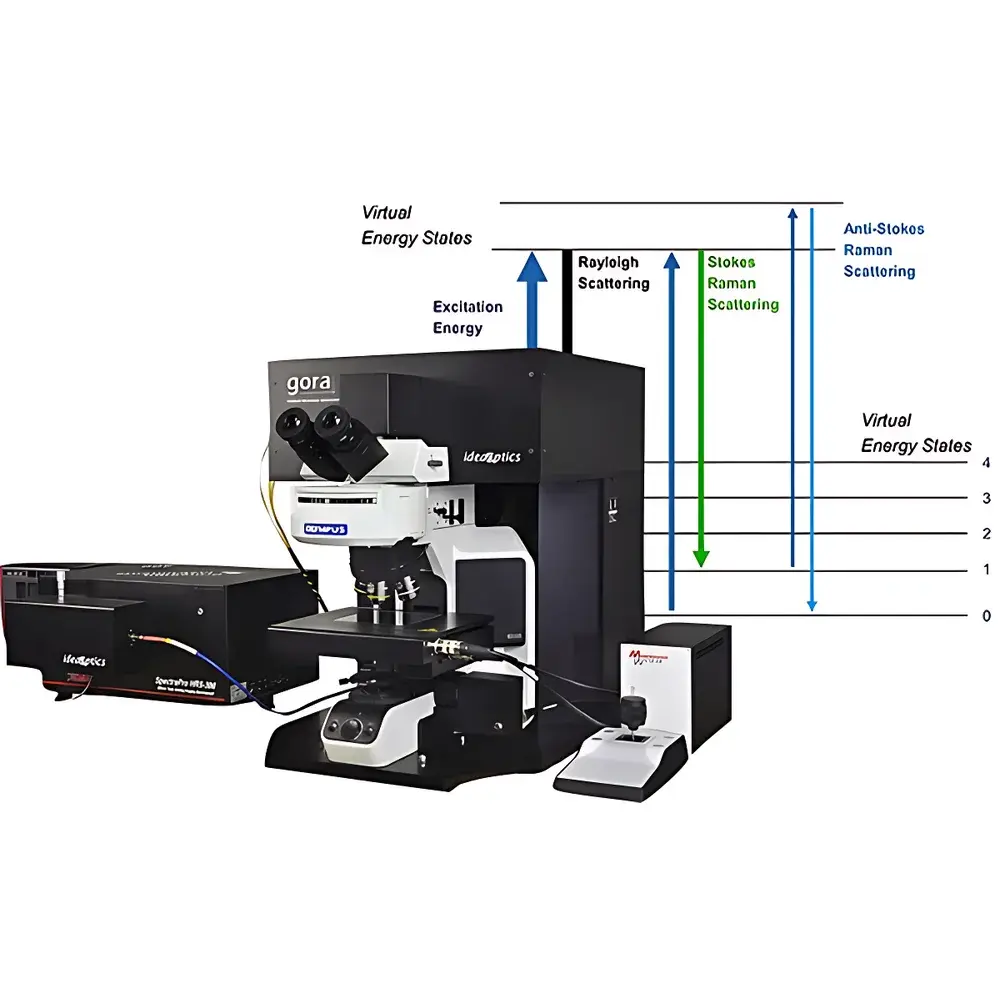
IdeaOptics gora Confocal Raman Spectrometer
| Brand | IdeaOptics |
|---|---|
| Origin | Shanghai, China |
| Manufacturer Type | Direct Manufacturer |
| Regional Classification | Domestic (China) |
| Model | gora |
| Instrument Type | Confocal Micro-Raman Spectrometer |
| Excitation Wavelengths | 532 nm, 633 nm, 785 nm |
| Spectral Resolution | 1.08 cm⁻¹ @ 585 nm (1800 grooves/mm grating, 500 mm focal length) |
| Spatial Resolution | <0.9 µm (XY) |
| Minimum Detectable Raman Shift | 10 cm⁻¹ (customizable to <10 cm⁻¹ with low-wavenumber notch filter) |
| Spectral Reproducibility | <0.9 µm (XY) |
Overview
The IdeaOptics gora Confocal Raman Spectrometer is an engineered platform for high-fidelity micro-spatial and spectral characterization of solid, liquid, and thin-film samples. Built upon a fiber-coupled confocal architecture, it replaces the conventional pinhole-based detection with a 5 µm single-mode optical fiber—enabling diffraction-limited spatial resolution (<0.9 µm in XY) while maintaining high optical throughput and alignment stability. This design implements Couette-type confocality via fiber mode filtering, ensuring precise point excitation and collection without mechanical scanning of apertures. The system operates across three standard laser excitation wavelengths—532 nm (green), 633 nm (red), and 785 nm (near-infrared)—each co-axially aligned through the proprietary Laser Hub optical engine. This multi-wavelength capability supports resonance enhancement, fluorescence suppression, and material-specific signal optimization, making the gora suitable for applications ranging from semiconductor defect analysis to pharmaceutical polymorph identification.
Key Features
- Fiber-confocal architecture using 5 µm single-mode fiber: achieves sub-micron spatial resolution (<0.9 µm XY) with inherent mechanical robustness and long-term alignment stability.
- Multi-excitation Laser Hub: integrates ≥3 laser sources (532 nm, 633 nm, 785 nm) into a single collinear beam path—no realignment required when switching wavelengths.
- Plug-and-Play modular interface (FiberPort): enables rapid integration of third-party or add-on modules—including time-correlated single-photon counting (TCSPC) units for fluorescence lifetime imaging (FLIM), hyperspectral detectors, or external cryostats—without compromising confocal integrity.
- Automated Raman mapping: synchronized control between motorized XYZ sample stage and spectrometer acquisition software allows programmable grid-based spectral acquisition with sub-micron step precision.
- Customizable low-wavenumber configuration: optional ultra-low-frequency optics package includes high-optical-density notch filters and optimized spectrograph alignment to achieve effective spectral acquisition down to <10 cm⁻¹—critical for terahertz-range phonon and intermolecular vibration studies.
Sample Compatibility & Compliance
The gora accommodates standard microscope slides, silicon wafers, metallurgical cross-sections, polymer films, and biological tissue sections (fixed or cryo-mounted). Its open optical path and modular fiber interface support vacuum-compatible and inert-atmosphere sample chambers (e.g., glovebox-integrated setups). The system complies with ISO/IEC 17025 requirements for calibration traceability when used with NIST-traceable Raman shift standards (e.g., silicon at 520.7 cm⁻¹, cyclohexane at 2924 cm⁻¹). Data acquisition workflows support audit-ready metadata logging (timestamp, laser power, grating position, objective magnification), aligning with GLP and GMP documentation practices. While not pre-certified for FDA 21 CFR Part 11, the software architecture permits integration with validated electronic lab notebook (ELN) systems via standardized API protocols.
Software & Data Management
Acquisition and analysis are performed using IdeaOptics’ goraControl Suite—a native Windows application supporting real-time spectral preview, automated focus tracking, and batch mapping parameter scripting. Raw spectra are stored in HDF5 format with embedded metadata (excitation wavelength, integration time, grating groove density, detector gain). Quantitative processing includes baseline correction (asymmetric least squares), peak deconvolution (Voigt fitting), and multivariate analysis (PCA, cluster mapping). Export options include CSV, ASCII, and JCAMP-DX for interoperability with third-party chemometric platforms (e.g., MATLAB, Unscrambler, Python scikit-learn). All user actions—including parameter changes, calibration events, and data exports—are logged in a tamper-evident activity journal compliant with ALCOA+ principles.
Applications
- Materials science: strain mapping in 2D heterostructures (MoS₂, graphene), phase distribution in battery cathode composites (NMC, LFP), and crystallinity assessment in perovskite thin films.
- Pharmaceutical QA/QC: polymorph differentiation in active pharmaceutical ingredients (APIs), counterfeit drug screening via spectral fingerprint matching, and coating uniformity verification on tablet surfaces.
- Semiconductor metrology: dopant activation profiling, stress-induced Raman shifts in SiGe channels, and contamination identification on EUV mask blanks.
- Life sciences: label-free cellular component mapping (lipids vs. proteins vs. nucleic acids), calcification detection in vascular tissues, and amyloid fibril conformational analysis.
- Forensics & art conservation: pigment identification in historical paintings, ink differentiation in questioned documents, and polymer degradation assessment in archival plastics.
FAQ
What laser safety class does the gora system operate under?
The gora is configured as Class 3B or Class 4 depending on selected laser module; full compliance with IEC 60825-1:2014 is maintained via integrated interlocks, key-switched operation, and beam shutter controls.
Can the system be upgraded for time-resolved Raman or SERS measurements?
Yes—via FiberPort interface, users may integrate TCSPC modules for picosecond-resolved Raman kinetics or plasmonic substrates for surface-enhanced Raman scattering (SERS), with optical coupling verified via manufacturer-provided alignment templates.
Is spectral calibration traceable to international standards?
Factory calibration uses NIST-traceable reference materials; end-users may perform in-house recalibration using certified silicon or polystyrene standards, with results exportable as PDF reports containing uncertainty budgets.
What is the typical acquisition time per spectrum in mapping mode?
At 1 s integration per pixel and 1 µm step size, a 100 × 100 µm² map (100 × 100 pixels) requires ~3 hours; dwell time is fully adjustable from 10 ms to 60 s based on signal-to-noise requirements.
Does the system support cryogenic or environmental cell integration?
Yes—the open-beam architecture and fiber-coupled design allow direct coupling to commercial cryostats (e.g., Janis ST-500), humidity-controlled stages, or electrochemical cells with optical access windows.





