
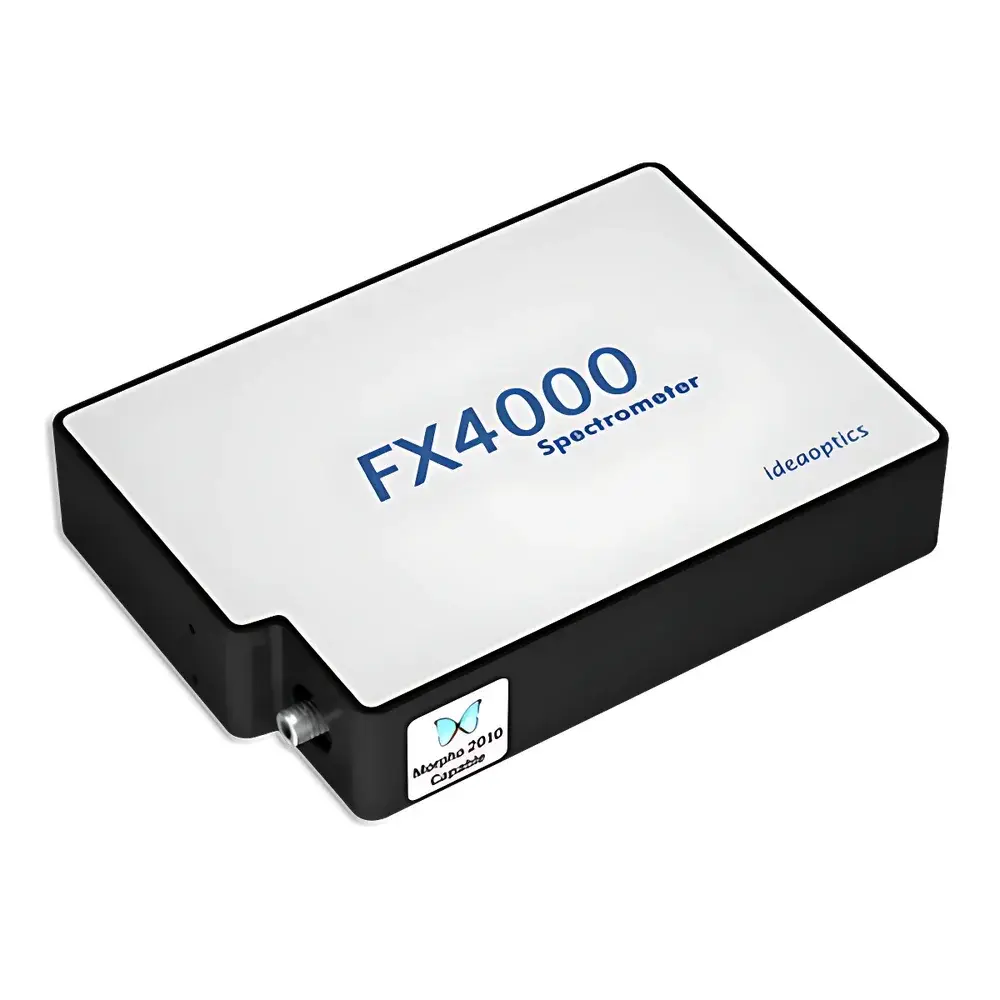
IdeaOptics FX4000 Fiber Optic Spectrometer
| Brand | IdeaOptics |
|---|---|
| Model | FX4000 |
| Origin | Shanghai, China |
| Manufacturer Type | Original Equipment Manufacturer (OEM) |
| Spectral Range | 200–1100 nm |
| Detector Type | CCD |
| Signal-to-Noise Ratio | >400:1 (at saturation) |
| Dynamic Range | >3000:1 |
| Optical Resolution | Up to 0.17 nm (FWHM) |
| Grating | Dual-blazed holographic grating |
| Integration Time Adjustment Speed | <1 ms |
| Compliance | CE, RoHS |
| Interface | USB 2.0, TTL trigger support |
Overview
The IdeaOptics FX4000 is a compact, high-performance fiber optic spectrometer engineered for precision spectral measurement across the ultraviolet–visible–near-infrared (UV-VIS-NIR) range (200–1100 nm). Based on Czerny-Turner optical architecture and equipped with a dual-blazed holographic diffraction grating, the FX4000 eliminates higher-order diffraction artifacts while maintaining uniform spectral responsivity over its full wavelength range. Its core design emphasizes optical stability, thermal robustness, and repeatability—critical for quantitative applications in research laboratories, industrial process monitoring, and quality control environments. Unlike benchtop spectrometers, the FX4000 integrates into modular optical setups via SMA905 fiber coupling, enabling flexible deployment in OEM instrumentation, portable analyzers, and embedded spectroscopic systems.
Key Features
- Dual-Blazed Holographic Grating: Optimized for broad-band efficiency and minimal stray light; suppresses overlapping orders without mechanical filter switching.
- High Optical Resolution: Achieves up to 0.17 nm full-width-at-half-maximum (FWHM) resolution—enabling discrimination of closely spaced absorption or emission features (e.g., atomic line spectra or narrowband LED characterization).
- Low-Noise CCD Detector: Back-illuminated, thermoelectrically stabilized sensor delivers >400:1 signal-to-noise ratio at saturation and >3000:1 dynamic range—supporting both low-light fluorescence measurements and high-intensity irradiance quantification.
- Sub-Millisecond Configuration Agility: Integration time, gain, and averaging parameters are reconfigurable in under 1 millisecond—facilitating real-time adaptive acquisition protocols and synchronized multi-channel measurements.
- OEM-Ready Architecture: Compatible with FX2000-series long-focal-length optics and flag-bit metadata tagging, allowing seamless integration into custom-built spectrometers with extended focal length, enhanced stray-light rejection, or multi-spectral channel routing.
Sample Compatibility & Compliance
The FX4000 supports diverse sample interaction geometries—including transmission cuvettes, integrating spheres, reflectance probes, and collimated free-space beams—via standardized 200 µm core optical fiber input (SMA905). It meets CE marking requirements for electromagnetic compatibility (EN 61326-1) and environmental safety (RoHS Directive 2011/65/EU). While not certified for GMP or FDA 21 CFR Part 11 out-of-the-box, its deterministic firmware behavior, non-volatile configuration storage, and timestamped spectral data output enable traceable implementation in GLP-compliant workflows when paired with validated software and audit-log-enabled host systems.
Software & Data Management
The FX4000 operates with IdeaOptics’ cross-platform SDK (C/C++, Python, LabVIEW, MATLAB), providing low-level register access and hardware-timed acquisition control. Raw spectra are delivered in 16-bit integer format with calibrated wavelength arrays (nm) and intensity units (counts). Optional bundled software includes SpectraSuite™ for rapid visualization, baseline correction, peak identification, and export to CSV, HDF5, or ASTM E131-compliant spectral data interchange formats. All spectral datasets include embedded metadata (integration time, detector temperature, grating position, firmware version), supporting ISO/IEC 17025 traceability frameworks.
Applications
- UV-VIS absorbance quantification of chemical solutions (e.g., protein concentration via Bradford assay, nitrate detection in water)
- NIR reflectance analysis of agricultural products (moisture, starch, oil content in grains and seeds)
- LED and laser diode spectral characterization (center wavelength, FWHM, side-mode suppression ratio)
- Plasma emission monitoring in semiconductor etch processes
- Fluorescence lifetime excitation profiling using gated integration modes
- OEM integration into handheld Raman spectrometers, colorimeters, and environmental UV index sensors
FAQ
What is the typical calibration uncertainty for the FX4000’s wavelength axis?
Wavelength calibration is performed using NIST-traceable Hg-Ar emission lines; residual RMS error is ≤ ±0.2 nm across the 200–1100 nm range.
Can the FX4000 operate in continuous scanning mode at maximum resolution?
Yes—when configured for 0.17 nm resolution and 10 ms integration time, sustained acquisition rates exceed 80 spectra per second with full 2048-pixel readout.
Is dark current compensation supported in hardware or software?
Hardware-based dark reference acquisition is triggered automatically before each spectrum; user-definable dark integration times and averaging are supported via SDK.
Does the FX4000 support external triggering with microsecond-level jitter?
Yes—TTL-compatible trigger input accepts rising-edge pulses with <1 µs timing jitter; synchronization latency between trigger and first pixel exposure is <100 ns.
Are spectral response corrections (e.g., slit function deconvolution) included in the standard firmware?
No—slit function and instrument line shape (ILS) modeling require post-processing; however, ILS characterization reports and convolution kernels are available upon request for advanced spectral unmixing applications.




