
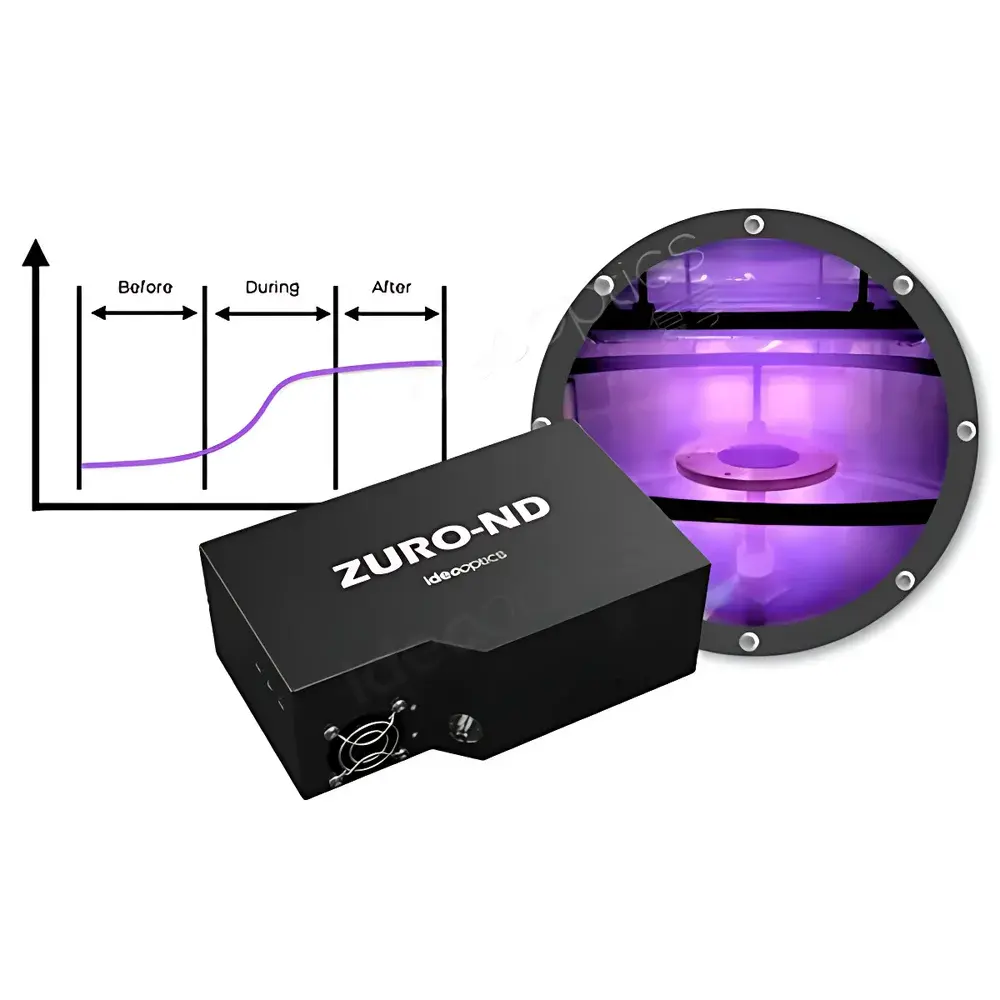
IdeaOptics ZURO Series Emission Spectroscopy Monitoring Spectrometer
| Brand | IdeaOptics |
|---|---|
| Origin | Shanghai, China |
| Manufacturer Type | Original Equipment Manufacturer (OEM) |
| Product Origin | Domestic (China) |
| Model | ZURO |
| Detector Type | CCD |
| Spectral Range | 200–980 nm |
| Optical Resolution | 0.77 nm (FWHM) |
| Signal-to-Noise Ratio | 1000:1 (typical), up to 3000:1 in nonlinear region |
| Dynamic Range | 25,000:1 |
Overview
The IdeaOptics ZURO Series Emission Spectroscopy Monitoring Spectrometer is an industrial-grade fiber optic spectrometer engineered for real-time, in-situ plasma emission monitoring in semiconductor fabrication environments. Based on dispersive optical spectroscopy using a high-efficiency Czerny-Turner optical bench and back-illuminated CCD detection, the ZURO platform captures atomic and molecular emission signatures across the deep UV to near-IR spectrum (200–980 nm). Its design prioritizes long-term operational stability under cleanroom conditions—validated for continuous operation exceeding 10,000 hours in active fab tool integration. Unlike laboratory spectrometers optimized for sensitivity or resolution alone, the ZURO system balances optical resolution (0.77 nm FWHM), wide dynamic range (25,000:1), and robust signal fidelity to resolve weak spectral lines amid intense plasma continuum background—critical for endpoint detection and process drift identification in reactive ion etching (RIE), ashing, PVD/CVD chamber monitoring, and MEMS Bosch process control.
Key Features
- Optical resolution of 0.77 nm (FWHM) at 500 nm, enabling reliable discrimination of closely spaced emission lines (e.g., Si I 288.16 nm / Cl I 288.22 nm) essential for multi-element plasma composition tracking.
- Dynamic range of 25,000:1 achieved via proprietary signal modulation and dual-gain readout architecture—supports simultaneous detection of dominant species (e.g., Ar II 488 nm) and trace indicators (e.g., F I 703 nm) without saturation or clipping.
- Back-illuminated CCD detector with enhanced quantum efficiency from 200 nm to 980 nm; optional UV-enhanced coating and order-sorting filters suppress second-order artifacts and improve spectral accuracy in complex plasma chemistries.
- Thermally stabilized optical bench and hermetically sealed housing rated for ISO Class 5 cleanroom operation; qualified per SEMI S2/S8 safety and environmental standards for integration into cluster tools and single-wafer platforms.
- Dual-model configuration: ZURO-ND (normal dispersion, optimized for broad-band plasma fingerprinting) and ZURO-SM (symmetric mount, improved stray light rejection for high-contrast endpoint transitions).
Sample Compatibility & Compliance
The ZURO spectrometer interfaces directly with standard optical feedthroughs (e.g., CF-35, KF-40) on etch, ash, and deposition tools via low-OH silica fiber (200 µm core, 1.5 m length, armored jacket). It supports both pulsed and continuous plasma sources—including ICP, CCP, and microwave-excited discharges—with no requirement for external calibration lamps during routine operation. All hardware and firmware comply with CE marking requirements (EMC Directive 2014/30/EU, Low Voltage Directive 2014/35/EU) and meet RoHS 3 (2015/863/EU) material restrictions. Data acquisition protocols are compatible with GLP/GMP-aligned audit trails when used with ideaEPD software (see Software & Data Management section).
Software & Data Management
The ZURO system integrates natively with ideaEPD—a purpose-built industrial endpoint detection platform developed by IdeaOptics for semiconductor process engineers. ideaEPD supports concurrent monitoring of up to 10 process chambers, time-synchronized spectral acquisition at configurable rates (1–100 Hz), and algorithmic endpoint detection using user-defined metrics: peak intensity ratios (e.g., C₂/CN), derivative-based inflection points, PCA-driven multivariate trend analysis, and custom Python-scripted logic. Raw spectra and processed results are stored in HDF5 format with embedded metadata (timestamp, chamber ID, recipe step, gas flow setpoints). The SDK provides RESTful API and .NET/C++ libraries for MES integration (e.g., CIMConnect, SECS/GEM), and supports FDA 21 CFR Part 11-compliant electronic signatures and audit logging when deployed on validated Windows Server environments.
Applications
- Gate Etch Monitoring: Real-time tracking of polysilicon etch endpoints via Si I (288.16 nm) and Cl I (288.22 nm) line evolution; suppression of O I (288.2 nm) interference through spectral deconvolution.
- Trench Etch Control (IGBT): In-situ depth estimation using sidewall polymer emission (CF₂*, 235 nm) and bulk etch rate correlation with SiCl₄* (251 nm), reducing post-process metrology dependency.
- Bosch Process Supervision: Cycle-resolved monitoring of SF₆/O₂ etch phase and C₄F₈ passivation phase via F I (703 nm), O I (777 nm), and C₂ (516 nm) band dynamics—enabling adaptive duty cycle adjustment.
- Ash Endpoint Detection: Multi-wavelength ratio analysis (CO₂⁺/H₂O⁺) to distinguish complete photoresist removal from residual polymer, minimizing over-ashing and substrate damage.
- Chamber Health Diagnostics: Trending of electrode erosion markers (Al I 396.15 nm), coolant leaks (H₂O vapor bands), and pump oil contamination (hydrocarbon fragments at 309 nm, 340 nm) for predictive maintenance scheduling.
FAQ
What spectral calibration options are available for the ZURO spectrometer?
Factory calibration uses NIST-traceable Hg/Ar/Ne emission lamps; field recalibration is supported via optional internal LED reference source (part number ZURO-CAL-LED) with automated wavelength and intensity correction routines in ideaEPD.
Can the ZURO operate in high-vibration environments typical of cluster tools?
Yes—the optical bench employs kinematic mounting and epoxy-free assembly; vibration testing per SEMI F22-0204 confirms stable spectral registration under 0.5 g RMS broadband excitation (5–500 Hz).
Is fiber coupling loss compensated in the system’s radiometric accuracy?
Absolute irradiance calibration is performed with the delivery fiber attached; ideaEPD applies fiber-specific throughput correction curves derived from factory-measured spectral responsivity maps.
How does the ZURO handle spectral interference from ambient light in open-bay tool configurations?
ZURO-SM includes integrated mechanical shutter and synchronized gated acquisition mode (minimum gate width: 10 µs), allowing temporal isolation of plasma emission pulses while rejecting background scatter.
Does IdeaOptics provide application support for custom endpoint algorithm development?
Yes—application engineers offer collaborative co-development of detection logic, including spectral library generation, noise modeling, and validation against CD-SEM or ellipsometry ground truth data.





