
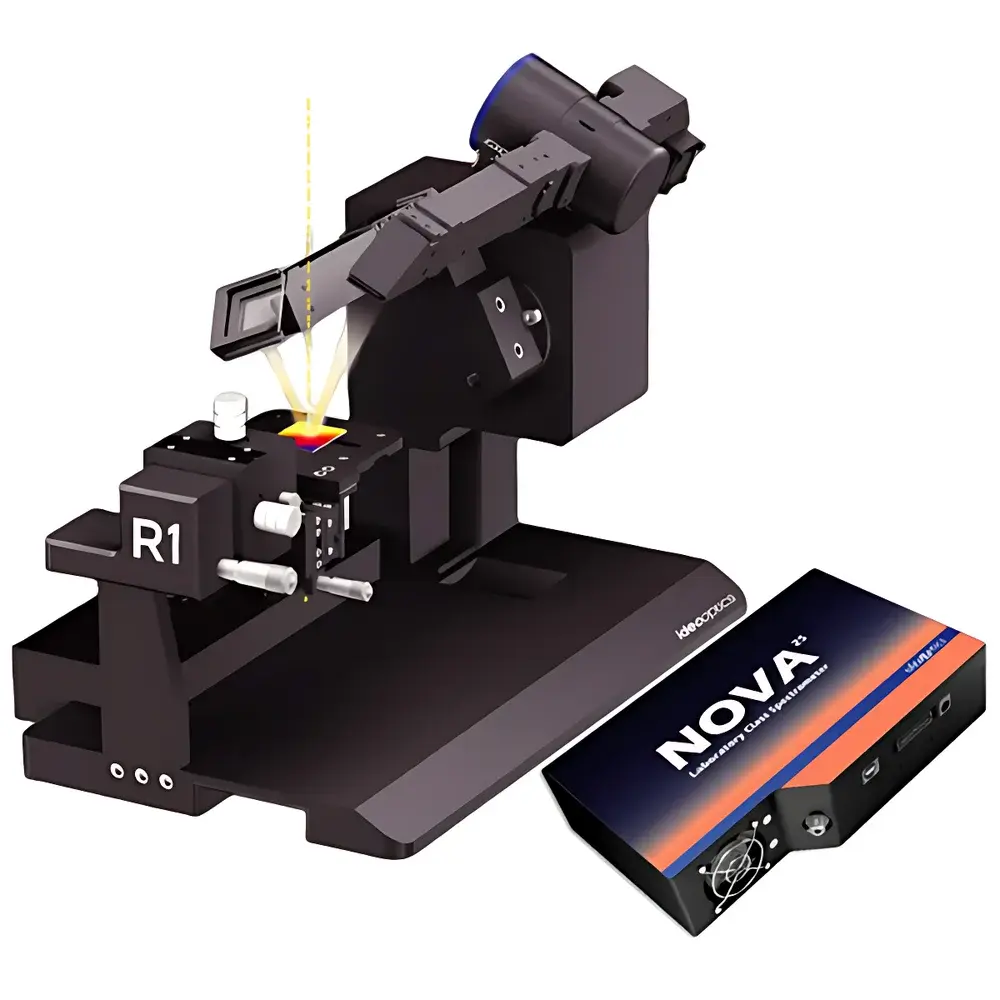
IdeaOptics R1 Angle-Resolved Spectrometer
| Brand | IdeaOptics |
|---|---|
| Origin | Shanghai, China |
| Manufacturer Type | Original Equipment Manufacturer (OEM) |
| Product Origin | Domestic (China) |
| Model | R1 |
| Pricing | Available Upon Request |
Overview
The IdeaOptics R1 Angle-Resolved Spectrometer is an engineered optical measurement platform designed for quantitative spectral characterization as a function of incident and/or collection angle across a broad wavelength range. It operates on the principle of angle-resolved spectroscopy—capturing spectral response (e.g., reflectance, transmittance, absorbance, scattering, or emission) while systematically varying the geometric orientation of illumination and/or detection relative to the sample surface. Unlike conventional fixed-angle spectrometers, the R1 integrates a high-precision rotational arm architecture that enables full 360° spatial rotation of the optical path while maintaining the sample in a stationary, horizontal plane. This design eliminates mechanical perturbation of delicate micro/nanostructures during angular scanning and ensures mechanical stability critical for reproducible measurements. The system’s all-reflective optical layout—free of refractive elements—eliminates chromatic aberration across the entire 220–2500 nm spectral window, enabling diffraction-limited performance from deep UV through short-wave infrared without recalibration or hardware swapping.
Key Features
- Full 360° angular resolution: Motorized rotational arm with sub-0.1° positional repeatability supports continuous or discrete angular sampling in both illumination and collection paths.
- Wideband achromatic optics: All-reflective design ensures uniform optical throughput and minimal wavefront distortion from 220 nm to 2500 nm—validated via NIST-traceable spectral irradiance standards.
- Seven configurable measurement modes: Simultaneously supports reflectance, transmittance, absorbance, scattering, radiance, free-space emission, and programmable multi-angle sequence acquisition—all within a single instrument configuration.
- High-fidelity photometric accuracy: Calibrated against certified reference materials (e.g., Spectralon® standards for reflectance; NIST SRM 2036 for transmittance), achieving <1% absolute uncertainty in bidirectional reflectance distribution function (BRDF) and bidirectional transmittance distribution function (BTDF) measurements.
- Modular sample interface: Accommodates standard 25 mm diameter substrates, custom holders for photonic crystal wafers, thin-film stacks, OLED/LED chips, and metamaterial arrays—with optional vacuum or environmental chamber integration.
Sample Compatibility & Compliance
The R1 is optimized for planar, solid-state optical samples including dielectric multilayers, plasmonic metasurfaces, photonic crystal slabs, quantum dot films, perovskite emitters, and structural color surfaces. Its non-contact, non-destructive measurement protocol complies with ISO 9276-2 (representation of particle size distributions), ASTM E275 (description of ultraviolet, visible, and near-infrared spectrophotometers), and supports traceability workflows aligned with ISO/IEC 17025 requirements for calibration laboratories. For regulated environments—including GLP-compliant material qualification and FDA-submitted optical safety assessments—the system supports audit-ready metadata logging, user access control, and electronic signature capability when paired with validated software configurations.
Software & Data Management
The R1 is operated via IdeaOptics’ proprietary SpectraView™ software suite, built on a deterministic real-time acquisition engine compliant with IEEE 1588 Precision Time Protocol for synchronized hardware triggering. The GUI provides intuitive workflow scripting for angular sweeps (e.g., θi–θr mapping), polarization-resolved acquisition, and automated BRDF/BTDF matrix generation. Advanced post-processing modules include band structure reconstruction (via Fourier-space transformation of angular reflectance data), CIE 1931 chromaticity projection, Mie scattering modeling integration, and export to industry-standard formats (HDF5, .spc, .jdx). All raw and processed datasets are stored with embedded metadata—including instrument configuration, calibration timestamps, environmental conditions, and operator ID—enabling full FAIR (Findable, Accessible, Interoperable, Reusable) compliance.
Applications
- Structural color analysis: Quantitative correlation between angular dispersion, peak wavelength shift, and physical lattice parameters in biomimetic nanostructures.
- Photonic crystal characterization: Direct mapping of photonic bandgaps and defect-mode angular localization to inform fabrication tolerance budgets.
- Optical thin-film metrology: Angle-dependent ellipsometric and photometric validation of coating designs under variable incidence—critical for anti-reflective, beam-splitting, and narrowband filter applications.
- Luminescent material evaluation: Far-field radiation pattern profiling (Lambertian vs. directional emission), viewing-angle-dependent CIE coordinates, and efficiency roll-off quantification for display and lighting R&D.
- Metamaterial and plasmonic device testing: Experimental verification of anomalous refraction, Huygens’ surface response, and generalized Snell’s law behavior across visible and NIR bands.
FAQ
What wavelength range does the R1 support, and how is chromatic aberration eliminated?
The R1 covers 220–2500 nm using an exclusively reflective optical train—no lenses or prisms—thereby eliminating dispersion-related focus shift and ensuring consistent spot size and resolution across the full band.
Can the R1 measure both reflection and transmission from the same sample mount?
Yes. The modular optical head allows rapid reconfiguration between reflectance (45°/0°, variable angle) and transmittance (collimated normal incidence with integrating sphere or direct detector coupling) geometries without sample relocation.
Is the system compatible with external light sources or detectors?
The R1 features SMA905 and FC/PC fiber ports, plus free-space optical interfaces compliant with ANSI Z80.10 mechanical standards, enabling integration with tunable lasers, supercontinuum sources, or cryogenic InSb/MCT detectors.
Does the software support automated compliance reporting for ISO or ASTM standards?
SpectraView™ includes preconfigured report templates aligned with ASTM E308 (computing tristimulus values) and ISO 13655 (spectral measurement of printing), with customizable fields for lab-specific QA documentation.
What level of angular precision and repeatability is achievable during long-duration scans?
The motorized goniometer delivers ±0.05° absolute angular positioning accuracy and 10,000-cycle operation, verified via HeNe laser interferometry and maintained through active thermal drift compensation.





