
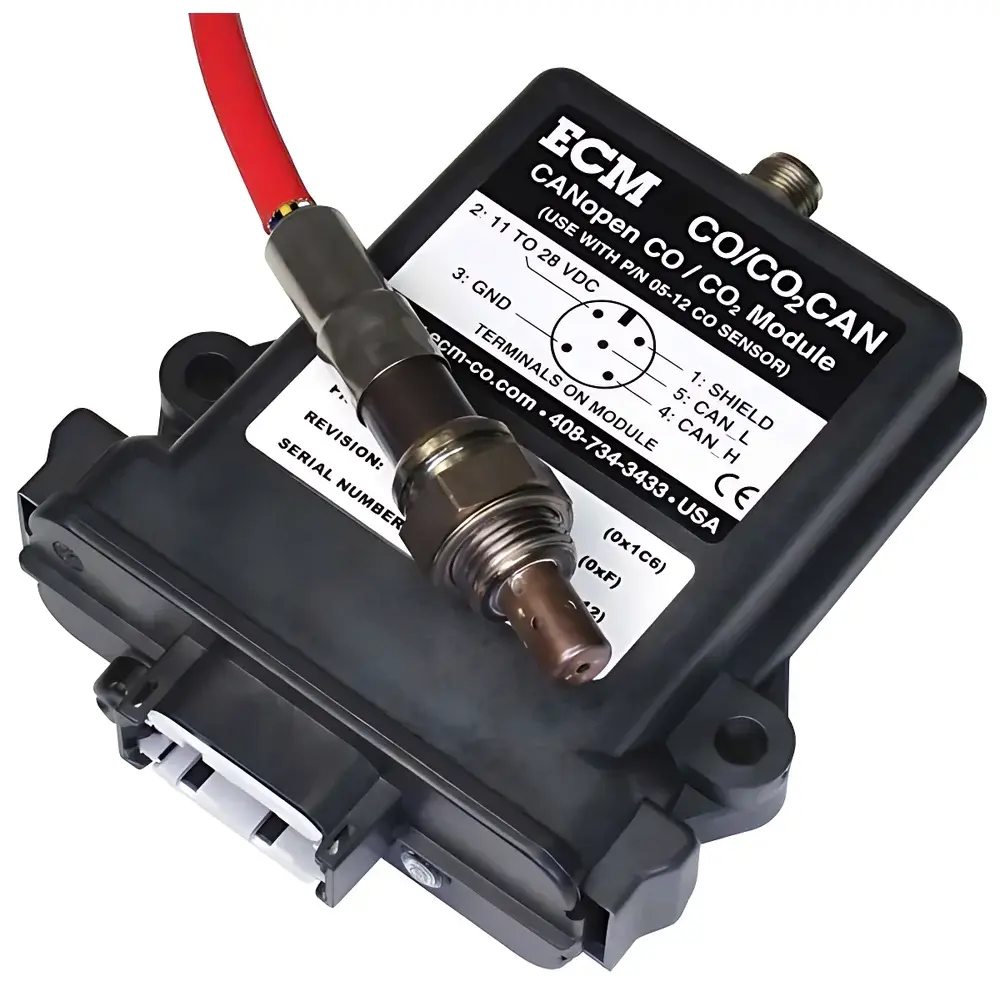
ECM CO/CO2CAN Dual-Gas CAN-Enabled Exhaust Gas Analysis Module
| Brand | ECM |
|---|---|
| Origin | USA |
| Model | CO/CO2CAN |
| Instrument Type | Online |
| Detection Principle | Electrochemical Sensing |
| Max. Permissible Error | ±0.9% |
| Repeatability | ±0.15% |
| Measurement Ranges | %CO 0–20, %CO₂ 0–20, λ 0.40–25, AFR 6.0–364, %O₂ 0–25 |
| Accuracy | %CO/%CO₂ ±0.15% (abs), λ/AFR ±0.6% (theoretical), ±0.9% (mean), %O₂ ±0.1% (abs) |
| Response Time | <200 ms |
| Operating Temperature | −55 °C to +125 °C |
| Enclosure Rating | IP67 |
| Dimensions | 145 × 120 × 40 mm |
| Power Supply | 11–28 VDC |
| Communication | High-Speed CAN Bus (ISO 11898 compliant) |
| Sensor Interface | Integrated ceramic CO/CO₂ sensor with onboard EEPROM calibration memory |
| Optional | Pressure compensation kit, dual-module display head, extended sensor cable (2 m), AC/DC adapter |
Overview
The ECM CO/CO2CAN is a compact, high-reliability, CAN-enabled exhaust gas analysis module engineered for real-time, in-situ measurement of carbon monoxide (CO), carbon dioxide (CO₂), oxygen (O₂), air-fuel ratio (AFR), and equivalence ratio (λ) in internal combustion engine exhaust streams. Unlike conventional benchtop analyzers, the CO/CO2CAN employs robust electrochemical sensing technology integrated directly into a ceramic-based, high-temperature exhaust probe—capable of continuous operation at exhaust temperatures up to 950 °C. Its core architecture is designed for embedded integration within engine control units (ECUs), aftertreatment control strategies, and emissions validation test benches. The module communicates via ISO 11898-compliant high-speed CAN bus, enabling deterministic, low-latency data transmission without requiring host PC intervention. All calibrated parameters—including %CO, %CO₂, %O₂, λ, AFR, and sensor diagnostics—are transmitted as standardized CAN frames, supporting seamless interoperability with dSPACE, ETAS, Vector, and other automotive HIL and calibration platforms.
Key Features
- Integrated ceramic CO/CO₂ electrochemical sensors with embedded EEPROM memory for factory-traceable zero/span calibration—ensuring metrological consistency across distributed test cells and production lines.
- Real-time computation of λ and AFR using user-configurable fuel composition ratios (H:C, O:C, N:C, H₂), supporting gasoline, diesel, ethanol blends (E10–E85), biodiesel, and synthetic fuels.
- Programmable CAN Node ID allows multiple CO/CO2CAN modules to coexist on a single CAN bus—enabling multi-point exhaust monitoring (e.g., pre- and post-catalyst, EGR loop, or dual-bank V-engine configurations).
- IP67-rated aluminum enclosure with integrated thermal management—validated for continuous operation from −55 °C to +125 °C ambient, suitable for under-hood deployment and dynamometer cell integration.
- Sub-200 ms system response time (T₉₀), optimized for transient engine cycle analysis including WLTC, RDE, and cold-start emissions profiling.
- Optional pressure compensation kit enables accurate λ calculation under variable backpressure conditions—critical for turbocharged engines and active DPF regeneration monitoring.
Sample Compatibility & Compliance
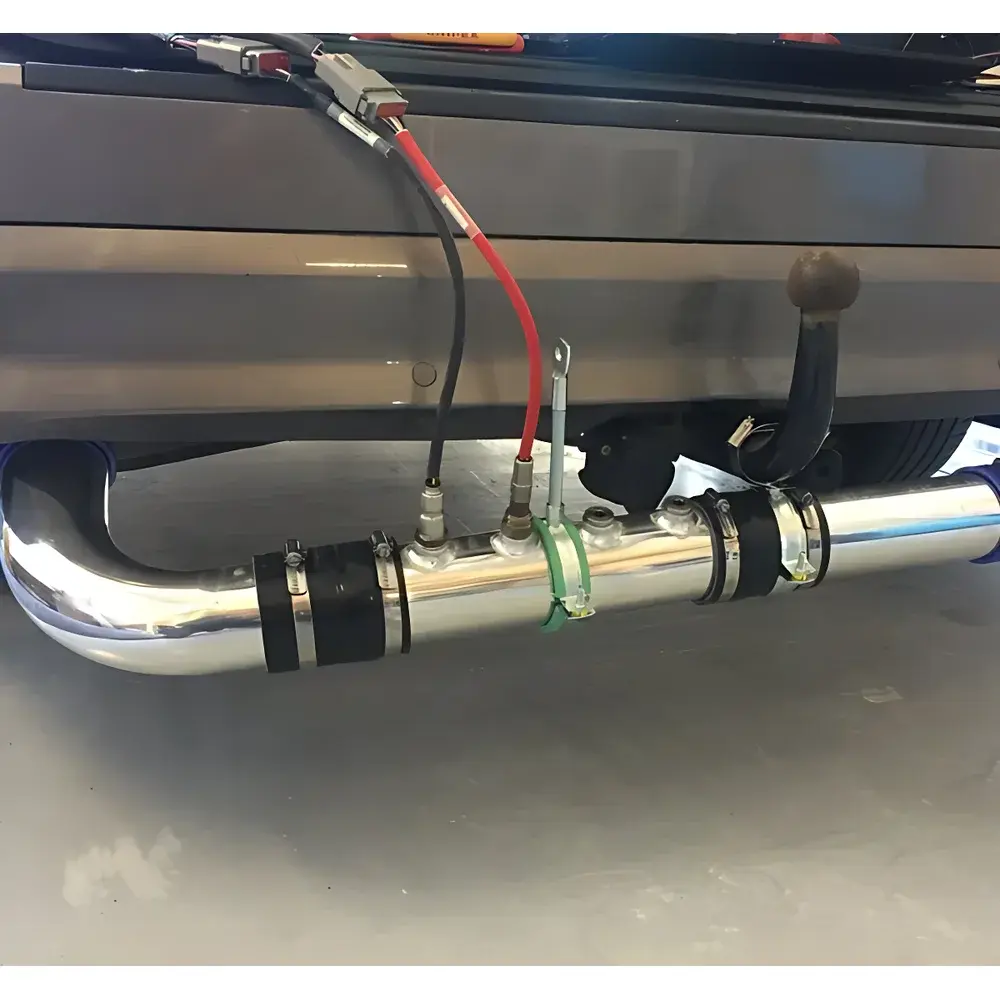
The CO/CO2CAN is validated for direct installation into exhaust manifolds, downpipes, and aftertreatment housings using standard M18×1.5 threaded mounting. Its ceramic sensor assembly tolerates condensate exposure, particulate-laden gas streams, and short-term thermal shock—making it compatible with both light-duty and heavy-duty diesel/gasoline applications. The module complies with ISO 20000-1 (service management), supports GLP/GMP-aligned audit trails when used with certified calibration software, and meets EMC requirements per CISPR 25 Class 4 and ISO 11452-2. While not certified as a standalone emissions compliance device per EPA 40 CFR Part 1065 or EU Regulation (EU) 2017/1151, it is widely deployed as an engineering-grade diagnostic tool in type-approval development, OBD strategy validation, and R&D emissions mapping per SAE J1930 and ISO 15031.
Software & Data Management
Configuration, calibration, and real-time monitoring are performed via ECM’s Windows-based CAN Configuration Utility (supplied separately). The utility communicates over USB-to-CAN adapter (not included) and provides full access to sensor diagnostics, calibration history, temperature compensation tables, and CAN message filtering. All calibration coefficients—including span drift correction factors and fuel-specific stoichiometric constants—are stored in non-volatile memory on the sensor connector’s EEPROM, eliminating manual recalibration during sensor replacement. Raw CAN data (11-bit and 29-bit identifiers) is exportable in ASC, BLF, and CSV formats for post-processing in MATLAB, Python (CANalyzer-compatible), or AVL PUMA. Audit logging supports FDA 21 CFR Part 11–compliant electronic signatures when paired with validated IT infrastructure.
Applications
- Engine development: Real-time AFR/λ feedback for closed-loop fuel control algorithm tuning and knock mitigation studies.
- Aftertreatment system validation: Monitoring catalyst light-off behavior, SCR ammonia slip correlation, and DPF soot loading estimation via CO/CO₂ ratio trends.
- RDE testing: Portable integration into vehicle test fleets for on-road lambda and combustion efficiency assessment.
- Powertrain HIL simulation: Providing physical-layer exhaust gas feedback to virtual ECU models for hardware-in-the-loop fidelity improvement.
- Emissions lab QA/QC: Cross-validation against FTIR or NDIR reference analyzers using traceable sensor calibration protocols.
FAQ
Is the CO/CO2CAN module certified for regulatory emissions testing?
No—it is an engineering-grade analytical module intended for development, diagnostics, and control strategy support—not for official certification testing per EPA, EU, or CARB protocols.
Can the module operate without a PC after initial configuration?
Yes. All operational parameters are stored onboard; once configured via CAN, it functions autonomously with no external host dependency.
What is the recommended calibration interval?
ECM recommends annual verification against traceable gas standards in accordance with ISO 17025-accredited procedures; zero/span stability is verified by built-in self-test routines.
Does the module support CAN FD?
No—it implements classical CAN 2.0B (ISO 11898-1) at up to 1 Mbps; CAN FD is not supported.
Is pressure compensation mandatory for accurate λ calculation?
It is optional but strongly recommended for turbocharged or variable-geometry turbine applications where exhaust backpressure exceeds 10 kPa.
Related Products







