
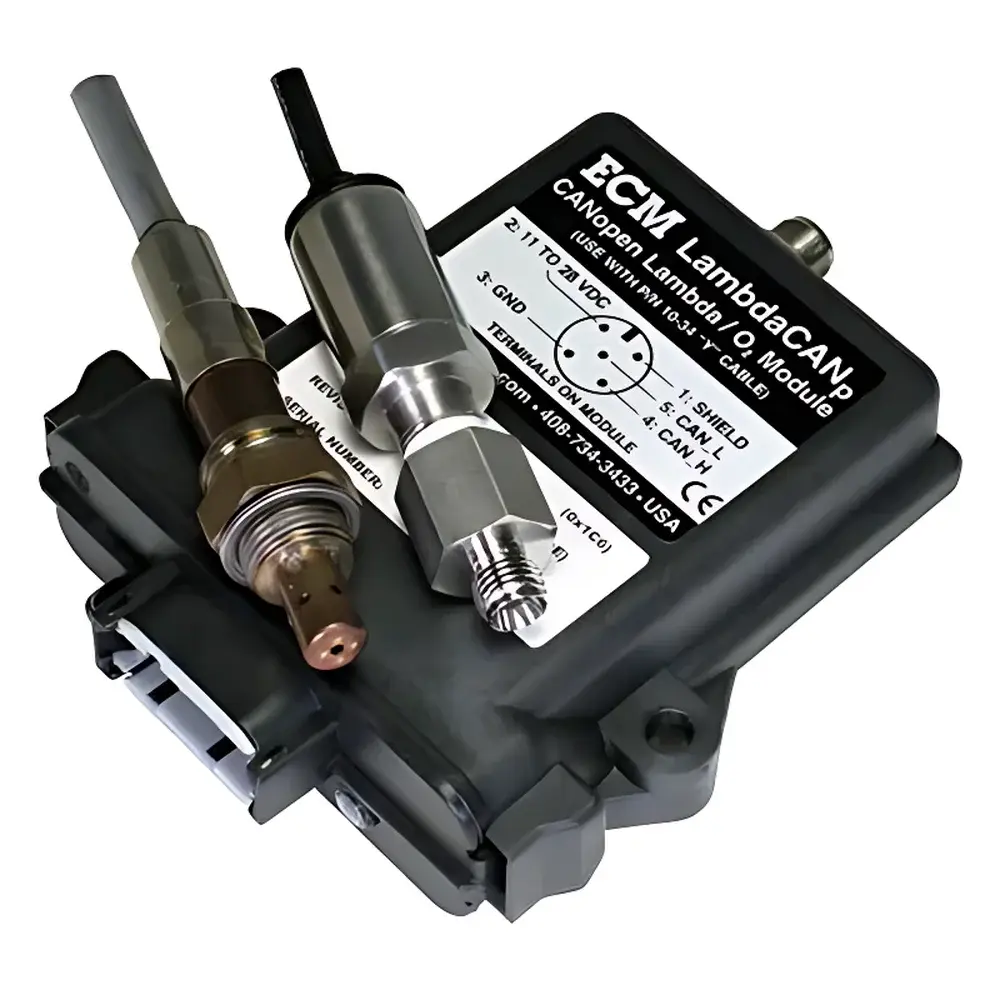
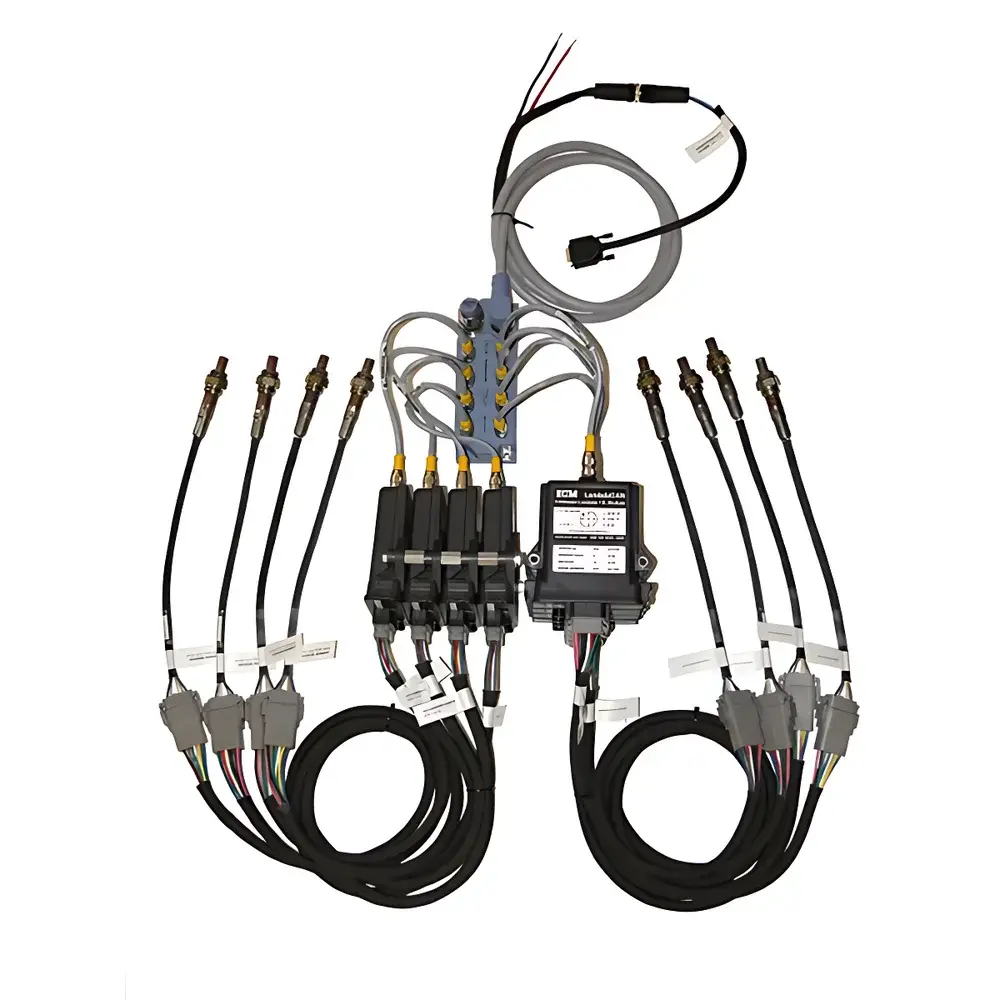
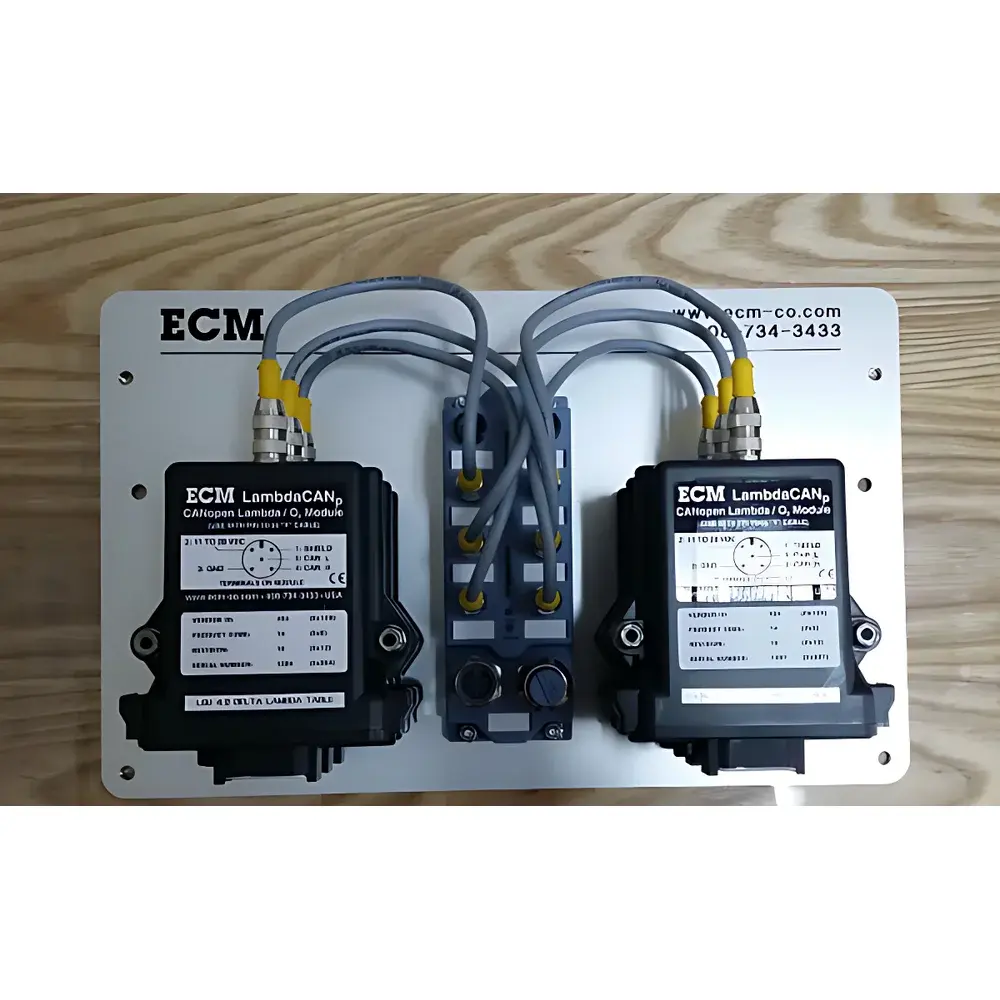
ECM LambdaCANp Wideband Air-Fuel Ratio Measurement Module
| Brand | ECM |
|---|---|
| Origin | USA |
| Model | LambdaCANp |
| Instrument Type | Online |
| Detection Principle | Electrochemical |
| Input | 1 lambda sensor + 1 optional pressure sensor |
| Lambda Range | 0.40–25 |
| AFR Range | 6.0–364 |
| φ Range | 0.04–2.5 |
| %O₂ Range | 0–25 |
| Pressure Range | 0–517 kPa |
| Lambda Accuracy | ±0.005 (λ=1), ±0.008 (λ=0.8–1.2), ±0.009 (other) |
| AFR Accuracy | ±0.1 (14.6 AFR), ±0.2 (12–18 AFR), ±0.5 (other) |
| %O₂ Accuracy | ±0.2 (0–2% O₂), ±0.4 (other) |
| Pressure Accuracy | ±5.2 kPa |
| Response Time | <150 ms |
| Fuel Ratio Configurability | H:C, O:C, N:C, H₂ |
| Communication | High-Speed CAN (ISO 11898 compliant) |
| Operating Temperature | −55 °C to +125 °C |
| Enclosure Rating | IP67 |
| Dimensions | 145 mm × 120 mm × 40 mm |
| Power Supply | 11–28 VDC |
| Sensor Thread | 18 mm × 1.5 mm (lambda), 1/4" NPT (pressure) |
| Cable Options | 1 m (standard), 2 m or 3 m (optional) |
Overview
The ECM LambdaCANp is a high-precision, online wideband air-fuel ratio (AFR) and lambda (λ) measurement module engineered for demanding engine development, emissions compliance testing, and real-time combustion optimization applications. It employs electrochemical sensing technology based on dual-cell zirconia-based wideband oxygen sensors—operating in controlled-potential electrolysis mode—to deliver accurate, stable, and repeatable λ, AFR, and %O₂ measurements across an exceptionally broad dynamic range (λ = 0.40–25). Unlike conventional narrowband sensors limited to stoichiometric detection, the LambdaCANp supports full lean-to-rich characterization required for modern gasoline direct injection (GDI), diesel, flex-fuel, and hydrogen-combustion engines. Its core innovation lies in factory-traceable calibration and integrated pressure compensation (P-COMP™), which directly addresses two dominant sources of measurement uncertainty in wideband systems: sensor aging and barometric/pressure-induced drift—particularly critical under transient intake manifold or boosted engine conditions.
Key Features
- Factory-calibrated wideband lambda and optional absolute pressure sensors, with calibration coefficients permanently stored in EEPROM within the sensor connector—enabling plug-and-play traceability and eliminating field recalibration dependencies.
- Onboard environmental-air zero-point recalibration capability: users may perform rapid (<5 s), non-intrusive recalibration at ambient conditions; updated calibration data is automatically written to the same EEPROM location.
- P-COMP™ pressure compensation algorithm corrects λ and AFR outputs for deviations from standard atmospheric pressure (101.3 kPa), enabling metrologically valid measurements in intake manifolds, turbocharged systems, altitude-varying test cells, and low-pressure exhaust recirculation (EGR) streams.
- Full compatibility with industry-standard Bosch LSU 4.9, LSU ADV, and NTK UEGO wideband sensors—ensuring interoperability with existing test benches and OEM validation infrastructure.
- Configurable fuel composition parameters (H:C, O:C, N:C, H₂ ratios) via CAN interface, supporting accurate stoichiometry calculation for alternative fuels including ethanol blends (E10–E85), methanol, natural gas (CNG/LNG), and hydrogen-enriched mixtures.
- Real-time output of auxiliary diagnostic parameters—including pump cell current, Nernst cell resistance, sensor aging factor (SAF), and internal temperature—facilitating predictive maintenance and sensor health monitoring per ISO 26262 functional safety guidelines.
Sample Compatibility & Compliance
The LambdaCANp is designed for continuous, in-situ measurement of exhaust and intake gases in internal combustion engine (ICE) test cells, vehicle onboard diagnostics (OBD-II) validation rigs, and stationary power generation systems. It accepts standard 18 mm × 1.5 mm threaded wideband oxygen sensors and optional 1/4″ NPT absolute pressure transducers. All hardware and firmware comply with ISO 11898-2 (high-speed CAN physical layer), EMC Directive 2014/30/EU, and RoHS 2011/65/EU. Calibration traceability aligns with ISO/IEC 17025 requirements when used with certified reference gases (e.g., NIST-traceable O₂/N₂ blends). The module’s IP67-rated enclosure and −55 °C to +125 °C operating envelope support deployment in harsh under-hood environments and climatic test chambers without external housing.
Software & Data Management
Configuration and real-time monitoring are performed via CAN bus using ECM’s standardized CANopen-based protocol (DS-301 compliant) and proprietary PC-based configuration software. Each module supports user-defined Node ID assignment, enabling daisy-chained multi-node architectures on shared CAN networks. All operational parameters—including fuel ratio settings, CAN bitrate (up to 1 Mbps), and alarm thresholds—are programmable over CAN. Raw sensor data (λ, AFR, %O₂, pressure, pump current, SAF) is transmitted at configurable update rates up to 100 Hz. Output messages adhere to SAE J1939-compatible parameter group numbers (PGNs) for seamless integration with AVL PUMA, ETAS INCA, dSPACE SCALEXIO, and National Instruments VeriStand platforms. Audit trails, calibration history, and firmware version logs are retained internally and retrievable via CAN request—supporting GLP/GMP-aligned data integrity requirements per FDA 21 CFR Part 11 when paired with validated host software.
Applications
- Engine control unit (ECU) development and closed-loop lambda control validation
- Regulatory emissions testing (EPA Tier 3, Euro 6d, China 6b) requiring high-fidelity AFR feedback during WLTC/RDE cycles
- Combustion efficiency mapping and knock margin optimization in research dynamometers
- Aftertreatment system diagnostics—including three-way catalyst (TWC), SCR, and GPF performance assessment under transient load
- Hydrogen and ammonia dual-fuel combustion studies where precise O₂ and λ quantification is essential for NOₓ and unburned H₂ management
- Onboard diagnostic (OBD) readiness monitoring and fault tree analysis for O₂ sensor degradation
FAQ
Does the LambdaCANp require periodic recalibration in the field?
No—factory calibration is permanent and stored in sensor-connector EEPROM. Environmental-air zero-point recalibration is optional and only recommended after extended storage or exposure to extreme thermal shock; it does not replace factory calibration.
Can the module compensate for exhaust backpressure effects?
No—P-COMP™ compensates for absolute static pressure (e.g., intake manifold or ambient barometric pressure), not dynamic exhaust backpressure. For exhaust stream measurement, install upstream of the turbine or use differential pressure referencing.
Is the LambdaCANp compatible with CAN FD networks?
No—it implements classical high-speed CAN (ISO 11898-2) at up to 1 Mbps. CAN FD support is not included in current firmware revisions.
What is the expected service life of the wideband sensor when used with LambdaCANp?
Typical sensor lifetime exceeds 5,000 hours under normal exhaust conditions (≤800 °C); lifespan is extended significantly when measuring intake air or diluted exhaust streams due to reduced thermal and chemical stress.
Does the module support analog voltage or RS-232 outputs?
No—LambdaCANp is CAN-native only. Analog or serial interfaces require external CAN-to-analog gateways certified for automotive EMC environments.
Related Products







