
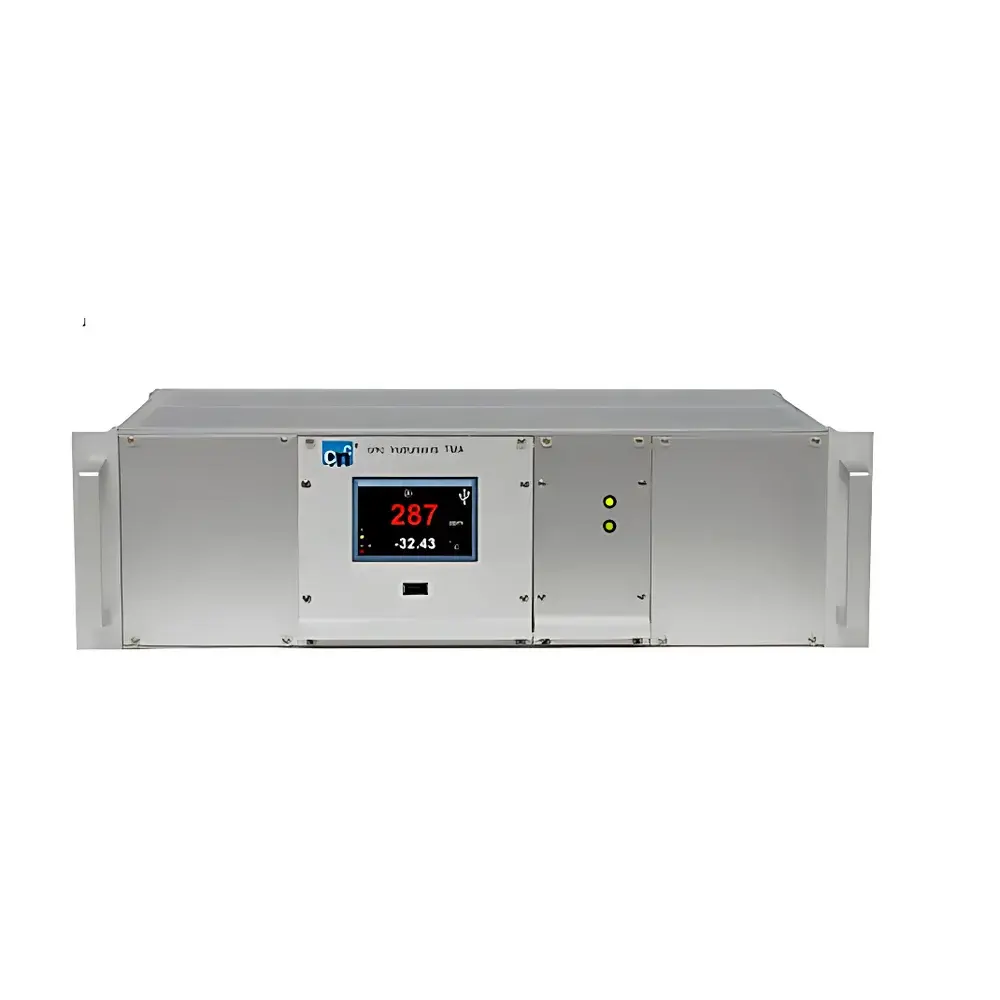
CMC TMA-202-19″ P₂O₅ Electrolytic Moisture Analyzer
| Brand | CMC |
|---|---|
| Origin | Germany |
| Model | TMA-202-19" |
| Type | Online Dew Point Analyzer |
| Principle | Phosphorus Pentoxide (P₂O₅) Electrolytic Method |
| Operating Temperature | -10°C to +50°C |
| Accuracy | ±1% of full scale |
| Repeatability | ±0.1% of full scale |
| Measurement Ranges | 0–10 ppm / 0–100 ppm / 0–1000 ppm / 0–2500 ppm (auto/manual switching) |
| Response Time (T₉₀) | <1 s |
| T₅₀ Response | <8 s |
| Sample Flow Rate | 20 NL/h |
| Recommended Sample Pressure | 0.1–0.5 barg |
| Sample Temperature | 5–50°C |
| Ambient Temperature | 5–65°C |
| Display | Touchscreen with multilingual UI (including Chinese) |
| Analog Output | 0/4–20 mA (configurable) |
| Alarm Outputs | 2 relay outputs |
| Enclosure Dimensions | 482 mm (W) × 133 mm (H) × 350 mm (D) |
| Standard Cable Length | 3 m (up to 300 m optional) |
Overview
The CMC TMA-202-19″ is a high-precision, online electrolytic moisture analyzer engineered for continuous trace water measurement in aggressive and combustible process gases. It employs the internationally recognized phosphorus pentoxide (P₂O₅) electrolytic principle—based on Faraday’s law of electrolysis—to deliver absolute, calibration-free quantification of moisture down to sub-ppm levels. Unlike optical or capacitive methods, this technique relies on the stoichiometric decomposition of water molecules (H₂O → H₂ + ½O₂) across a hygroscopic P₂O₅-coated electrode pair, generating an electrolytic current directly proportional to the water concentration in the sample stream. The sensor’s glass-bodied cylindrical construction, combined with inert electrode materials (platinum or rhodium), ensures long-term stability and chemical resistance—critical for applications involving corrosive gases such as Cl₂, HCl, SO₂, H₂S, and high-purity industrial gases including SF₆, Ar, He, N₂, H₂, O₂, and natural gas. Its design eliminates drift-related recalibration needs, enabling true “set-and-forget” operation in demanding industrial and laboratory environments.
Key Features
- True absolute measurement: No zero/span calibration required under stable operating conditions; sensor regeneration restores baseline performance without external standards.
- Ultra-fast response: T₉₀ < 1 second and T₅₀ < 8 seconds enable real-time monitoring of rapid moisture transients in purge lines, synthesis reactors, or gas distribution networks.
- Robust P₂O₅ sensor architecture: Chemically inert glass cell and noble-metal electrodes ensure compatibility with highly reactive and acidic gas matrices.
- Intelligent range management: Four selectable full-scale ranges (0–10, 0–100, 0–1000, 0–2500 ppm) with automatic or manual switching to optimize signal-to-noise ratio across varying moisture loads.
- Microprocessor-controlled diagnostics: Built-in self-test at power-on verifies sensor integrity, amplifier functionality, and relay status—supporting predictive maintenance planning.
- NAMUR-compliant interface: Analog output (4–20 mA) and dual relay alarm outputs meet NE 43 and NA 107 specifications for integration into DCS and safety instrumented systems (SIS).
Sample Compatibility & Compliance
The TMA-202-19″ is validated for use with over 25 industrial gases—including Xe, Kr, D₂, F₂, PH₃, C₂H₂, CO₂, CH₄, Freon variants, and ozone—where conventional sensors degrade or exhibit cross-sensitivity. It complies with IEC 61000-6-2 (immunity) and IEC 61000-6-3 (emissions), and its enclosure meets IP54 rating for protection against dust and water splashing. While not intrinsically safe by default, it may be deployed in Zone 2/Class I Div 2 environments when installed with appropriate barrier systems. The analyzer supports GLP/GMP-aligned data integrity practices through time-stamped event logging and non-volatile memory storage of operational history—facilitating audit readiness per FDA 21 CFR Part 11 requirements when paired with compliant SCADA or LIMS platforms.
Software & Data Management
The embedded touchscreen HMI provides intuitive navigation in English, German, and Chinese, with configurable display units (ppm, µg/L, dew point °C/°F), user-accessible calibration logs, and alarm history review. All analog and digital outputs are timestamped and scalable via front-panel configuration or Modbus RTU (RS-485 optional). Raw current signals from the P₂O₅ cell are digitized at 16-bit resolution and processed using temperature-compensated algorithms to correct for ambient and sample thermal effects. Data export is supported via USB port (CSV format), enabling traceability for QA/QC documentation and statistical process control (SPC) charting.
Applications
- High-purity semiconductor gas delivery systems (e.g., Cl₂, HCl, NH₃, silane lines)
- Power transformer insulating oil off-gas analysis (SF₆ monitoring)
- Cryogenic air separation unit (ASU) purity verification
- Hydrogen fuel production and refueling station quality assurance
- Pharmaceutical nitrogen blanketing and lyophilization chamber validation
- Petrochemical acid gas treatment (amine scrubber outlet monitoring)
- Electronics-grade specialty gas certification per ISO 8573-8 and ASTM D7615
FAQ
Does the P₂O₅ sensor require periodic replacement?
No—electrode regeneration is performed in situ via controlled reverse-current application, restoring the H₃PO₄ electrolyte layer without disassembly.
Can the analyzer operate under vacuum or elevated pressure?
It is rated for sample pressures between 0.1–0.5 barg; operation outside this range requires external pressure regulation and may affect accuracy.
Is the instrument suitable for measuring moisture in liquefied gases?
No—it is designed exclusively for gaseous-phase analysis; liquid-phase or aerosol-laden streams must be conditioned with coalescing filters and vaporizers prior to inlet.
How is measurement traceability maintained?
Each unit ships with a factory-issued calibration certificate referencing NIST-traceable dew point standards; field verification may be performed using certified gas standards per ISO 6141.
What maintenance intervals are recommended?
Visual inspection every 6 months; sensor regeneration triggered automatically upon signal deviation >±0.5% FS; full system verification annually or after exposure to condensation or particulate overload.
Related Products




