
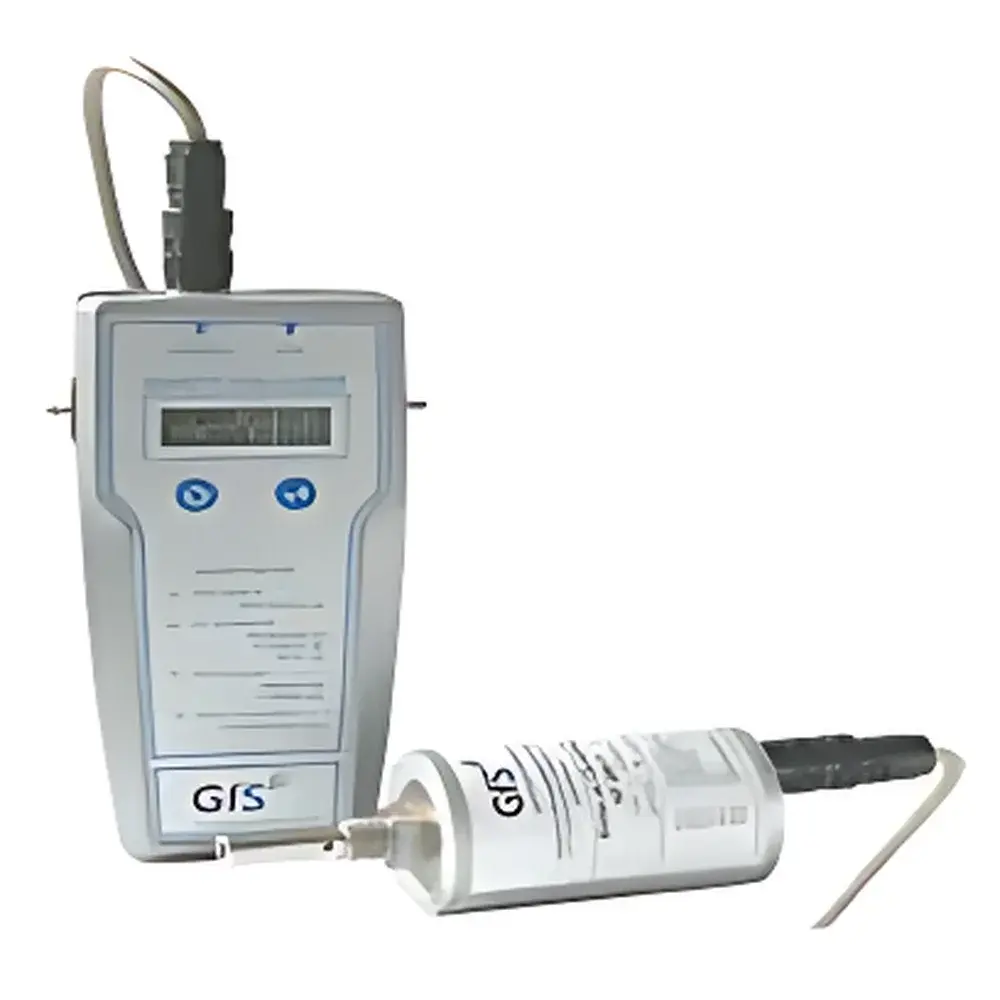
GFS NP330-G Portable Aluminum Oxide Dew Point Meter
| Brand | GFS |
|---|---|
| Origin | Germany |
| Model | NP330-G |
| Product Type | Portable Dew Point Meter |
| Measurement Principle | Aluminum Oxide Capacitive Sensor |
| Range | Standard −80 °C to +20 °C (optional −100 °C to +20 °C) |
| Accuracy | ±2 °C |
| Sample Gas Temperature | ≤ +60 °C |
| Operating Pressure | Up to 300 bar |
| Recommended Flow Rate | 1–5 L/min |
| Power Supply | 18–28 V DC, max. 70 mA |
| Ambient Temperature | −20 °C to +60 °C |
| Cable Length | 3 m |
| Ingress Protection | IP65 |
| Filter | 80 µm Sintered Stainless Steel |
| Sensor Thread | G1/2″, Insertion Depth: 50 mm |
| Calibration Interval | Annually Recommended |
| Dimensions | Total Length 176 mm |
| Weight | ~450 g |
Overview
The GFS NP330-G is a high-performance portable dew point meter engineered for precise, real-time moisture monitoring in compressed gases and industrial process streams. It employs a robust aluminum oxide (Al2O3) capacitive sensor—a proven technology widely adopted in critical applications requiring trace-level water vapor quantification. Unlike chilled-mirror or tunable diode laser methods, the Al2O3 principle relies on humidity-dependent changes in dielectric constant across a hygroscopic ceramic layer, enabling stable, low-drift measurements without optical alignment or refrigeration. The NP330-G is specifically designed for field-deployable use where portability, pressure resilience, and long-term sensor stability are paramount—particularly in environments demanding compliance with ISO 8573-1 (compressed air purity), ASTM D6673 (moisture in natural gas), and pharmaceutical-grade gas qualification per EU GMP Annex 1.
Key Features
- Al2O3 ceramic capacitive sensor with integrated temperature compensation—ensuring consistent accuracy across variable ambient and sample conditions
- Extended operational pressure range up to 300 bar, suitable for high-pressure natural gas transmission lines, hydrogen compression systems, and semiconductor bulk gas delivery networks
- Wide dew point measurement span: standard −80 °C to +20 °C; optional extended range down to −100 °C for ultra-dry applications such as SF6 insulation gas or cryogenic nitrogen
- IP65-rated housing with stainless steel sintered filter (80 µm pore size), providing protection against particulates and mechanical ingress in harsh industrial settings
- Compact, lightweight design (≈450 g) with G1/2″ threaded sensor interface—enabling direct insertion into sampling ports, manifolds, or custom adapters without flow restriction
- Low-power 18–28 V DC operation and minimal maintenance requirements—ideal for battery-powered surveys or permanent installation in remote locations
Sample Compatibility & Compliance
The NP330-G is validated for use with non-corrosive, non-condensing gases including nitrogen, oxygen, argon, helium, compressed air, natural gas (dry), hydrogen, and CO2. It is not intended for continuous exposure to acidic or highly reactive species such as HCl, SO2, Cl2, or ammonia, which may degrade the sensor’s alumina layer. All units are manufactured in Germany under ISO 9001-certified processes and conform to electromagnetic compatibility standards (EN 61326-1). For regulated industries, the instrument supports audit-ready documentation: calibration certificates traceable to NIST or PTB standards, annual recalibration recommendations aligned with ISO/IEC 17025, and full traceability of sensor lot numbers and factory verification data.
Software & Data Management
While the NP330-G operates as a standalone field meter with local LCD display and analog/digital outputs (4–20 mA, RS-485 Modbus RTU), it integrates seamlessly into centralized SCADA or LIMS platforms via optional communication modules. Raw dew point, temperature, and pressure data are timestamped and logged internally (with external memory card support in configured variants). Data export complies with ASTM E2500 and FDA 21 CFR Part 11 requirements when paired with validated software—supporting electronic signatures, user access control, and immutable audit trails for GxP environments.
Applications
- Air separation plants: Monitoring dryness of product oxygen/nitrogen prior to liquefaction or pipeline injection
- Natural gas processing: Verifying water content downstream of glycol dehydrators and molecular sieve beds per GPA 2166
- Pharmaceutical manufacturing: Qualifying instrument air, nitrogen purge gas, and cleanroom supply lines against ISO 8573-1 Class 2 or Class 3 limits
- Semiconductor fabrication: Ensuring ultra-low dew points (<−70 °C) in bulk specialty gases used for CVD/PVD tool purging
- HVAC commissioning: Validating desiccant dryer performance and verifying dew point suppression in chilled water systems
- R&D laboratories: Characterizing moisture sorption isotherms, evaluating desiccant efficiency, and supporting material stability studies under controlled humidity
FAQ
What gases are incompatible with the NP330-G sensor?
Acidic, oxidizing, or condensable gases—including HCl, HF, SO2, Cl2, NH3, and saturated hydrocarbons—may chemically attack or contaminate the Al2O3 sensing layer and are not supported for continuous measurement.
Is the sensor suitable for high-flow applications?
Yes—the recommended flow rate of 1–5 L/min ensures optimal response time and thermal equilibrium; higher flows (>10 L/min) require inline pressure regulation to avoid sensor cooling artifacts.
How often must the instrument be calibrated?
GFS recommends annual calibration using certified reference dew point generators traceable to national metrology institutes; more frequent verification is advised after exposure to extreme pressure transients or suspected contamination.
Can the NP330-G operate at sub-zero ambient temperatures?
Yes—its specified operating range extends to −20 °C; however, condensation on external surfaces must be prevented, and battery performance should be verified for extended low-temperature deployment.
Does the device meet explosion-proof requirements?
The base NP330-G is not intrinsically safe or ATEX-certified; for hazardous area use, consult GFS for approved explosion-proof housings or remote-sensor configurations compliant with IECEx/ATEX Zone 1/2 specifications.




