
ECM Lambda 5220 Wide-Range Air-Fuel Ratio and Exhaust Gas Oxygen Analyzer
| Brand | ECM |
|---|---|
| Origin | USA |
| Model | Lambda 5220 |
| Type | Online Analyzer |
| Detection Principle | Electrochemical (Zirconia-based Wideband Sensor) |
| Max. Permissible Error | ±0.5% of reading |
| Zero Drift | ±1% FS/24h |
| Span Drift | ±1% FS/24h |
| Repeatability | ±0.2% FS |
| Measurement Ranges | λ 0.4–25, AFR 6–364, Φ 0.04–2.5, O₂ 0–25% vol, Pressure 0–517 kPa (optional) |
| Accuracy | λ ±0.005 (at λ=1), ±0.008 (λ=0.8–1.2), ±0.009 (elsewhere) |
| Response Time | <150 ms (t₉₀) |
| Operating Temperature | −40 °C to +85 °C |
| Power Supply | 11–28 VDC |
| Analog Outputs | Six isolated 0–5 V linearized channels |
| Communication Interfaces | CAN 2.0B (user-configurable protocol), USB, RS-232 |
| Sensor Interface | M18×1.5 (Lambda probe), 1/4" NPT (pressure transducer) |
| Max. Cable Length | 100 m (sensor to analyzer) |
| Fuel Composition Parameters | Adjustable H:C, O:C, N:C, H₂ ratios |
| Compliance | Designed for R&D and production environments requiring traceable calibration per ISO/IEC 17025 practices |
Overview
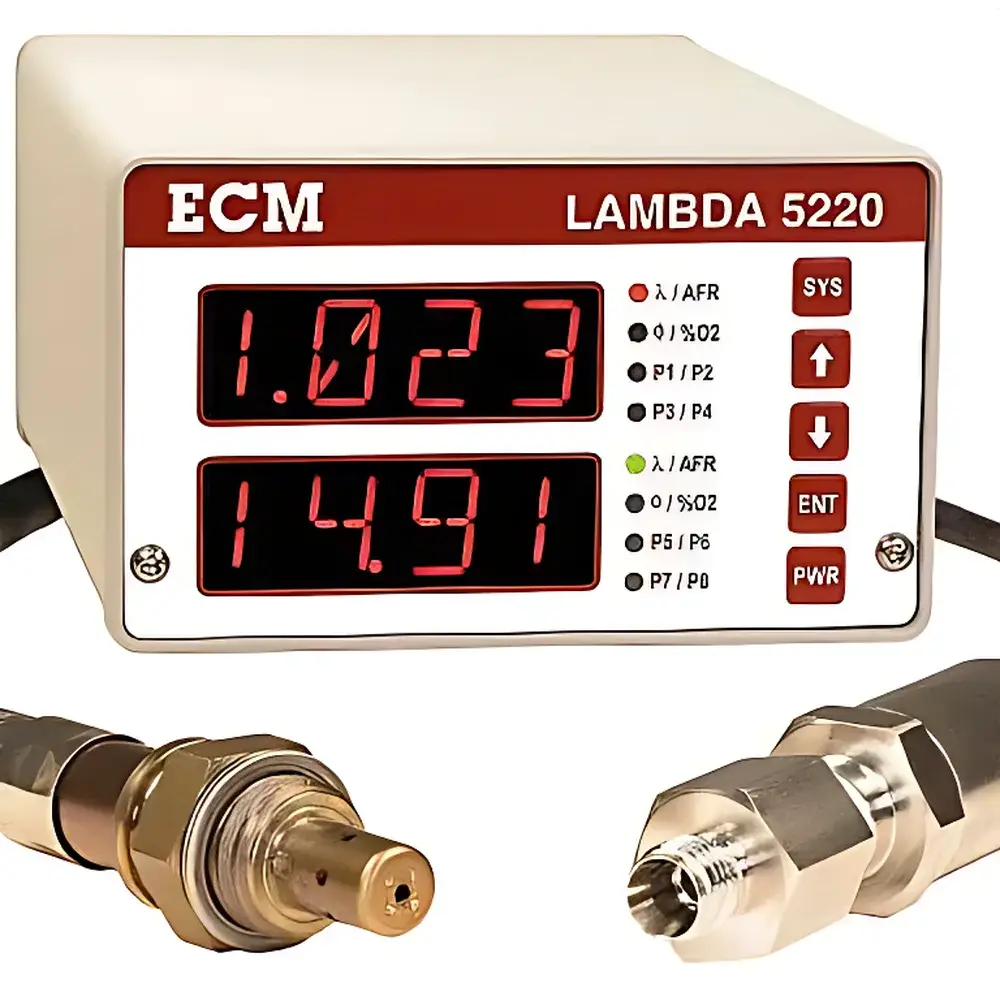
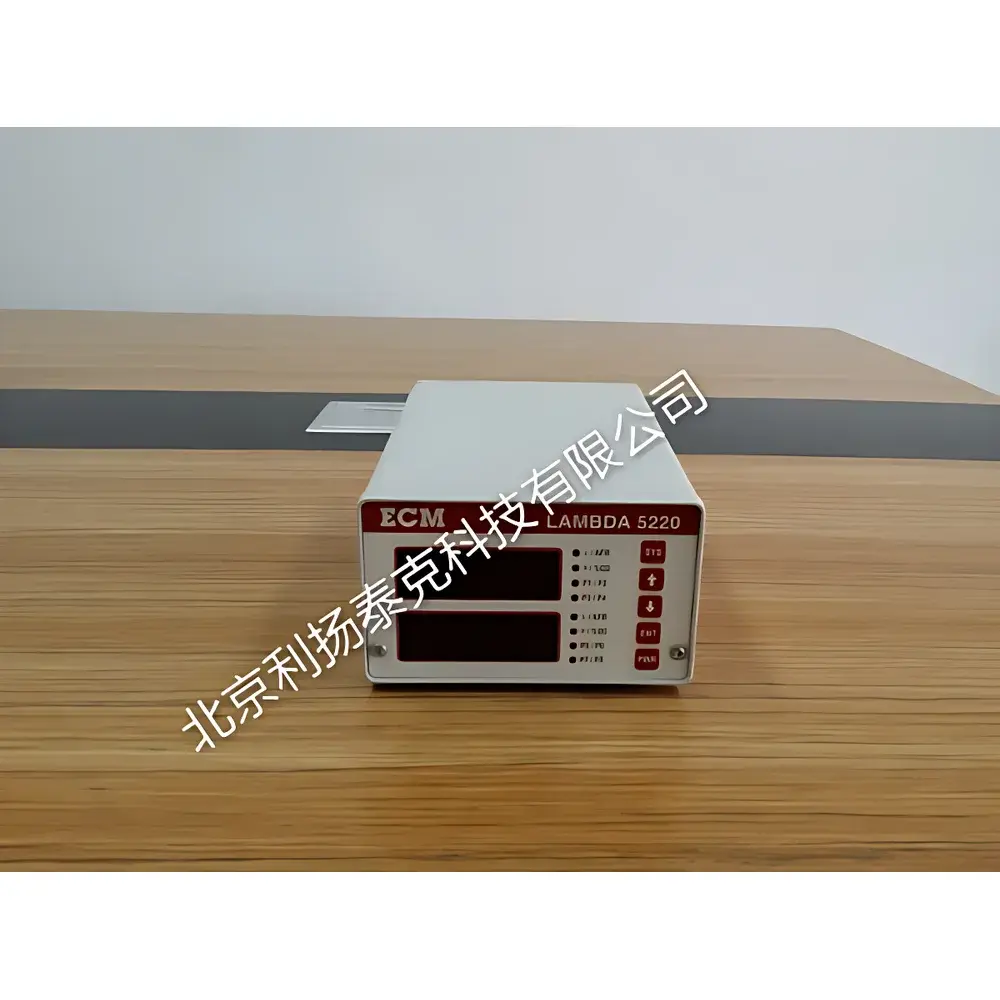
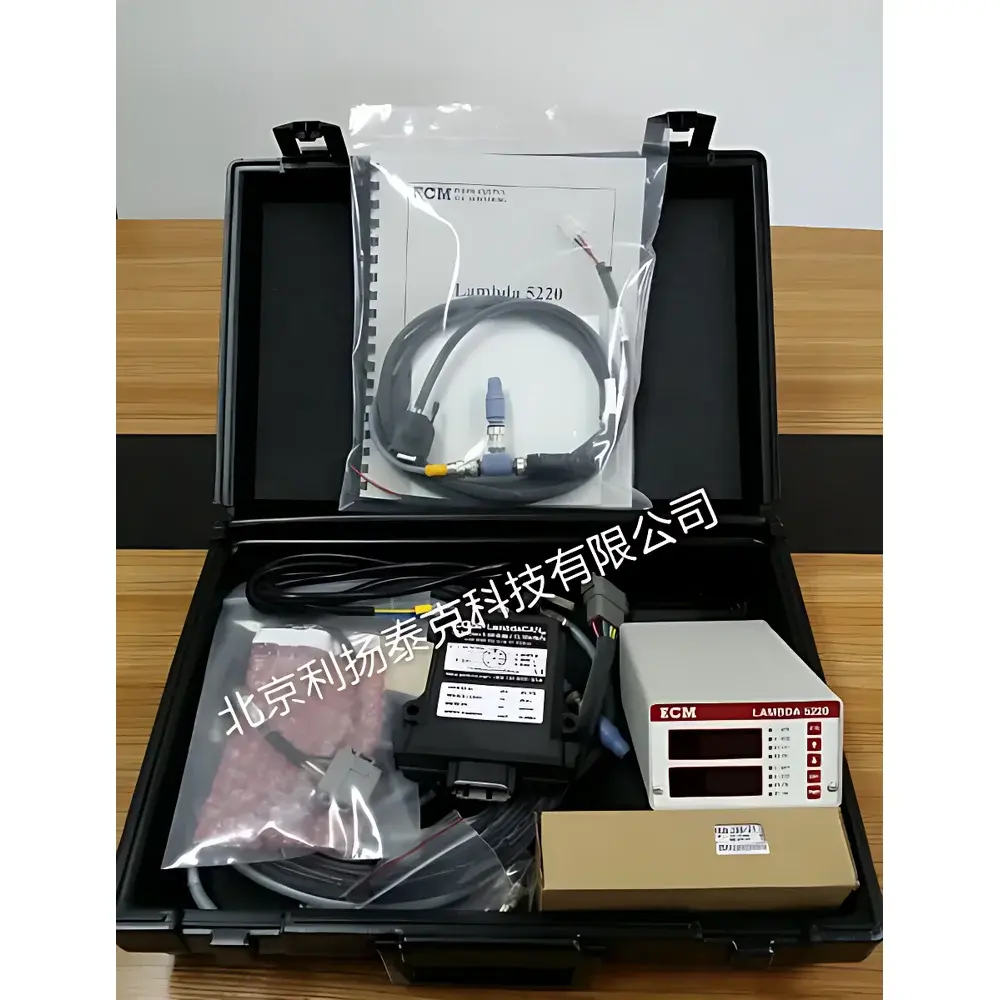
The ECM Lambda 5220 is a high-performance, wide-range air-fuel ratio (AFR) and exhaust gas oxygen analyzer engineered for precision engine development, emissions compliance testing, and real-time combustion diagnostics. Based on electrochemical zirconia wideband sensor technology, it delivers calibrated, stoichiometrically referenced measurements of lambda (λ), equivalence ratio (Φ), AFR, and volumetric oxygen concentration (%O₂) across dynamically varying combustion conditions. Its core architecture integrates factory-traceable sensor calibration stored directly on the sensor connector’s EEPROM—enabling plug-and-play deployment without manual calibration tables. The analyzer supports field recalibration in ambient air, with updated calibration coefficients automatically written to the same memory location, ensuring metrological continuity across sensor swaps and long-term deployments. Designed for both steady-state test benches and transient onboard vehicle applications, the Lambda 5220 operates reliably from −40 °C to +85 °C and maintains sub-150 ms response time (t₉₀), making it suitable for closed-loop control validation, catalyst efficiency studies, and aftertreatment system characterization.
Key Features
- Wide dynamic measurement range: λ 0.4–25, AFR 6–364, Φ 0.04–2.5, %O₂ 0–25, and optional absolute pressure up to 517 kPa
- High-accuracy electrochemical sensing with factory-calibrated zirconia elements (e.g., Bosch LSU 4.2/4.9, NTK 4/6 mA, Delphi OSL)
- Onboard pressure compensation algorithm to correct for non-standard atmospheric conditions (e.g., altitude, forced induction), eliminating systematic bias up to ±0.58 λ error at +34 kPa overpressure
- Six isolated, linearized 0–5 V analog outputs supporting simultaneous transmission of λ, AFR, Φ, %O₂, pressure, and diagnostic parameters (pump current, sensor resistance, aging factor)
- Multi-protocol digital connectivity: CAN 2.0B (configurable bit rate and message ID), USB 2.0, and RS-232 for integration with DAQ systems, ECUs, and HIL platforms
- Automotive-grade power management: ignition-switch triggered power-on/off, 11–28 VDC input tolerance, and robust EMI/EMC design compliant with ISO 11452 and SAE J1113 standards
- Modular sensor interface: M18×1.5 thread for lambda probes; 1/4″ NPT port for optional pressure transducers; support for fuel composition parameterization (H:C, O:C, N:C, H₂ mass fractions)
Sample Compatibility & Compliance
The Lambda 5220 interfaces seamlessly with industry-standard wideband oxygen sensors used in automotive OEM and Tier-1 R&D laboratories. It is fully compatible with Bosch LSU 4.2 and LSU 4.9, NTK’s 4 mA and 6 mA variants, and Delphi OSL series sensors—ensuring interoperability across legacy and next-generation combustion platforms. All calibration data resides on the sensor’s embedded memory chip, enabling full traceability and eliminating manual coefficient entry errors. While not certified as a standalone emissions compliance instrument per EPA 40 CFR Part 1065 or EU Regulation (EU) 2017/1151, the Lambda 5220 meets the metrological rigor required for Type Approval development testing, engine mapping, and durability validation under ISO 2534, ISO 1585, and SAE J1349 protocols. Its data logging architecture supports timestamped, audit-ready output suitable for GLP and GMP-aligned quality systems, including 21 CFR Part 11-compliant electronic signatures when paired with validated software environments.
Software & Data Management
The Lambda 5220 operates autonomously but is fully programmable via its native PC configuration utility (Windows-based, no runtime dependencies). Users define fuel composition ratios, select CAN message formats (J1939, custom, or OEM-specific), assign analog output scaling, and configure pressure compensation thresholds—all without firmware updates. Raw sensor diagnostics—including pump cell current, reference cell voltage, Nernst resistance, and calculated aging indices—are streamed alongside primary measurements, enabling predictive maintenance and sensor health monitoring. Data export supports CSV and binary formats with microsecond-resolution timestamps. When integrated into larger testbed ecosystems (e.g., AVL PUMA, ETAS INCA, dSPACE SCALEXIO), the analyzer functions as a deterministic I/O node with deterministic latency and jitter <10 µs—critical for model-in-the-loop (MIL) and hardware-in-the-loop (HIL) validation.
Applications
- Engine calibration and ECU development: real-time λ feedback for stoichiometric and lean-burn control strategy tuning
- Emissions certification testing: high-speed AFR profiling during WLTC, FTP-75, and RDE cycles
- Aftertreatment system analysis: DOC, DPF, and SCR light-off characterization using dynamic λ sweeps
- Fuel flexibility research: multi-fuel combustion studies (gasoline, ethanol blends, hydrogen-enriched CNG, synthetic fuels) with adjustable elemental composition inputs
- Powertrain durability testing: long-duration monitoring of sensor drift and exhaust composition stability under thermal cycling
- Onboard diagnostics (OBD) validation: correlation of lambda readings with OEM OBD-II PID outputs under transient load conditions
FAQ
Does the Lambda 5220 require periodic recalibration in the lab?
No—its embedded EEPROM stores full calibration data, and field recalibration in ambient air preserves traceability without external equipment.
Can it operate at high exhaust temperatures?
The analyzer unit itself is rated for −40 °C to +85 °C ambient; high-temperature exhaust sampling requires an appropriate cooled probe assembly or dilution system upstream of the sensor.
Is pressure compensation mandatory for accurate lambda measurement?
It is strongly recommended for applications involving forced induction, high-altitude operation, or variable backpressure, as uncompensated pressure deviations introduce quantifiable bias in λ calculation.
What is the maximum allowable cable length between the sensor and analyzer?
Up to 100 meters using shielded twisted-pair cabling meeting MIL-STD-1553 or SAE AS5643 specifications; signal integrity is maintained via active line driving and impedance-matched termination.
How does the Lambda 5220 handle sensor aging or contamination?
It continuously monitors internal diagnostics (pump current, Nernst resistance, reference cell voltage) and reports a normalized aging factor—enabling users to schedule preventive replacement before measurement degradation exceeds specification limits.







