
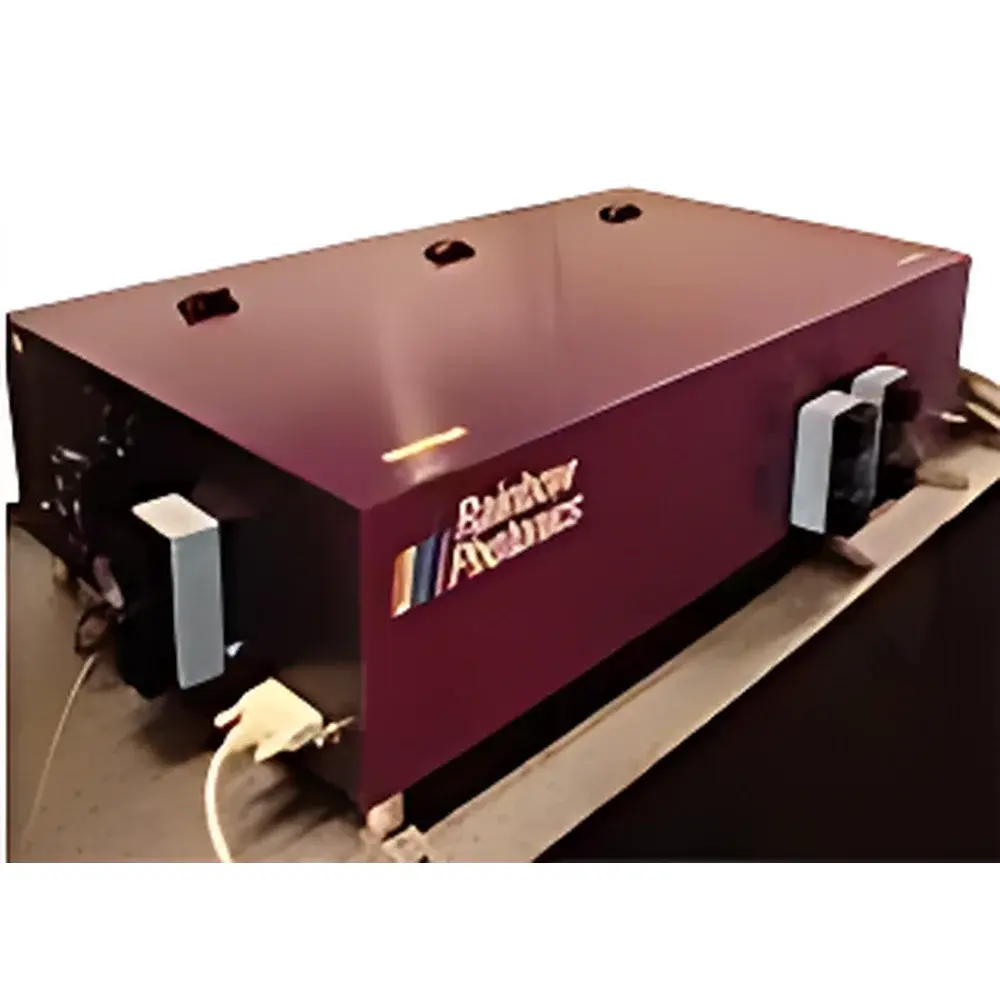
Rainbow Photonics TeraTune Tunable THz Source
| Brand | Rainbow Photonics |
|---|---|
| Origin | Switzerland |
| Model | newopto |
| Frequency Range | 1–20 THz |
| Pulse Bandwidth | <100 GHz |
| Repetition Rate | 100 Hz |
| Average THz Power | 1–10 µW |
| Pulse Energy (THz) | 10–100 nJ |
| Polarization | Linear |
| OPO Tuning Range | 1330–1480 nm |
| OPO Linewidth | <100 GHz |
| OPO Pulse Duration | 7–10 ns |
| OPO Pulse Energy | >10 mJ |
| Nd | YAG Pump Laser: 100 Hz, 10 ns, >125 mJ @ 532 nm, M² < 2, Beam Diameter: 5 mm, Divergence: 0.5 mrad, Energy Stability: <1%, Linewidth: 90 MHz |
| Power Consumption | <2.5 kW |
| System Dimensions (TeraTune) | 900 × 500 × 180 mm³ |
| Laser Power Supply Dimensions | 300 × 450 × 450 mm³ |
Overview
The Rainbow Photonics TeraTune is a turnkey, optically pumped tunable terahertz (THz) source engineered for high-resolution spectroscopy, time-domain THz generation, and coherent THz radiation studies in research laboratories. It operates on the principle of difference-frequency generation (DFG) between two near-infrared (NIR) beams derived from a synchronously pumped optical parametric oscillator (OPO), itself driven by a Q-switched Nd:YAG laser at 532 nm. This architecture enables precise, continuous tuning across the 1–20 THz band with narrow spectral bandwidth (<100 GHz), supporting both broadband and narrowband THz experiments requiring high frequency accuracy and phase stability. The system delivers linearly polarized, pulsed THz radiation with microjoule-level average power and nanosecond-scale temporal structure—ideal for pump-probe dynamics, low-energy excitations in quantum materials, and non-destructive evaluation of dielectric and semiconducting samples.
Key Features
- Wide, continuously tunable THz output (1–20 THz) via synchronized OPO-DFG architecture
- Narrow intrinsic linewidth (<100 GHz) enabling high-resolution rotational and vibrational spectroscopy
- Stable 100 Hz repetition rate synchronized to the pump laser, facilitating lock-in detection and time-resolved measurements
- Integrated, air-cooled Nd:YAG pump laser with >125 mJ pulse energy at 532 nm, M² < 2 beam quality, and <1% pulse-to-pulse energy stability
- Optimized OPO subsystem with 1330–1480 nm signal/idler tuning range, >10 mJ per pulse, and sub-10 ns pulse duration
- Compact modular design: main TeraTune unit (900 × 500 × 180 mm³) and separate laser power supply (300 × 450 × 450 mm³) for flexible lab integration
- Low divergence (<0.5 mrad) and collimated THz output beam, compatible with standard parabolic mirror coupling and free-space THz optics
Sample Compatibility & Compliance
The TeraTune is designed for use with solid-state, liquid, and gaseous samples in transmission, reflection, and attenuated total reflection (ATR) configurations. Its narrowband, tunable output supports compliance with ASTM E1492 (Standard Practice for Calibration of Spectrometers Used in Infrared, Raman, and Near-Infrared Spectroscopy) and ISO/IEC 17025 requirements for traceable spectral calibration. The system’s mechanical stability, thermal management, and vibration-isolated optical path meet GLP-compliant laboratory infrastructure standards. While not FDA-cleared as a medical device, its performance parameters align with research-grade instrumentation benchmarks referenced in USP (Spectroscopic Identification) and IEC 61000-4-3 (EMC immunity for scientific equipment).
Software & Data Management
Control and data acquisition are managed via Rainbow Photonics’ proprietary TeraControl software suite, running on Windows-based host PCs. The software provides real-time monitoring of laser energy, OPO wavelength position, THz frequency setpoint, and detector signal amplitude. All instrument parameters—including scan speed, dwell time, step size, and averaging cycles—are programmable and stored with metadata (timestamp, operator ID, environmental conditions) in HDF5 format for auditability. Export options include CSV, MATLAB (.mat), and SPC-compatible spectra files. The software architecture supports optional integration with third-party LabVIEW VIs or Python APIs (via TCP/IP or USB CDC protocols) for automated workflows compliant with 21 CFR Part 11 when configured with electronic signature and audit trail modules.
Applications
- High-resolution gas-phase rotational spectroscopy of polar molecules (e.g., H₂O, NH₃, CH₃OH)
- Phonon and magnon dispersion mapping in quantum magnets and topological insulators
- Carrier dynamics and conductivity extraction in 2D materials (graphene, TMDCs) via THz time-domain spectroscopy (THz-TDS)
- Non-invasive thickness and doping profiling in semiconductor wafers and epitaxial layers
- Security screening and pharmaceutical polymorph identification using fingerprint THz absorption signatures
- Calibration reference source for FTIR, synchrotron-based THz beamlines, and cryogenic bolometer arrays
FAQ
What is the typical THz beam diameter and divergence at the output port?
The collimated THz output has a nominal beam diameter of ~12 mm (1/e²) and divergence <0.5 mrad, optimized for coupling into standard off-axis parabolic mirrors (f/# = 2–4).
Can the TeraTune be synchronized with external femtosecond lasers for pump-probe experiments?
Yes—the 100 Hz trigger output is TTL-compatible and phase-locked to the Nd:YAG master oscillator; optional RF synchronization modules support jitter <10 ps for hybrid fs/ps pump-probe configurations.
Is vacuum or purged operation required for optimal THz transmission?
For frequencies above ~5 THz, atmospheric water vapor absorption becomes significant; operation under dry nitrogen purge (dew point < −40 °C) or in evacuated beam paths is recommended for maximum signal-to-noise ratio.
Does the system include THz detection capability?
No—the TeraTune is a source-only platform. It is fully compatible with commercial electro-optic sampling (EOS) detectors, bolometers, Golay cells, and pyroelectric sensors—integration guidance is provided in the application notes.
What maintenance is required for long-term operational stability?
Annual alignment verification and OPO crystal temperature calibration are recommended; no consumables or user-serviceable optics are required under normal operating conditions (20–25 °C, <60% RH, non-corrosive environment).



