
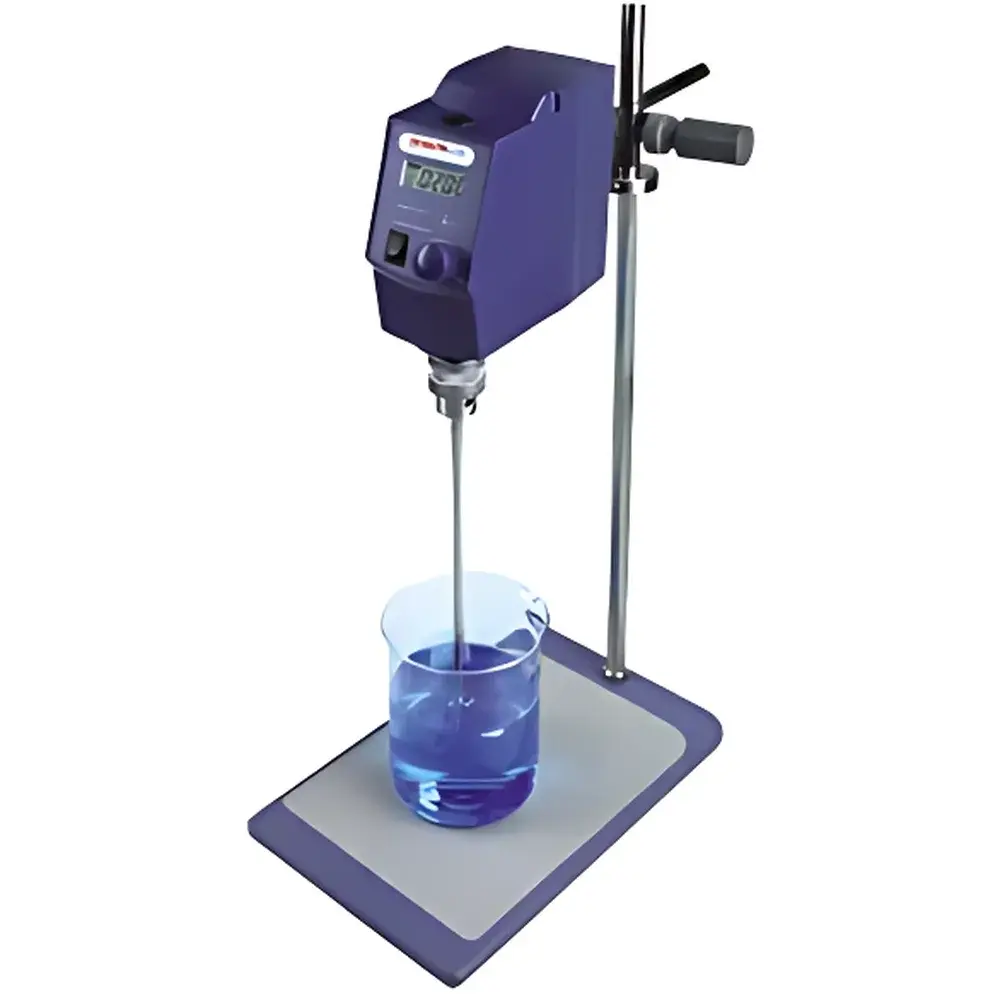
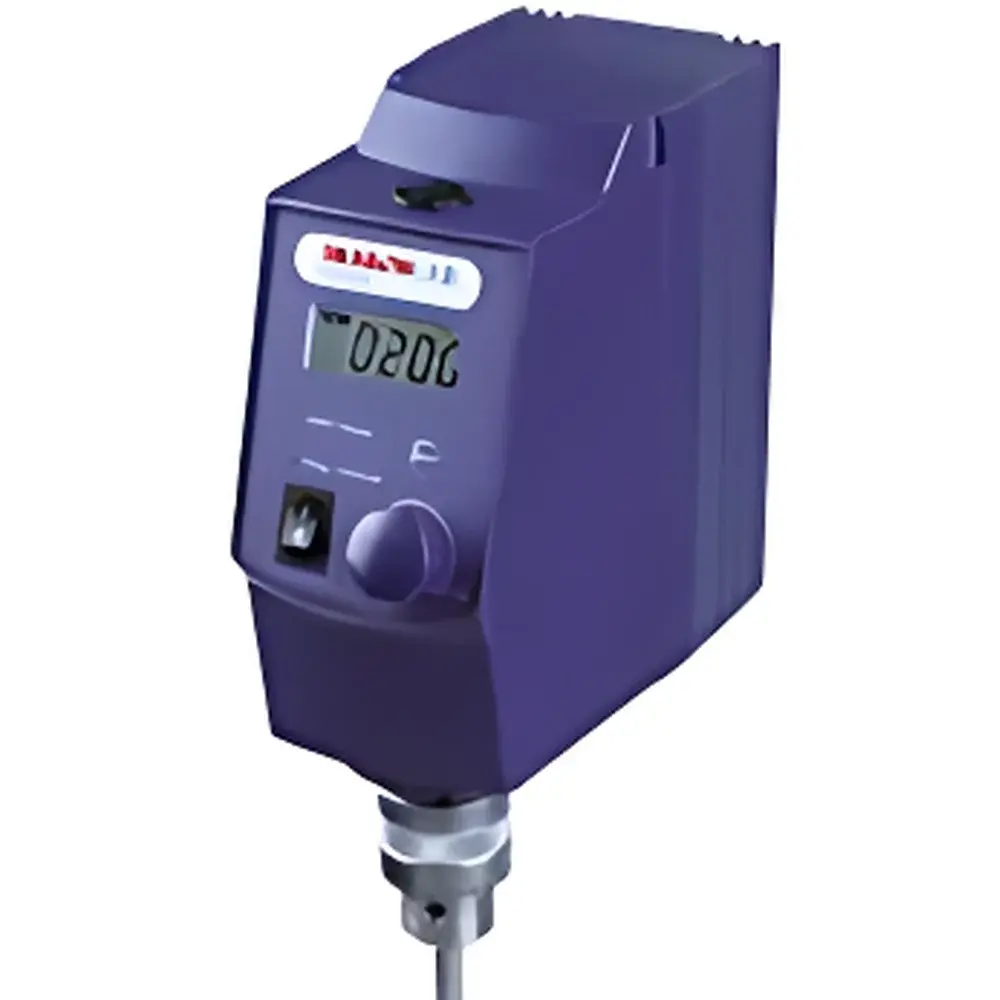
DLAB OS40-Pro & OS20-Pro Overhead Digital Stirrers
| Brand | DLAB |
|---|---|
| Model | OS40-Pro / OS20-Pro |
| Motor Type | Brushless DC Explosion-Proof Motor |
| Max. Stirring Volume (H₂O) | 40 L / 20 L |
| Speed Range | 50–2200 rpm |
| Speed Accuracy | ±3 rpm |
| Speed Resolution | ±1 rpm |
| Max. Torque | 60 N·cm / 40 N·cm |
| Max. Viscosity | 50,000 mPa·s / 10,000 mPa·s |
| Chuck Capacity | 0.5–10 mm |
| Input Power | 120 W / 60 W |
| Output Power | 100 W / 50 W |
| Voltage | 100–240 VAC |
| Frequency | 50/60 Hz |
| Protection Rating | IP42 (DIN EN 60529) |
| Dimensions (W×H×D) | 83 × 220 × 186 mm |
| Weight | 2.8 kg / 2.6 kg |
| Ambient Temp | 5–40 °C |
| Relative Humidity | ≤80 % RH |
| RS232 Interface | Yes |
| Safety Certifications | CE, cTUVus, FCC |
Overview
The DLAB OS40-Pro and OS20-Pro overhead digital stirrers are engineered for precision, safety, and long-term reliability in demanding laboratory environments. Designed around a brushless DC motor architecture, these units eliminate carbon brush wear and electromagnetic interference while delivering consistent torque output across variable load conditions — essential for reproducible mixing of medium-to-high-viscosity fluids and heterogeneous suspensions. Unlike magnetic stirrers limited by heat sensitivity and torque constraints, overhead stirrers apply mechanical drive directly to the impeller shaft, enabling scalable agitation from small-volume analytical samples to large-scale reaction vessels (up to 40 L with water-equivalent viscosity). The system operates on universal AC input (100–240 VAC, 50/60 Hz), ensuring compatibility across global laboratory power infrastructures without external transformers. All electrical and mechanical components are housed within an IP42-rated enclosure per DIN EN 60529, providing protection against solid objects ≥1 mm and vertically falling water droplets — critical for spill-prone chemistry and bioprocessing workflows.
Key Features
- Explosion-proof brushless DC motor with integrated thermal and current monitoring for intrinsically safe operation in volatile solvent environments
- Real-time LCD display with backlighting showing actual and set speed (±1 rpm resolution), torque feedback, and system status indicators
- Auto-torque compensation algorithm maintains constant rotational speed despite viscosity fluctuations — critical for polymer dissolution, emulsion formation, or crystallization studies
- Dual-stage safety architecture: hardware-level overcurrent cutoff + software-monitored speed deviation detection; triggers audible alarm and LED fault indication upon overload, short circuit, or RPM drift exceeding ±10%
- Gentle ramp-up profile minimizes vortex-induced splashing and sample loss during startup — validated with Newtonian and shear-thinning fluids up to 50,000 mPa·s (OS40-Pro)
- RS232 serial interface compliant with EIA/TIA-232-F standards enables bidirectional communication with host PCs for remote parameter setting, real-time data logging, and GLP-compliant audit trail generation
Sample Compatibility & Compliance
These stirrers accommodate standard laboratory impellers (propeller, paddle, anchor, and helical types) via a 0.5–10 mm keyless chuck, supporting both glass and stainless-steel shaft configurations. They are routinely deployed in applications involving corrosive reagents (e.g., concentrated acids/bases), temperature-sensitive biological matrices (e.g., cell culture media, enzyme solutions), and flammable organic solvents (e.g., acetone, THF, ethanol). Compliance extends beyond CE, cTUVus, and FCC marks to functional alignment with ISO/IEC 17025 requirements for equipment verification, ASTM D2196 for viscosity measurement support, and USP guidelines on analytical instrument qualification. The IP42 housing meets minimum ingress protection thresholds for routine wet-lab use under GLP and GMP-aligned quality systems.
Software & Data Management
While standalone operation requires no software, the RS232 port supports integration with third-party laboratory information management systems (LIMS) or custom Python/Matlab scripts using standard ASCII command protocols (e.g., “SPEED=1500”, “READ_TORQUE?”). Logged parameters — including timestamped speed, torque, runtime, and fault events — can be exported as CSV files for traceability. When used in regulated environments, the device’s deterministic response time (<100 ms) and non-volatile error memory facilitate 21 CFR Part 11 compliance when paired with validated PC software implementing electronic signatures, audit trails, and role-based access control.
Applications
- Chemical synthesis: Homogenization of Grignard reagents, nitration mixtures, and multi-phase catalytic reactions
- Pharmaceutical development: Dissolution testing of extended-release tablets, suspension formulation stability trials, and API crystallization kinetics
- Food & cosmetics: Emulsification of mayonnaise analogues, thickener hydration profiling (xanthan, guar gum), and pigment dispersion in lotion bases
- Materials science: Dispersion of nanocellulose, graphene oxide, or silica nanoparticles in aqueous/organic media
- Environmental analysis: Digestion of solid waste samples in EPA Method 3050B acid leaching protocols
FAQ
What is the difference between OS40-Pro and OS20-Pro?
The OS40-Pro delivers higher output power (100 W vs. 50 W), greater maximum torque (60 N·cm vs. 40 N·cm), and supports up to 40 L of water-equivalent volume — making it suitable for larger reactors and highly viscous systems. The OS20-Pro offers identical control fidelity and safety features at a reduced power envelope for benchtop or fume hood–constrained installations.
Can these stirrers operate continuously for 24 hours?
Yes. Both models are rated for uninterrupted operation under nominal load conditions (≤80% max torque) at ambient temperatures between 5–40 °C and relative humidity ≤80%, provided adequate ventilation around the housing is maintained.
Is calibration required before first use?
No factory calibration is needed; however, users should verify speed accuracy using a certified tachometer per ISO 17025 Annex A.3 prior to critical applications. Torque calibration is not user-adjustable and remains traceable to DLAB’s internal metrology lab.
Does the RS232 interface support USB adapters?
Yes — industry-standard USB-to-RS232 converters (FTDI chipset recommended) are fully compatible, though driver installation and COM port configuration must be performed on the host PC.
Are spare chucks or impeller shafts available?
DLAB supplies OEM-certified replacement chucks (part no. OS-CHUCK-KIT), stainless-steel shafts (300 mm and 450 mm lengths), and PTFE-coated impellers through authorized distributors. All accessories comply with the same IP42 and safety certification framework.
Related Products



