
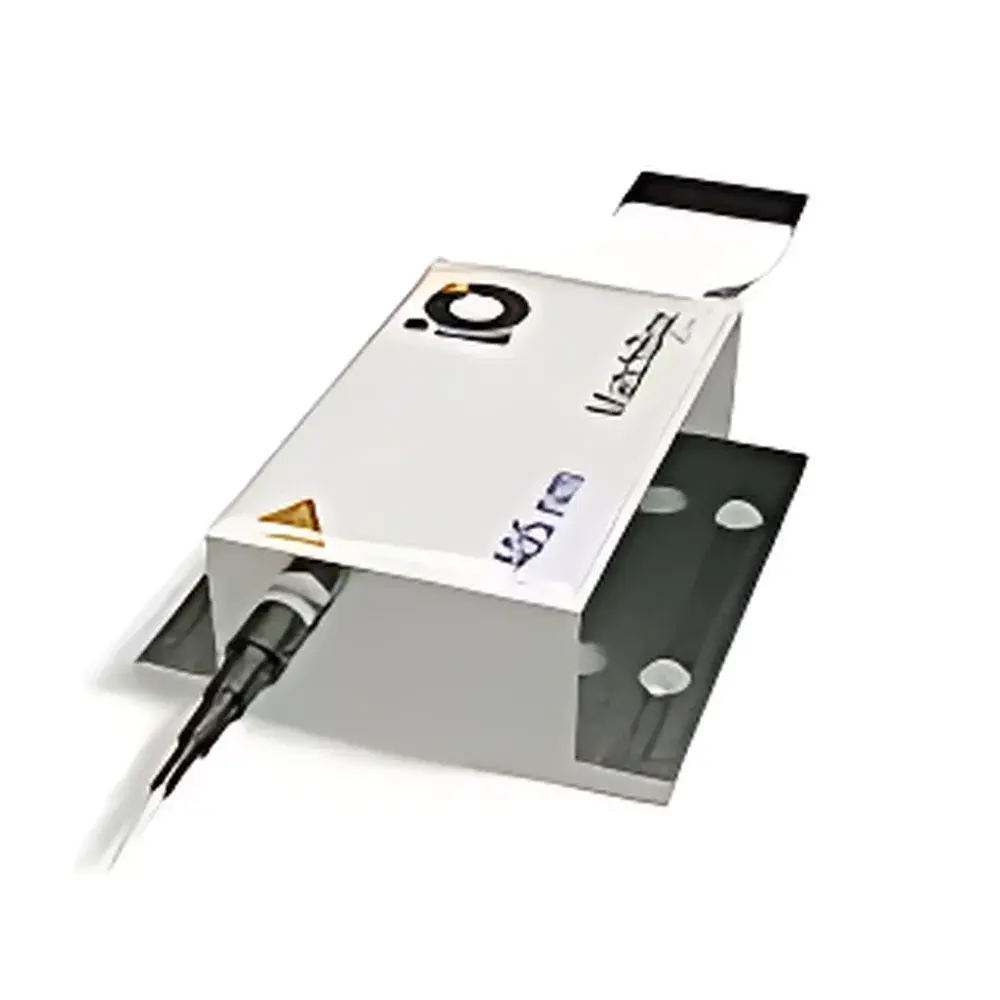
NewOpto OEM Micro Laser Module
| Brand | NewOpto |
|---|---|
| Model | OEM Lasers |
| Type | Semiconductor Laser Source for Integration |
| Origin | Zhejiang, China |
| Wavelength Range | 405–1342 nm |
| Output Power | 10–500 mW (model-dependent) |
| Spectral Linewidth | <0.1 pm to <2 nm |
| Long-Term Power Stability | <1–2% (RMS, 8h) |
| Wavelength Accuracy | ±0.1 nm to ±3 nm |
| Operating Temperature | 15–35 °C |
| Cooling | Conductive / TEC-stabilized (depending on variant) |
| Modulation | Analog & TTL (optional) |
| Beam Diameter (1/e²) | 0.8–1.2 mm |
| M² | <1.3 |
| Polarization Ratio | >100:1 |
| Interface | SMA905 or FC/PC fiber coupling (customizable) |
| Compliance | RoHS, CE (Laser Class 3B/4 per IEC 60825-1) |
Overview
The NewOpto OEM Micro Laser Module is a compact, high-stability semiconductor laser source engineered for seamless integration into analytical, biomedical, and industrial instrumentation platforms. Designed specifically for original equipment manufacturers (OEMs), this series delivers precise, wavelength-specific emission across the ultraviolet (UV) to near-infrared (NIR) spectrum — from 405 nm to 1342 nm — with narrow spectral linewidths and exceptional long-term power stability. Each module operates on the principle of stimulated emission in III–V semiconductor gain media (e.g., GaN, InGaN, AlGaAs, Nd:YVO₄), with integrated temperature control (TEC), photodiode feedback, and driver electronics housed in a hermetically sealed, thermally optimized package. Its modular architecture supports both free-space and fiber-coupled configurations (SMA905 or FC/PC), enabling direct drop-in replacement or custom integration into Raman spectrometers, flow cytometers, holographic interferometers, confocal microscopes, and metrology systems requiring multi-wavelength excitation sources.
Key Features
- Multi-wavelength portfolio: 32 discrete wavelengths spanning 405 nm to 1342 nm, including critical lines for fluorescence excitation (405, 447, 488, 532, 561, 635, 785 nm), Raman shift calibration (532.1, 785±0.2, 1064 nm), and NIR tissue penetration (808, 850, 980, 1030 nm).
- High spectral purity: Linewidths as narrow as <0.1 pm (for single-frequency variants) up to <2 nm (broad-area diodes), supporting applications demanding high-resolution spectroscopy or low-noise interferometry.
- Stable output performance: Power stability ≤1% RMS over 8 hours at constant ambient temperature; wavelength drift <±0.05 nm/°C (TEC-controlled models).
- OEM-optimized form factor: Compact housing (typically 35 × 25 × 12 mm) with standardized electrical interfaces (5 V / 12 V DC input), analog modulation (0–5 V), and TTL triggering (<10 ns rise time).
- Configurable beam delivery: Options include collimated free-space output (M² <1.3, ellipticity <1.1:1) or polarization-maintaining (PM) fiber coupling (SMF-28 or HI1060, length customizable).
- Comprehensive thermal management: Integrated thermistor and TEC enable active temperature stabilization to ±0.05 °C, critical for maintaining wavelength accuracy in sensitive optical alignment tasks.
Sample Compatibility & Compliance
The OEM Micro Laser Module is compatible with a wide range of sample types and measurement geometries, including transparent liquids (aqueous buffers, solvents), scattering colloids (nanoparticles, liposomes), biological tissues (ex vivo sections, cell suspensions), and solid-state reference materials (NIST-traceable Raman standards). It meets IEC 60825-1:2014 safety requirements for Class 3B and Class 4 laser products, with built-in interlock circuitry and emission indicators. All units are RoHS-compliant and CE-marked. For regulated environments (e.g., clinical diagnostics or pharmaceutical QC), modules can be supplied with full traceable calibration certificates (wavelength and power), batch-specific test reports, and documentation aligned with ISO 13485 and FDA 21 CFR Part 11 requirements upon request.
Software & Data Management
While the OEM Micro Laser Module operates as a hardware component without embedded firmware, it is fully compatible with industry-standard control ecosystems. Digital and analog interfaces allow synchronization with data acquisition systems (e.g., National Instruments DAQ, Thorlabs Kinesis, LabVIEW, Python-based PyVISA drivers). NewOpto provides SDKs for Windows/Linux that support real-time power monitoring, temperature setpoint adjustment, and fault logging. For GLP/GMP workflows, integration with LIMS or ELN platforms is enabled via ASCII serial commands or TCP/IP protocols, supporting audit trails for laser activation events, operational duration, and parameter changes — essential for compliance with ISO/IEC 17025 and USP analytical instrument qualification.
Applications
- Raman Spectroscopy: Multi-line excitation (532, 633, 785, 1064 nm) enables resonance Raman, surface-enhanced Raman scattering (SERS), and deep-penetration NIR-Raman in pharmaceutical polymorph screening and material science.
- Flow Cytometry & Fluorescence Microscopy: Simultaneous excitation of multiple fluorophores (e.g., FITC, PE, APC, Cy5) using 405/488/561/635 nm sources in compact benchtop or portable cytometers.
- Holography & Interferometry: Single-frequency variants (e.g., 632.8 nm HeNe-equivalent, 1064±0.1 nm) provide coherence lengths >10 m for digital holographic microscopy and displacement metrology.
- Bio-Medical Instrumentation: Embedded use in OCT light sources (1319/1342 nm), photodynamic therapy (635/660 nm), and laser Doppler perfusion monitors (785 nm).
- Industrial Metrology: Alignment lasers (635/671 nm), encoder calibration, and structured-light 3D scanning systems leveraging stable pointing and low noise.
FAQ
What wavelength options are available for volume OEM orders?
NewOpto supports custom wavelength selection from its standard 32-line portfolio; minimum order quantities apply for non-stock configurations (e.g., 491±0.1 nm or 1122±0.5 nm). Custom line widths and power levels can be specified during design-in.
Do these modules support analog modulation for lock-in detection?
Yes — all models feature 0–5 V analog modulation input with bandwidth up to 1 MHz (dependent on model), enabling direct integration with lock-in amplifiers for noise-sensitive measurements such as weak Raman signal recovery.
Is fiber coupling included by default?
Free-space output is standard; fiber coupling (SMA905 or FC/PC, SMF or PMF) is an optional configuration selected at order entry. Coupling efficiency and numerical aperture matching are documented per unit.
How is wavelength calibration verified and traceable?
Each unit undergoes spectral characterization using a NIST-traceable wavemeter (Bristol 621A or equivalent) and calibrated photodiode power meter. Calibration reports list measured center wavelength, FWHM, and power at 25 °C, with uncertainty budgets provided upon request.
Can these lasers be used in Class I enclosed systems?
Yes — when integrated into fully interlocked enclosures meeting IEC 60825-1 Annex D requirements, the OEM modules enable Class I system certification. NewOpto provides mechanical drawings and safety interface schematics to support enclosure design validation.




