
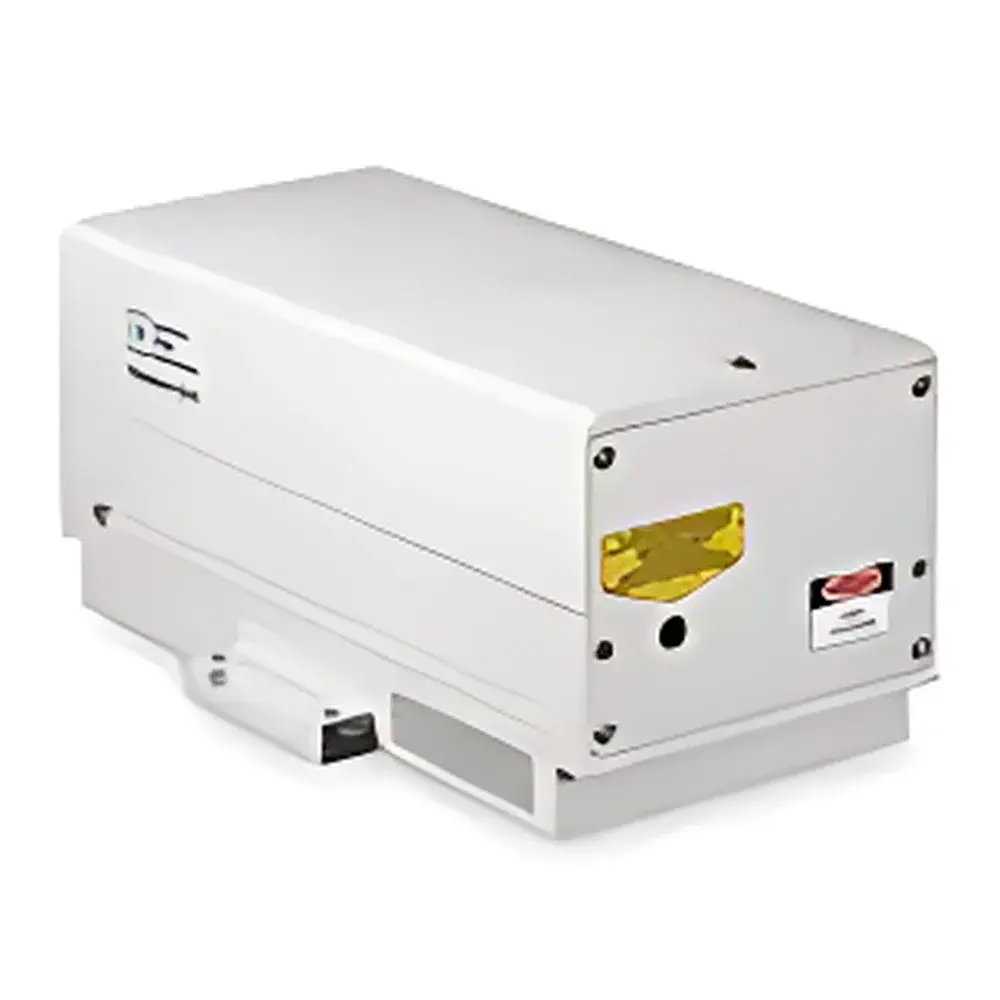
NewOpto YAG Diode-pumped Q-switched Laser System (1064 nm Fundamental)
| Brand | NewOpto |
|---|---|
| Origin | USA |
| Manufacturer Type | Authorized Distributor |
| Product Category | Imported Instrument |
| Model | YAG Diode-pumped Q-switched Lasers |
| Core Components | Diode-pumped solid-state (DPSS) laser system with integrated harmonic generation options |
| Wavelength | 1064 nm (fundamental), with optional harmonics at 532 nm, 355 nm, 266 nm, and 213 nm |
| Pulse Energy (1064 nm) | 4 mJ to 1400 mJ depending on model configuration |
| Repetition Rate | Single-shot to 100 Hz (model-dependent) |
| Pulse Width (FWHM) | 6–18 ns |
| Beam Profile | Near TEM₀₀, Gaussian content >75% |
| Beam Divergence | ≤1.3 mrad (high-end models) |
| Polarization | Linear, horizontal |
| Pulse-to-Pulse Energy Stability | ≤0.7 % rms (Q2 series), ≤2.5 % rms (LQ-series amplifiers) |
| Timing Jitter (external trigger) | ±1 ns rms |
| Cooling | Air-cooled or self-contained water-to-air cooling |
| Interface | RS232 |
| Compliance | Designed for integration into ISO/IEC 17025-compliant analytical workflows |
Overview
The NewOpto YAG Diode-pumped Q-switched Laser System is a high-stability, solid-state pulsed laser platform engineered for precision time-resolved spectroscopy and material interaction applications. Based on Nd:YAG crystal architecture, it employs diode pumping and electro-optic or acousto-optic Q-switching to generate nanosecond-duration pulses at the fundamental wavelength of 1064 nm. The system operates on the principle of stimulated emission in a four-level laser medium, where population inversion is achieved via 808 nm diode pump excitation and temporally confined by active Q-switching. This architecture delivers high peak power (>1 MW typical), excellent pulse-to-pulse reproducibility, and low temporal jitter—critical parameters for quantitative techniques such as Laser-Induced Breakdown Spectroscopy (LIBS), Time-of-Flight Mass Spectrometry (TOF-MS), and Laser Ablation Inductively Coupled Plasma Mass Spectrometry (LA-ICP-MS). Its modular design supports OEM integration and laboratory-scale deployment under controlled environmental conditions (15–30 °C, non-condensing humidity).
Key Features
- Diode-pumped Nd:YAG gain medium ensures long-term operational stability and reduced thermal lensing compared to flashlamp-pumped alternatives.
- Q-switched operation enables precise control over pulse timing, with external triggering capability and jitter <1 ns rms for synchronization-critical experiments.
- Multi-harmonic output options (532 nm, 355 nm, 266 nm, 213 nm) are available via integrated LG-series harmonic generators, enabling UV–VIS–NIR spectral flexibility without external optics alignment.
- Beam quality optimized for near-diffraction-limited performance: M² 75%, divergence ≤1.3 mrad, and pointing stability <100 μrad (LQ-series).
- Configurable repetition rates from single-shot to 100 Hz, with pulse energy scalability across model families—from compact oscillators (4–50 mJ at 1064 nm) to multi-stage amplifier systems (up to 1400 mJ).
- Self-contained water-to-air cooling (LQ and LQ5xx/LQ9xx series) eliminates dependency on facility chillers while maintaining thermal equilibrium during extended acquisition sequences.
- RS232 interface enables remote parameter control and automated sequencing within LabVIEW, Python, or MATLAB-based data acquisition environments.
Sample Compatibility & Compliance
The laser system is compatible with a broad range of solid, liquid, and gaseous samples, including conductive metals, dielectric ceramics, biological tissues, aerosols, and thin-film substrates. Its pulse energy and temporal profile meet the operational requirements of ASTM E2926-23 (Standard Test Method for LIBS Analysis), ISO 11171 (for particle-induced ablation calibration), and USP (Laser-Based Analytical Techniques). When integrated into regulated analytical platforms, the system supports audit-trail-capable operation through external timestamped logging of trigger events, pulse counts, and energy monitor readings—facilitating compliance with FDA 21 CFR Part 11 and EU Annex 11 requirements for electronic records and signatures. No internal battery or radioactive components are present; all electrical subsystems conform to IEC 61000-6-3 (EMC emissions) and IEC 61010-1 (safety for laboratory equipment).
Software & Data Management
While the laser itself operates as a hardware-peripheral device without embedded GUI software, its RS232 command protocol is fully documented and supports bidirectional communication for status interrogation, parameter setting (e.g., repetition rate, delay timing), and real-time energy monitoring via optional photodiode feedback modules. Integration into third-party software ecosystems—including Thermo Fisher’s Qtegra, PerkinElmer’s Syngistix, and custom Python-based acquisition frameworks—is routinely implemented using PySerial or NI-VISA drivers. Pulse timing metadata (e.g., trigger latency, inter-pulse delay) can be logged alongside spectrometer or mass analyzer data streams to ensure temporal correlation in multi-instrument experiments. For GxP environments, integration with ELN systems (e.g., LabArchives, Benchling) is achieved via CSV export or REST API middleware.
Applications
- Laser-Induced Breakdown Spectroscopy (LIBS): High peak irradiance enables robust plasma generation on heterogeneous surfaces, supporting elemental mapping and rapid alloy identification.
- Time-of-Flight Spectroscopy (TOFS): Sub-nanosecond jitter and stable pulse energy support precise ion flight-time calibration in reflectron and linear TOF mass analyzers.
- Laser Ablation (LA): Controlled ablation thresholds allow depth-resolved analysis of layered materials (e.g., coatings, geological sections) with minimal thermal diffusion.
- Matrix-Assisted Laser Desorption/Ionization (MALDI): Tunable UV harmonics (266 nm, 213 nm) provide optimal desorption efficiency for high-molecular-weight biomolecules and synthetic polymers.
- Pulsed Laser Deposition (PLD): High pulse energy and beam uniformity enable stoichiometric transfer of complex oxide targets (e.g., YBCO, PZT) onto single-crystal substrates.
- Remote Sensing & LIDAR: Eye-safe 1064 nm output (with appropriate attenuation) supports atmospheric aerosol profiling and differential absorption LIDAR (DIAL) configurations.
FAQ
What safety certifications does this laser system comply with?
The system conforms to IEC 60825-1:2014 Class 4 laser product requirements. Full compliance documentation—including nominal ocular hazard distance (NOHD) calculations and interlock circuit schematics—is provided upon request for institutional laser safety officer (LSO) review.
Can the laser be synchronized with external detectors or gated cameras?
Yes. All models feature TTL-compatible trigger input/output ports with sub-nanosecond jitter specification. Delay generators (e.g., Stanford DG645) may be used to introduce programmable offsets between laser firing and detector gating.
Is harmonic generation built-in or requires external modules?
Harmonic generation is implemented via optional plug-in modules (LG101, LG103, LG105) that mount directly to the laser head. These are factory-aligned and thermally stabilized to maintain phase-matching across ambient temperature fluctuations.
What maintenance is required for long-term operation?
No routine optical realignment is necessary. Diode pump lifetimes exceed 10,000 hours. Water-to-air coolers require annual filter replacement and biannual coolant level verification per manufacturer guidelines.
Does NewOpto provide application-specific support for method development?
Yes. Application engineers offer remote and on-site assistance for LIBS calibration, MALDI matrix optimization, and LA-ICP-MS coupling—subject to service agreement terms and instrument configuration.




