
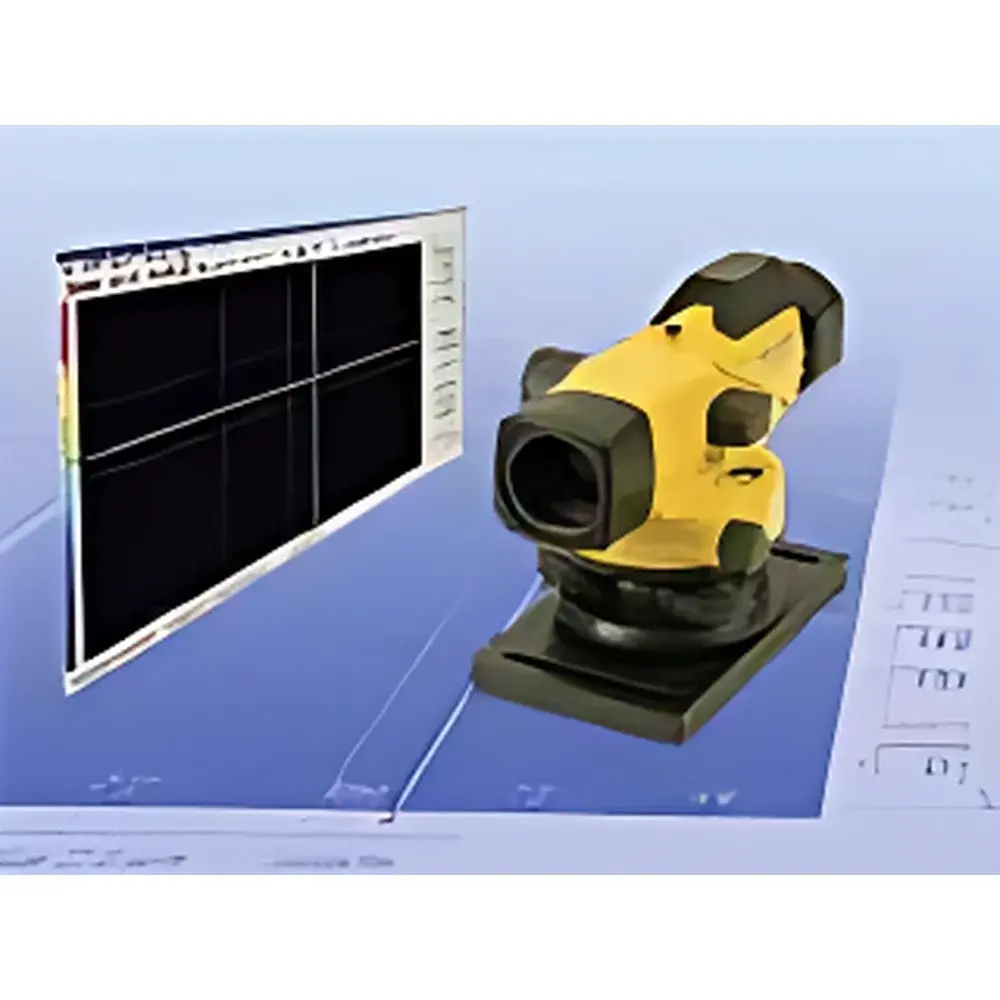
Duma Optronics EAC-1210 Electronic Autocollimator
| Brand | Duma Optronics |
|---|---|
| Origin | Israel |
| Model | EAC-1210 |
| Field of View | 42′ (H) auto / 84′ × 2 (H) manual |
| Angular Accuracy | ±2.5 arcseconds |
| Sensor | 1/2″ CCD (1/3″ optional) |
| Interface | USB 2.0 |
| System Includes | Collimator unit, CCD camera, control software on CD |
Overview
The Duma Optronics EAC-1210 Electronic Autocollimator is a precision optomechanical instrument engineered for high-resolution angular displacement measurement based on the principle of autocollimation. It combines the optical functionality of a traditional autocollimator with that of a collimating telescope in a single integrated platform. The device projects a collimated beam onto a reflective surface and analyzes the retro-reflected image using a high-stability USB 2.0 CCD sensor—enabling non-contact, real-time quantification of angular deviations down to ±2.5 arcseconds. Unlike mechanical or electro-mechanical angle sensors, the EAC-1210 relies on first-order geometric optics and pixel-level centroid detection, delivering traceable, drift-resistant measurements suitable for metrology-grade alignment tasks in both laboratory and industrial environments.
Key Features
- Integrated dual-mode operation: automatic field-of-view mode (42′ horizontal) and extended manual mode (84′ × 2 horizontal), enabling flexible trade-offs between resolution and capture range.
- High-sensitivity imaging core: standard 1/2″ monochrome CCD sensor (1/3″ variant available upon request), optimized for low-noise centroid calculation under ambient lighting or controlled lab conditions.
- USB 2.0 interface with deterministic latency: supports synchronous image acquisition and real-time position tracking without external frame grabbers or proprietary hardware controllers.
- Compact, rigid aluminum housing with kinematic mounting interfaces: designed for integration into vibration-isolated optical tables, coordinate measuring machines (CMMs), and semiconductor fabrication tooling.
- Factory-calibrated angular scale: traceable to NIST-traceable reference standards; calibration certificate provided with each unit per ISO/IEC 17025 guidelines.
Sample Compatibility & Compliance
The EAC-1210 is compatible with any optically flat or highly reflective surface exhibiting ≥90% specular reflectance in the visible spectrum (400–700 nm). It supports measurement of polished metal mirrors, fused silica substrates, silicon wafers, and coated optical components without requiring retroreflective targets or fiducial marks. The system complies with ISO 10110-7 (optical component surface imperfection specification), ISO 21098 (angular measurement instrumentation requirements), and meets electromagnetic compatibility (EMC) Class B limits per CISPR 32. While not certified as medical or safety-critical equipment, its design adheres to general-purpose laboratory instrument safety standards IEC 61010-1.
Software & Data Management
The included Windows-based application provides full instrument control, live image display, centroid tracking, statistical analysis (mean, std dev, min/max over time), and export to CSV, TXT, or MATLAB-compatible MAT formats. Software features include multi-point referencing, dynamic zero-setting, thermal drift compensation (via optional external temperature probe input), and audit trail logging compliant with GLP/GMP documentation workflows. Raw image data and processed angular values are timestamped and stored with metadata (exposure time, gain, ROI coordinates), satisfying basic FDA 21 CFR Part 11 requirements for electronic records when deployed on validated IT infrastructure.
Applications
- Optical alignment verification: collimation of laser cavities, interferometer arms, and fiber coupling stages.
- Metrology of motion systems: straightness evaluation of linear translation stages, angular repeatability assessment of rotary air-bearing platforms.
- Surface form error mapping: quantitative flatness deviation analysis of optical flats and semiconductor wafer chucks via multi-position scanning.
- Thermal stability monitoring: long-term angular drift characterization of mounts and optical benches under controlled temperature ramp profiles.
- Vibration mode identification: time-resolved angular oscillation tracking at frequencies up to 100 Hz (limited by USB 2.0 frame rate and exposure settings).
- Industrial calibration support: reference-grade angular verification for coordinate measuring machines, CNC machine tools, and lithography steppers.
FAQ
What is the minimum resolvable angular step under optimal conditions?
Under stable thermal conditions and with 1/2″ CCD sensor at maximum resolution ROI, the system achieves sub-arcsecond effective resolution via centroid interpolation—though specified accuracy remains ±2.5 arcseconds per ISO 21098.
Can the EAC-1210 measure absolute angle or only relative change?
It measures relative angular displacement from a user-defined zero reference position. Absolute angular orientation requires external calibration against a known reference surface or artifact.
Is third-party software integration supported?
Yes—DLL-based API and documented USB protocol enable integration with LabVIEW, Python (via PyUSB), MATLAB, and C# applications for custom automation and data pipeline architectures.
Does the system require periodic recalibration?
Annual recalibration is recommended for metrology-critical applications; factory recalibration includes full optical path verification and sensor linearity correction per ISO/IEC 17025 procedures.
How does ambient light affect measurement stability?
The system employs narrowband spectral filtering and adjustable exposure/gain control to maintain signal-to-noise ratio >40 dB in typical lab lighting; direct sunlight or intense broadband sources must be excluded from the optical path.





