
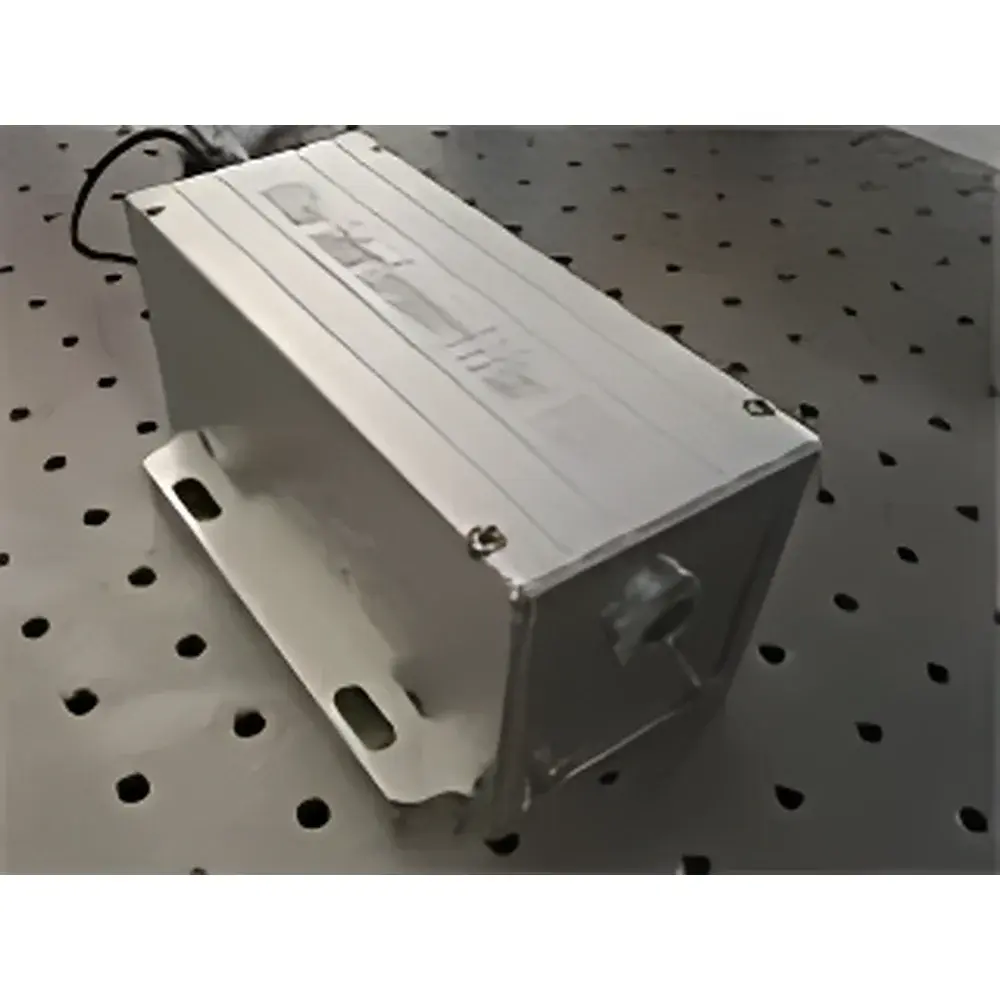
NewOpto Tunable External-Cavity Diode Laser (ECDL) System
| Brand | NewOpto |
|---|---|
| Origin | Zhejiang, China |
| Manufacturer Type | Authorized Distributor |
| Product Origin | Domestic (China) |
| Model | Tunable External-Cavity Diode Laser (ECDL) |
| Light Source Type | Tunable Single-Frequency Semiconductor Laser |
| Illumination Mode | External Illumination |
| Wavelength Options | 780 nm, 852 nm |
| Output Power | Up to 30 mW (diode-dependent) |
| Linewidth (FWHM) | Typically <150 kHz |
| Tuning Range | Typical 10 nm per diode configuration |
| Tuning Mechanism | Cat’s-eye retroreflector + ultra-narrowband interference filter (replacing alignment-sensitive diffraction gratings) |
Overview
The NewOpto Tunable External-Cavity Diode Laser (ECDL) System is an engineered solution for applications demanding narrow-linewidth, frequency-stabilized, and continuously tunable laser radiation in the visible to near-infrared spectrum. Unlike conventional Littrow- or Littman-Metcalf-configured ECDLs—which rely on mechanically sensitive diffraction gratings—this system employs a robust cat’s-eye retroreflector combined with an ultra-narrowband interference filter to achieve high wavelength selectivity and long-term mechanical stability. The optical architecture minimizes sensitivity to thermal drift and vibration, enabling reliable operation in both laboratory and compact experimental setups. Designed for precision atomic physics and quantum optics environments, the laser delivers single longitudinal mode (SLM) output with sub-150 kHz intrinsic linewidth (FWHM), making it suitable for Doppler-free spectroscopy, coherent population trapping, and active stabilization to atomic reference transitions.
Key Features
- Stable external-cavity design utilizing a cat’s-eye retroreflector and ultra-narrowband interference filter—eliminating grating alignment complexity and enhancing long-term pointing and frequency stability
- Continuous wavelength tuning over ~10 nm per gain chip, with factory-standard configurations at 780 nm (Rb D2 line) and 852 nm (Cs D2 line); custom wavelengths available from 400 nm to 1000 nm based on semiconductor diode selection
- Output power up to 30 mW (dependent on selected diode and cavity coupling efficiency), optimized for saturation spectroscopy and magneto-optical trap (MOT) loading
- Typical free-running linewidth <150 kHz (measured via delayed self-heterodyne interferometry), supporting sub-Doppler resolution in high-resolution absorption and dispersion measurements
- Integrated thermal and current control interfaces compatible with standard PID modules (e.g., Stanford Research Systems SIM928, Thorlabs TED200C) for active frequency locking
- Compact, modular housing with SM1-threaded collimated output and FC/APC or free-space coupling options for integration into vacuum-compatible optical benches
Sample Compatibility & Compliance
This ECDL system is routinely deployed in ultra-high vacuum (UHV) environments for cold atom experiments, including Rb and Cs magneto-optical traps, Bose-Einstein condensate (BEC) preparation, and atom interferometry. Its spectral purity and low phase noise meet requirements for optical frequency references traceable to primary standards (e.g., SI-second realization via Cs fountain clocks). While not certified to ISO/IEC 17025 or FDA 21 CFR Part 11 by default, the system supports full audit-trail logging when integrated with compliant data acquisition platforms (e.g., LabVIEW-based lock-in controllers with timestamped parameter recording). It complies with IEC 60825-1:2014 Class 3R laser safety specifications when operated within specified power limits and equipped with appropriate interlocks.
Software & Data Management
The laser operates as a hardware-controlled analog device; no proprietary software is embedded. All tuning, temperature, and current parameters are managed externally via standard 0–10 V analog inputs or RS-232/USB-to-serial interfaces. Users integrate the ECDL into existing control ecosystems—including Python-based automation (PyVISA, NI-VISA), MATLAB instrument control toolboxes, or EPICS IOC environments. For frequency stabilization, common protocols include Pound-Drever-Hall (PDH) error signal generation using commercial photodetectors and lock-in amplifiers. Optional add-ons include fiber-pigtailed versions with polarization-maintaining (PM) output and integrated wavelength meters (e.g., HighFinesse WSx series) for real-time calibration traceability to NIST-traceable standards.
Applications
- Atomic cooling and trapping (MOT, optical molasses, dipole traps)
- Laser frequency stabilization to atomic transitions (e.g., Rb ⁸⁷D₂, Cs ¹³³D₂, Ca⁺, Yb)
- High-resolution laser spectroscopy (saturation, Lamb-dip, two-photon)
- Raman spectroscopy and coherent anti-Stokes Raman scattering (CARS)
- Optical atomic clocks and frequency combs (as seed lasers)
- Atomic magnetometers and spin-exchange relaxation-free (SERF) sensors
- Atom interferometric inertial sensing and gravitational wave detection prototypes
- Nonlinear frequency conversion (e.g., SHG in PPLN waveguides for UV/blue generation)
- Biomedical optical coherence tomography (OCT) source development (with swept-wavelength variants)
- LIDAR and coherent free-space optical communications (FSOC)
FAQ
What wavelength ranges are supported beyond 780 nm and 852 nm?
Custom configurations are available from 400 nm to 1000 nm, contingent on gain chip availability, anti-reflection coating specifications, and cavity mirror broadband reflectivity profiles. Lead time and minimum order quantities apply.
Is the laser compatible with active frequency locking using PDH technique?
Yes—the output beam exhibits sufficient amplitude and phase stability for high-finesse cavity locking. Users typically employ a fiber-coupled electro-optic modulator (EOM) and low-noise photodetector to generate the PDH error signal.
Can this ECDL be integrated into a UHV chamber feedthrough?
The base model features a free-space collimated output. Optional vacuum-compatible versions include CF-40 flanged housings with fused silica viewports and kinematic mounts for direct optical access into UHV systems.
Does the system include built-in wavelength monitoring?
No internal wavemeter is included by default. However, the output port is designed for straightforward integration with commercial wavelength meters (e.g., Bristol 621, HighFinesse WS-U) via fiber patch cables or free-space beamsplitting.
What is the typical warm-up time to achieve thermal equilibrium?
Approximately 30–45 minutes under ambient lab conditions (22 ± 1°C), after which frequency drift remains below 10 MHz/hour without active stabilization.




