
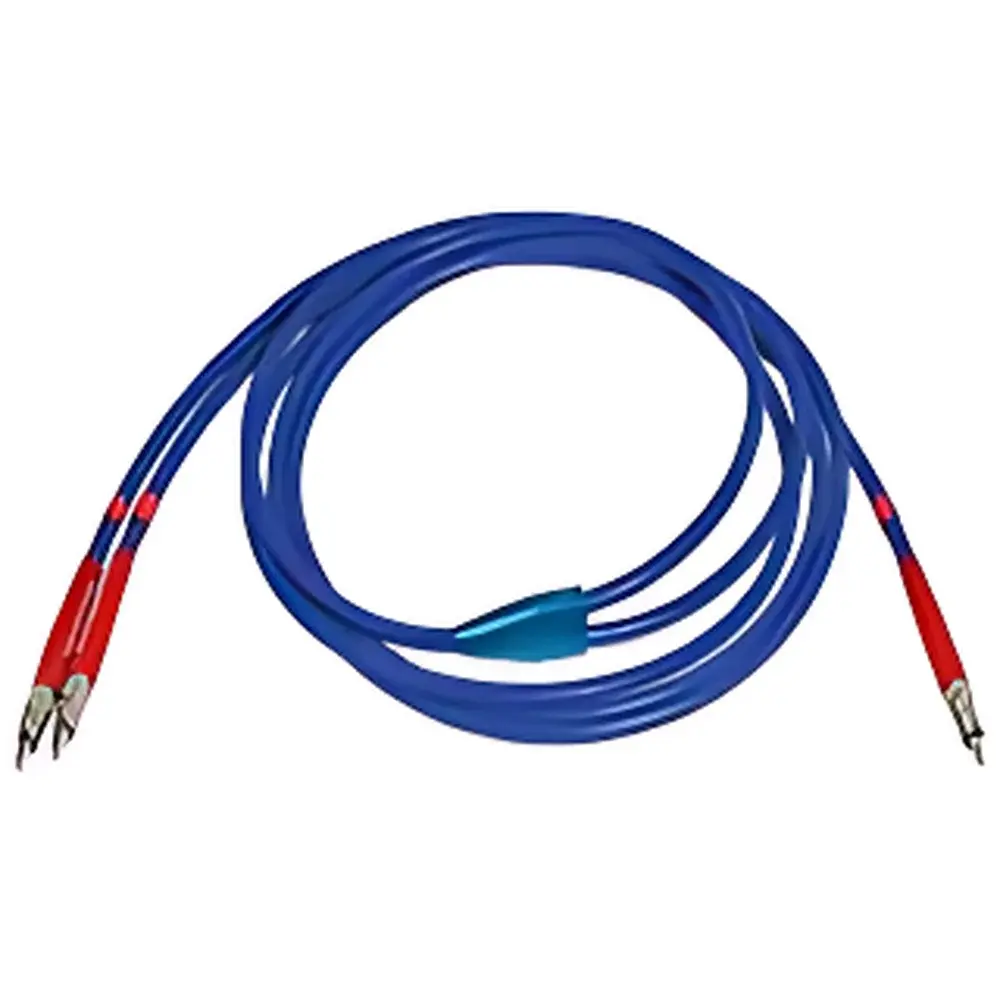
NewOpto NY-Series Y-Branch Optical Fiber Assembly
| Brand | NewOpto |
|---|---|
| Model | NY-Series Y-Branch Fiber |
| Core Diameter | 200/400/600 µm |
| Wavelength Range | 190–2200 nm (UV-VIS-NIR-BW variants) |
| Length | 2 m (standard), customizable (0.5/1/2 m) |
| Jacket Material | Plastic or Metal |
| Connector | SMA905 (standard), optional FC/ST |
| Spectral Transmission | Optimized per grade (UV, VIS, NIR, Broadband) |
| Numerical Aperture | 0.22 (typical, silica-based step-index) |
| Operating Temperature | −40 °C to +85 °C |
| Compliance | RoHS-compliant construction, ISO 9001-manufactured components |
Overview
The NewOpto NY-Series Y-Branch Optical Fiber Assembly is a precision-engineered passive optical component designed for spectral light routing in analytical instrumentation systems. Structurally, it consists of a single input fiber bifurcated into two output legs with controlled splitting ratio (typically 50:50 ±5% power distribution), enabling simultaneous signal delivery to dual detection paths—such as reference and sample channels in absorption spectroscopy, or excitation and collection arms in fluorescence or Raman configurations. The device operates on the principle of fused biconical taper coupling, where core-to-core evanescent field interaction ensures stable, wavelength-dependent power division across its specified transmission bands. Unlike active splitters, this all-fiber architecture eliminates insertion loss spikes, polarization sensitivity, and thermal drift—critical attributes for quantitative optical measurements in benchtop spectrometers, process analyzers, and OEM sensor modules.
Key Features
- Multi-spectral grade options: UV-grade (190–1100 nm), VIS-grade (300–1400 nm), NIR-grade (400–2200 nm), and broadband (280–2100 nm) variants—each optimized for minimal OH⁻ absorption and solarization resistance
- Selectable core diameters: 200 µm, 400 µm, and 600 µm—supporting trade-offs between étendue, numerical aperture (NA = 0.22), and coupling efficiency with common light sources and detectors
- Dual jacketing options: Flexible polymer (PVC or LSZH) for lab flexibility; stainless-steel armored sheathing for industrial vibration resistance and EMI shielding
- Standard SMA905 connectors with precision ferrule alignment (±3 µm concentricity); optional FC or ST terminations available under custom order
- Consistent mechanical robustness: Tensile strength ≥50 N, bend radius ≥15 mm (static), and repeatability <0.1 dB over 1,000 mating cycles
- Factory-tested spectral transmission curves and insertion loss data provided per batch (traceable to NIST-traceable calibration standards)
Sample Compatibility & Compliance
The NY-Series Y-fiber is compatible with standard optical interfaces used in UV-Vis-NIR spectrophotometers (e.g., Ocean Insight, Avantes, Hamamatsu), LED/laser excitation sources, CCD/CMOS array detectors, and photodiode-based transducers. Its low-autofluorescence quartz core and graded-index cladding minimize stray light generation—essential for low-signal applications such as trace gas detection or micro-volume absorbance. All assemblies conform to IEC 61300-2-2 (mechanical durability), IEC 61300-2-19 (tensile load), and RoHS Directive 2011/65/EU. While not intrinsically certified for hazardous locations, metal-jacketed variants meet IP67 environmental sealing when terminated with appropriate bulkhead fittings. Documentation includes material declarations, REACH SVHC screening reports, and ISO 9001:2015 manufacturing audit summaries.
Software & Data Management
As a passive hardware component, the Y-branch fiber requires no embedded firmware or driver software. However, its performance is fully integrable into instrument-level calibration workflows compliant with FDA 21 CFR Part 11 and ISO/IEC 17025:2017 requirements. Users may import measured transmission spectra (provided in CSV or SPC format) into spectral analysis platforms—including MATLAB, Python (SciPy/NumPy), or commercial tools like OceanView or AvaSoft—for correction matrix derivation and system-level radiometric calibration. Traceability is maintained via unique serial labeling and QC test reports archived in accordance with GLP/GMP record retention protocols (minimum 10-year retention recommended).
Applications
- Dual-beam UV-Vis spectrophotometry: Real-time reference channel compensation for lamp drift and solvent baseline correction
- Raman probe design: Separation of 532/785 nm excitation from Stokes-shifted scattered light using dichroic filtering at the fiber output ports
- In-line process monitoring: Simultaneous transmission and reflectance measurement in pharmaceutical tablet coating or chemical reaction kinetics
- Fluorescence lifetime instrumentation: Gating of excitation pulse and emission decay acquisition via time-resolved detector synchronization
- OEM integration in portable NIR analyzers: High-throughput light delivery to MEMS-based spectrometers with minimal modal noise
- Environmental sensor networks: Multiplexed deployment in distributed water quality monitoring (e.g., NO₃⁻, DOC, turbidity) using shared light source architecture
FAQ
What is the typical insertion loss for the NY-Series Y-fiber?
Insertion loss ranges from 3.2 dB to 3.8 dB (including connector contributions), depending on wavelength band and core size—verified at 550 nm, 850 nm, and 1550 nm per IEC 61300-3-4.
Can I specify non-standard lengths or custom connector combinations?
Yes. Standard lengths are 0.5 m, 1 m, and 2 m; custom lengths from 0.3 m to 5 m are supported. Mixed terminations (e.g., SMA905 input / FC output) are available under engineering review.
Is there polarization-dependent loss (PDL) data available?
PDL is ≤0.05 dB across all UV-VIS-NIR variants, measured using a polarized tunable laser source and rotating analyzer method per IEC 61300-3-37.
How does the metal-jacketed version differ mechanically from the plastic version?
Metal versions feature 304 stainless-steel braided armor over aramid strength members, achieving crush resistance >1,000 N/10 cm and torsional stiffness 3× higher than polymer equivalents—recommended for robotic arm integration or factory-floor deployment.
Do you provide spectral calibration certificates?
Yes. Each assembly ships with a certificate listing measured transmission % vs. wavelength (2 nm resolution), insertion loss, return loss (>40 dB), and physical inspection results—all traceable to internal reference standards calibrated annually against NIST SRM 2036.





