
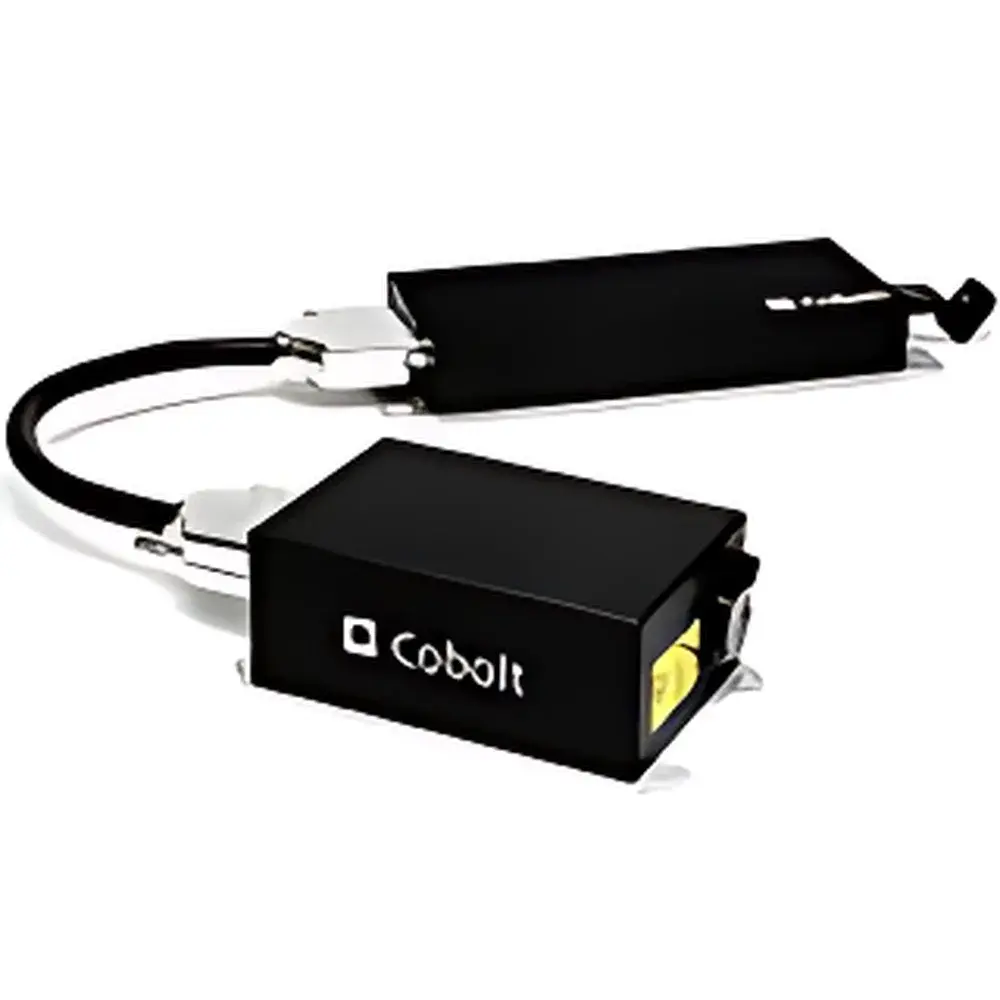
Cobolt Zouk / Twist / Blues / Calypso / Dual Calypso / Fandango / Samba / Jive / Mambo / Flamenco / Rumba Single-Frequency Solid-State Lasers
| Brand | Cobolt |
|---|---|
| Origin | Sweden |
| Laser Type | Diode-Pumped Solid-State (DPSS) |
| Wavelength Range | 355–1064 nm |
| Spectral Linewidth | <1 MHz (<0.001 pm) |
| Spatial Mode | TEM₀₀, M² < 1.1 |
| Beam Pointing Stability | <10 µrad/°C (typ. 5 µrad/°C) |
| Polarization Ratio | >100:1 |
| Operating Temperature | 10–40 °C |
| Laser Head Dimensions | 103×60×40 mm (04-01 series) or 125×70×45 mm (05-01 series) |
| Controller Dimensions | 190×72×28 mm |
| Communication Interface | RS-232 or USB |
| Warranty | 24 months (12 months for Zouk model) |
Overview
Cobolt single-frequency lasers represent a family of diode-pumped solid-state (DPSS) laser sources engineered for high spectral purity and long-term stability in demanding optical metrology and life science applications. These lasers operate exclusively in a single longitudinal mode (SLM), delivering narrow-linewidth emission (<1 MHz, equivalent to <0.001 pm) with exceptional coherence lengths exceeding 100 m—enabling precise interferometric measurements, coherent detection, and phase-sensitive spectroscopy. Unlike multimode or quasi-single-mode lasers, Cobolt’s proprietary frequency-stabilized resonator design suppresses mode-hopping and ensures robust single-frequency operation across ambient temperature fluctuations (±2 °C over 8 hours, wavelength drift ≤2 pm). The modular architecture supports both laboratory deployment and OEM integration, with compact laser heads, low-noise power supplies, and standardized communication protocols facilitating seamless incorporation into fluorescence microscopes, flow cytometers, DNA sequencers, Raman spectrometers, holographic systems, particle image velocimetry (PIV), and gravitational wave detector calibration setups.
Key Features
- True single-longitudinal-mode (SLM) output with spectral linewidth <1 MHz — verified via heterodyne beat-note measurement and Fabry–Pérot interferometry
- TEM₀₀ spatial profile with M² < 1.1, ensuring diffraction-limited beam quality and optimal coupling into single-mode fibers and high-NA objectives
- Wavelength stability of ≤2 pm over ±2 °C and 8-hour continuous operation — critical for applications requiring absolute spectral fidelity (e.g., cavity-enhanced absorption spectroscopy)
- Beam pointing stability <10 µrad/°C (typical 5 µrad/°C) — minimizing alignment drift during thermal cycling in vibration-isolated optical tables
- Polarization extinction ratio >100:1 — supporting polarization-sensitive techniques including ellipsometry, magneto-optic Kerr effect (MOKE), and polarized Raman scattering
- Compact form factor: laser head dimensions as small as 103 × 60 × 40 mm (04-01 series); controller fits standard 19″ rack-mount footprint
- Dual-wavelength capability via integrated Dual Combiner (e.g., 491 + 532 nm), enabling multi-color excitation without mechanical switching or alignment realignment
- Compliance with IEC 60825-1:2014 Class 3B/4 laser safety standards; CDRH-compliant models include key-switch interlock and emission indicator
Sample Compatibility & Compliance
Cobolt single-frequency lasers are compatible with a wide range of sample types and experimental configurations. Their stable, low-noise output enables quantitative analysis of biological specimens (live cells, fixed tissues, nucleic acid gels), colloidal suspensions (nanoparticles, liposomes), crystalline materials (semiconductors, perovskites), and gas-phase species (NH₃, CH₄, CO₂) in absorption or scattering geometries. All models meet ISO 13406-2 for laser-induced damage threshold (LIDT) certification on coated optics and conform to EN 61326-1 for electromagnetic compatibility (EMC) in laboratory environments. For regulated industries, the USB/RS-232 interface supports audit-trail-capable control logging when paired with validated software frameworks compliant with FDA 21 CFR Part 11 and EU Annex 11 requirements. Optional permanent single-mode (SM) or polarization-maintaining (PM) fiber pigtailing ensures reproducible coupling efficiency in GLP/GMP-aligned instrumentation platforms.
Software & Data Management
Each Cobolt laser is shipped with Cobolt Control Software (v3.x), a cross-platform application supporting Windows, macOS, and Linux. The software provides real-time monitoring of output power, temperature, current, and interlock status, with configurable auto-shutdown thresholds and user-defined power ramps. Command-line access via ASCII-based SCPI-like protocol enables integration into Python-, LabVIEW-, or MATLAB-driven automation sequences. Logged data (timestamped power readings, error codes, thermal sensor outputs) is exported in CSV format for traceability and statistical process control (SPC) analysis. Optional firmware upgrades—delivered via secure HTTPS portal—maintain backward compatibility while extending functionality such as external analog modulation (0–5 V, bandwidth >100 kHz) and TTL-triggered burst mode for time-resolved fluorescence lifetime imaging (FLIM).
Applications
- Fluorescence Microscopy: Stable excitation at 488 nm (Calypso), 561 nm (Jive), or 640 nm (Flamenco) minimizes photobleaching and improves signal-to-noise ratio in confocal, TIRF, and STED systems
- Flow Cytometry: Narrow linewidth enables precise spectral unmixing of fluorophore signatures; high polarization purity enhances scatter angle discrimination
- DNA Sequencing: Used in Illumina-style SBS platforms for base-calling accuracy via consistent excitation of reversible terminators
- Raman Spectroscopy: Suppression of laser-induced background and Rayleigh wing broadening ensures resolution of closely spaced vibrational modes (e.g., C=C stretch vs. C–H bend)
- Holography & Interferometry: Coherence length >100 m supports large-field digital holographic microscopy and nanometer-level displacement sensing
- Atomic Physics: Frequency-doubled 532 nm (Samba) and 355 nm (Zouk) variants serve as pump sources for Ti:sapphire amplifiers and cold atom trapping experiments
FAQ
What distinguishes Cobolt single-frequency lasers from conventional DPSS lasers?
Cobolt lasers incorporate an intracavity etalon and active thermal compensation to enforce single-longitudinal-mode operation, whereas standard DPSS lasers typically emit multiple longitudinal modes unless externally locked.
Can these lasers be fiber-coupled without performance degradation?
Yes—optional factory-installed SM/PM fiber pigtails maintain >85% coupling efficiency and preserve polarization extinction ratio; beam divergence and M² are characterized pre- and post-pigtailing.
Is remote control possible over Ethernet or GPIB?
Native support is limited to RS-232 and USB; however, third-party USB-to-Ethernet converters with virtual COM port emulation are widely deployed in industrial OEM systems.
How is wavelength calibration performed and maintained?
Each unit undergoes factory calibration using a wavemeter traceable to NIST standards; long-term stability is verified via periodic re-measurement against a reference iodine-stabilized HeNe laser.
Are there options for custom wavelengths outside the standard portfolio?
Cobolt offers limited-wavelength customization (e.g., 520 nm, 577 nm) under NRE agreement, subject to nonlinear crystal availability and minimum order quantities.



