
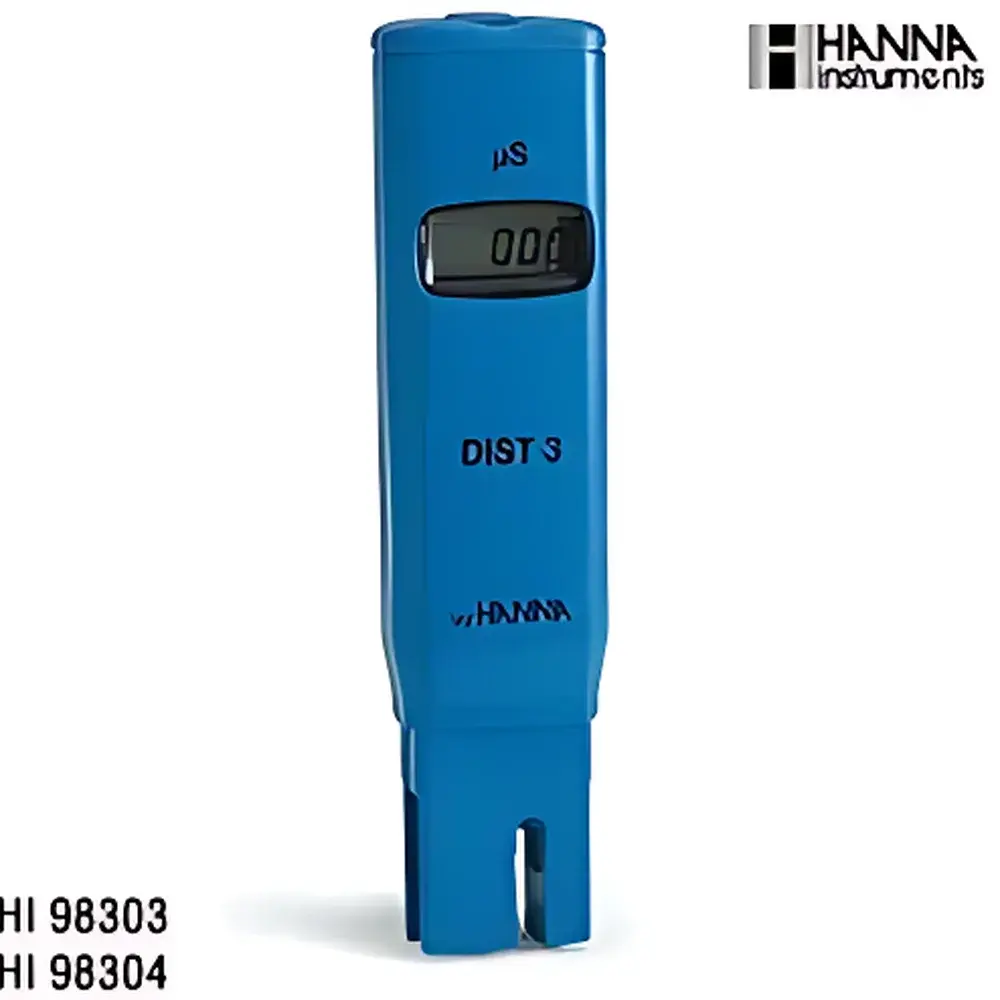
Hanna Instruments HI98303 and HI98304 Pocket-Sized Conductivity Meters
| Brand | Hanna Instruments |
|---|---|
| Origin | Italy |
| Model | HI98303, HI98304 |
| Measurement Range | 0–1999 µS/cm (HI98303), 0.00–19.99 mS/cm (HI98304) |
| Resolution | 1 µS/cm (HI98303), 0.01 mS/cm (HI98304) |
| Accuracy | ±2% F.S. |
| Calibration | Manual single-point |
| Recommended Calibration Solutions | HI7031L (for HI98303), HI7030L (for HI98304) |
| Temperature Compensation | Automatic (0–50°C) |
| Power Supply | 4 × 1.5 V AAA batteries |
| Operating Environment | 0–50°C, ≤95% RH |
| Dimensions & Weight | 175 × 41 × 23 mm, 95 g |
Overview
The Hanna Instruments HI98303 and HI98304 are compact, handheld conductivity meters engineered for rapid, reliable field- or benchtop-based measurement of electrical conductivity (EC) in aqueous samples. Designed according to fundamental principles of conductometric analysis—where conductivity is derived from the solution’s ability to carry electric current via dissolved ionic species—these pen-style instruments deliver direct EC readings without requiring complex setup or external accessories. Unlike laboratory-grade benchtop meters, the HI98303/HI98304 series prioritizes operational simplicity, rugged portability, and immediate response: users insert the integrated sensor directly into the sample, and stabilized readings appear within seconds. The devices incorporate automatic temperature compensation (ATC) referenced to the standard 25°C baseline, applying a linear β-coefficient algorithm compliant with ISO 7888 and ASTM D1125 for consistent cross-temperature comparability. Their sealed, epoxy-filled sensor design ensures mechanical stability and resistance to moisture ingress—critical for repeated use in wastewater treatment plants, aquaculture facilities, hydroponic operations, and environmental monitoring sites where dust, splash, or intermittent submersion may occur.
Key Features
- Pen-form factor with ergonomic, non-slip grip and integrated electrode—no separate probe handling or cable management required.
- Dual-range configuration: HI98303 optimized for low-conductivity applications (e.g., purified water, rainwater, nutrient solutions < 2 mS/cm); HI98304 tailored for higher-range measurements (e.g., brackish water, industrial effluents, fertilizer stock solutions).
- True automatic temperature compensation (0–50°C) using a built-in NTC thermistor, eliminating manual correction and reducing operator-induced error.
- Manual single-point calibration protocol compatible with standardized reference solutions—HI7031L (1413 µS/cm) for HI98303 and HI7030L (12.88 mS/cm) for HI98304—ensuring traceable alignment to internationally recognized conductivity standards.
- Low-power electronics powered by four AAA alkaline cells, providing >100 hours of continuous operation; auto-off function after eight minutes of inactivity extends battery life.
- IP67-rated housing (per IEC 60529) guarantees dust-tightness and temporary immersion resistance up to 1 m for 30 minutes—validated for real-world field durability.
Sample Compatibility & Compliance
These meters are validated for use with clean to moderately turbid aqueous matrices, including potable water, surface water, groundwater, wastewater effluent, hydroponic reservoirs, and aquarium systems. They are not intended for viscous, highly particulate, or strongly oxidizing media (e.g., concentrated acids, bleach solutions, or slurries), which may coat or degrade the graphite sensing elements. While not certified for regulatory submission under GLP or GMP frameworks, the HI98303/HI98304 support routine quality control workflows aligned with EPA Method 120.1 (conductivity), APHA Standard Method 2510 B, and ISO 7888:2012. Calibration records—though manually documented—can be retained alongside sample IDs and environmental notes to satisfy internal audit requirements for trend analysis and instrument performance verification.
Software & Data Management
The HI98303 and HI98304 operate as standalone instruments with no onboard data logging, Bluetooth, or USB connectivity. This architecture intentionally minimizes firmware complexity and maximizes long-term reliability in resource-constrained environments. Users record results manually in field notebooks or digital LIMS-compatible spreadsheets. For laboratories requiring electronic data capture, Hanna recommends pairing these meters with external barcode-scanned entry systems or integrating them into paper-based SOPs that mandate dual-operator verification and dated calibration logs. Though lacking 21 CFR Part 11-compliant audit trails, their fixed calibration protocol and stable analog-to-digital conversion path support repeatable, defensible measurements when used within defined procedural controls.
Applications
- On-site verification of reverse osmosis (RO) and deionization (DI) system performance via feed/permeate conductivity differentials.
- Routine salinity estimation in marine aquaculture and estuarine monitoring programs using empirical EC–salinity conversion tables (e.g., PSS-78).
- Hydroponic nutrient solution management—tracking EC drift to adjust fertilizer dosing and prevent osmotic stress in crops.
- Pre-screening of industrial rinse waters and cooling tower make-up water prior to lab-based ion chromatography or ICP-MS analysis.
- Educational demonstrations of ionic strength effects on conductivity, including comparative studies of strong vs. weak electrolytes.
FAQ
Can the HI98303 or HI98304 measure TDS directly?
No—these models report only EC (µS/cm or mS/cm). TDS estimation requires application of a user-defined conversion factor (typically 0.5–0.7) and is not embedded in firmware.
Is temperature compensation adjustable or fixed?
Compensation follows a fixed linear algorithm (β = 2.0%/°C) per ISO 7888 and cannot be modified by the user.
How often should calibration be performed?
Daily calibration is recommended for critical applications; otherwise, before each measurement session or when ambient temperature shifts >5°C.
Are replacement electrodes available separately?
No—the sensor is permanently integrated; full unit replacement is required upon electrode degradation or physical damage.
Do these meters comply with FDA or drinking water regulations?
They serve as screening tools—not certifiable compliance devices—and must be supplemented with accredited laboratory analysis for regulatory reporting.
Related Products






