
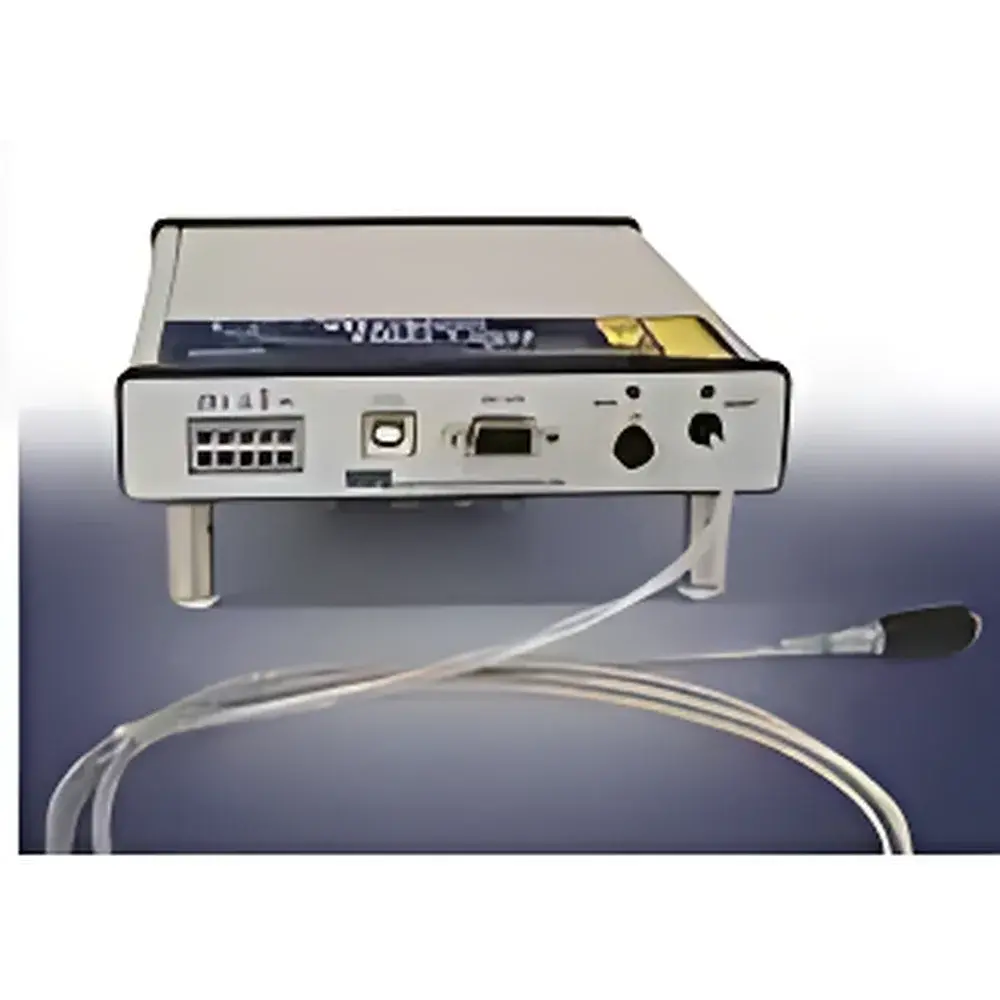
MPB newopto Yb-Doped Continuous-Wave Fiber Laser
| Brand | MPB |
|---|---|
| Model | newopto |
| Emission Wavelength | 1120 nm |
| Wavelength Accuracy | ±0.5 nm |
| Spectral Linewidth (FWHM) | <0.05 nm (YFL-P-10-1120) / <0.1 nm (YFL-P-20-1120) |
| Degree of Polarization | >99% |
| Mode Field Diameter | 6–6.5 µm |
| ASE Suppression (0.1 nm bandwidth) | >60 dB |
| Long-Term Wavelength Stability | ±0.02 nm |
| Long-Term Output Power Drift | <3% |
| Relative RMS Intensity Noise | <2% |
| Tunable Range Option | 1060–1120 nm |
| Compliance | CE, RoHS, IEC 60825-1 Class 4 Laser Product |
Overview
The MPB newopto Yb-doped continuous-wave (CW) fiber laser is an engineered solution for applications requiring high spectral purity, exceptional power stability, and robust single-transverse-mode output in the 1120 nm spectral region. Based on ytterbium-doped double-clad photonic crystal fiber architecture, this laser operates via stimulated emission within the Yb3+ ion energy transition (2F5/2 → 2F7/2), delivering narrow-linewidth, linearly polarized radiation with diffraction-limited beam quality (M² < 1.1). Unlike bulk solid-state or diode-pumped rod lasers, its all-fiber monolithic design eliminates free-space alignment, minimizing sensitivity to thermal drift and mechanical perturbation—critical for long-duration spectroscopic interrogation or interferometric metrology. The 1120 nm emission wavelength sits strategically between the conventional 1064 nm Nd:YAG line and longer-wavelength telecom bands, enabling access to underutilized absorption features in biological tissues, rare-earth-doped crystals, and polymer matrices.
Key Features
- Monolithic all-fiber architecture with fusion-spliced components ensures intrinsic alignment stability and resistance to environmental vibration
- Narrow spectral linewidth (<0.05 nm FWHM) achieved through intracavity fiber Bragg grating (FBG) stabilization and optimized cavity length control
- High polarization extinction ratio (>99%) maintained over temperature range –20 °C to +60 °C without active polarization control
- Integrated thermoelectric cooler (TEC) and digital PID controller enable sub-0.01 °C temperature regulation of the gain fiber coil
- Optional external second-harmonic generation (SHG) module compatible with standard 1120 nm output for real-time power monitoring and closed-loop feedback control
- Front-panel analog modulation input (0–5 V) supports direct current injection for fast power ramping or TTL-triggered pulsing (up to 100 kHz)
Sample Compatibility & Compliance
The laser is designed for integration into OEM instrumentation platforms and laboratory-grade optical systems where regulatory traceability and operational safety are mandatory. It conforms to IEC 60825-1:2014 as a Class 4 laser product, incorporating interlock-ready connectors, key-switched operation, and embedded laser emission indicators compliant with EN 60825-1 Annex B. All units undergo full factory calibration against NIST-traceable reference spectrometers and power meters. For regulated environments—including pharmaceutical process analytical technology (PAT) deployments or GLP-compliant spectroscopy labs—the system supports optional firmware logging with timestamped power and temperature records aligned to ISO/IEC 17025 audit requirements. No hazardous substances are used per RoHS Directive 2011/65/EU; CE marking reflects compliance with EU Machinery and EMC Directives.
Software & Data Management
The laser includes a USB-C interface supporting SCPI command set (IEEE 488.2 compliant) for seamless integration with LabVIEW, Python (PyVISA), MATLAB, or custom C++ control frameworks. Firmware version 2.3+ introduces dual-channel data streaming: real-time analog outputs (0–10 V) for simultaneous monitoring of output power and heatsink temperature, plus digital telemetry logs stored onboard (16 MB non-volatile memory). Optional software package “LaserLink Control Suite” provides GUI-based parameter scripting, automated warm-up profiling, and export of CSV-formatted stability reports compliant with FDA 21 CFR Part 11 requirements (electronic signatures, audit trails, user role management). Remote diagnostics via Ethernet option enables predictive maintenance alerts based on cumulative operating hours and thermal cycling history.
Applications
- Bio-optical imaging: 1120 nm lies within the “second biological window” (1100–1350 nm), offering deeper tissue penetration and reduced scattering in ex vivo histology and optoacoustic tomography
- High-resolution spectroscopy: Narrow linewidth and low RIN enable Doppler-free saturation spectroscopy of atomic vapors (e.g., dysprosium, erbium) and molecular overtone transitions in gas-phase detection
- Laser-assisted additive manufacturing: Optimized absorption in nickel-based superalloys and titanium powders improves melt pool consistency during selective laser melting (SLM) processes per ASTM F3184-21
- Fiber sensor interrogation: Used as a stable source for phase-sensitive optical time-domain reflectometry (Φ-OTDR) and distributed acoustic sensing (DAS) systems requiring <100 Hz linewidth stability
- Frequency doubling infrastructure: High peak intensity and polarization fidelity support efficient SHG in PPLN or MgO:PPLN waveguides for visible-light generation at 560 nm
FAQ
Is the 1120 nm output suitable for use with standard silica-based passive fiber components?
Yes—the laser’s 1120 nm wavelength resides well within the low-loss transmission window of standard SMF-28 and HI1060 fibers, with attenuation <0.3 dB/km and negligible nonlinear threshold up to 5 W average power.
Can output power be modulated at frequencies above 1 MHz?
No—this CW laser supports analog modulation up to 100 kHz; for GHz-range modulation, an external electro-optic modulator (EOM) is required in the beam path.
Are custom wavelengths available outside the 1060–1120 nm range?
Custom designs extending to 1030 nm (Yb3+ zero-phonon line) or 1180 nm (long-wavelength tail) are feasible but require requalification of pump diode wavelength, FBG reflectivity, and thermal management profile.
What is the expected lifetime of the pump diodes under continuous operation?
Rated minimum lifetime is 50,000 hours at 25 °C heatsink temperature, per Telcordia GR-468-CORE reliability testing protocols.
Does the system include factory calibration documentation?
Yes—each unit ships with a Certificate of Conformance including spectral scan data, power stability plot over 24 h, and polarization extinction measurement traceable to NIST SRM 2241.



