
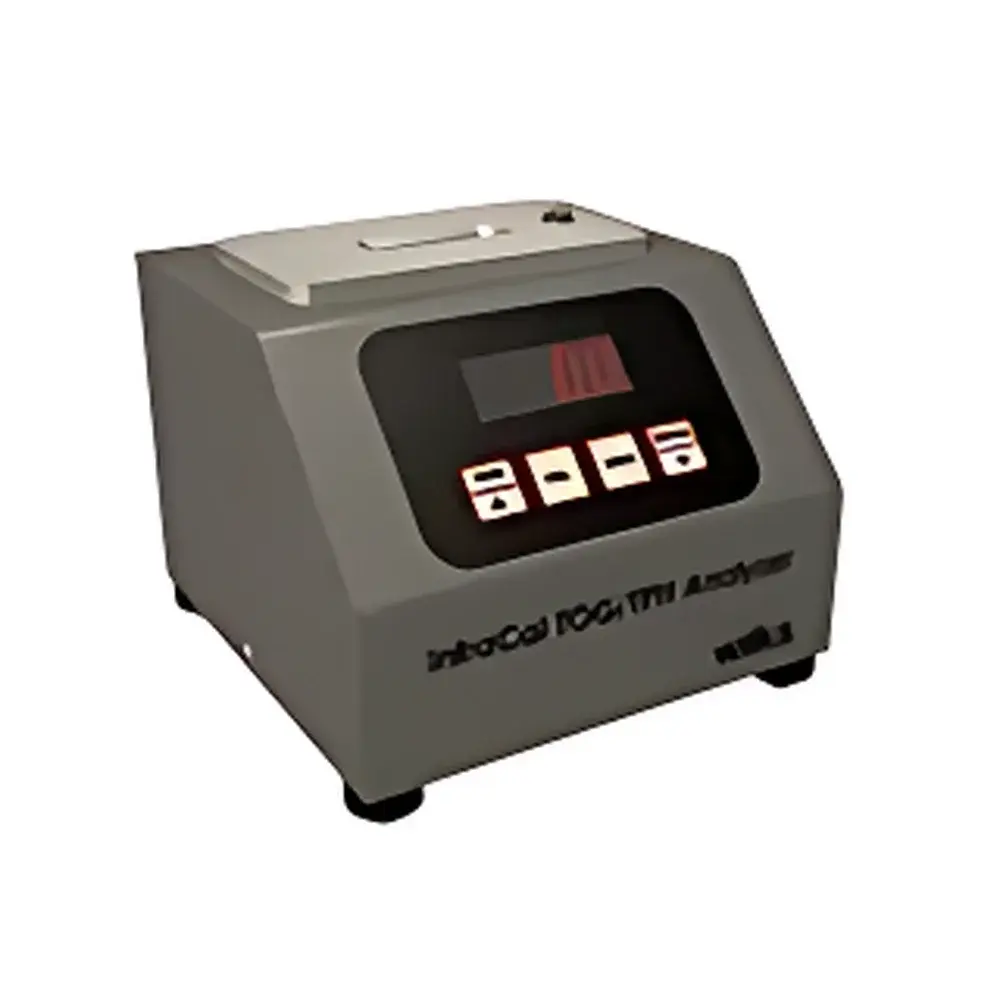
Wilks InfraCal Series Portable Infrared Oil & Grease Analyzer
| Brand | Wilks |
|---|---|
| Origin | USA |
| Model | InfraCal Series |
| Instrument Type | Portable |
| Wavenumber Range | 3400 nm (2941 cm⁻¹) |
| Spectral Resolution | 2 nm |
| Scan Time | 10 minutes per analysis |
| Signal-to-Noise Ratio | 1000:1 |
| Detection Range | 0.1–5000 ppm (hydrocarbons) |
| Compliance | ASTM D7066, EPA Method 1664, EPA 413.2, EPA 418.1, ISO 9377-2 |
Overview
The Wilks InfraCal Series Portable Infrared Oil & Grease Analyzer is a field-deployable, fixed-filter infrared spectrophotometer engineered for rapid, quantitative measurement of total oil and grease (TOG), total petroleum hydrocarbons (TPH), and fats, oils, and greases (FOG) in environmental and industrial samples. Operating at the characteristic C–H stretching absorption band near 3.4 µm (2941 cm⁻¹), the instrument leverages Beer–Lambert law-based quantification to deliver trace-level hydrocarbon detection without requiring full spectral acquisition. Its optical architecture employs a thermopile detector and precision interference filter optimized for aliphatic and aromatic hydrocarbon response, ensuring high specificity for petroleum-derived compounds while minimizing interferences from water, alcohols, or organic acids. Designed for compliance-driven workflows, the InfraCal series supports both solvent-extraction-based protocols (e.g., hexane, S-316, tetrachloroethylene) and direct ATR measurements, enabling deployment across wastewater treatment plants, soil remediation sites, regulatory monitoring programs, and industrial effluent control points.
Key Features
- Portable form factor (165 × 165 × 127 mm; 2.2 kg) with integrated battery power and ruggedized housing for field use
- Fixed-wavelength infrared detection at 2941 cm⁻¹ (3.4 µm), eliminating need for moving parts or monochromators
- Multiple configuration options: HATR-T2 (top-layer solvent extraction), CVH (bottom-layer solvent extraction), ATR-SP (single-point attenuated total reflectance), and TRANS-SP (transmission mode with quartz cuvettes)
- Calibration flexibility — factory-calibrated models support multi-point, matrix-matched standards traceable to NIST-certified reference materials
- Onboard data storage, password-protected method management, and USB/RS-232 export for audit-ready reporting
- Compliance-ready firmware supporting 21 CFR Part 11–compatible electronic signatures and GLP/GMP audit trails when paired with InfraLog software
Sample Compatibility & Compliance
The InfraCal series accommodates aqueous, solid, and semi-solid matrices following standardized solvent extraction procedures. For water samples, TOG/FOG is extracted using light solvents (e.g., hexane, cyclohexane) or heavy solvents (e.g., S-316, tetrachloroethylene), depending on phase separation requirements. Soil and sediment samples undergo Soxhlet or ultrasonic extraction prior to infrared measurement. All methods align with U.S. EPA Methods 1664A/B, 413.2, and 418.1, as well as ASTM D7066 and ISO 9377-2 for hydrocarbon quantification. Each model is validated for its specified detection limit under defined solvent and extraction conditions — e.g., InfraCal 2 Model TRANS-SP achieves 0.1 ppm detection in S-316 extracts, while HATR-T2 delivers 8 ppm sensitivity in hexane extracts. Regulatory documentation packages include method validation summaries, uncertainty budgets, and instrument-specific calibration certificates.
Software & Data Management
InfraCal instruments interface with Wilks’ InfraLog software (Windows-based) for method setup, calibration curve generation, result review, and PDF report export. The software supports multi-instrument fleet management, user role assignment (administrator/operator/auditor), and electronic signature capture compliant with FDA 21 CFR Part 11. Raw absorbance values, peak area integrals, and background-corrected transmittance are stored with timestamp, operator ID, and sample ID metadata. Internal memory retains ≥1,000 test records with automatic overwrite protection. Export formats include CSV (for LIMS integration), XML (for ELN systems), and encrypted PDFs with digital watermarking. Optional cloud synchronization enables real-time data aggregation across distributed monitoring networks.
Applications
- Regulatory wastewater discharge monitoring per NPDES permits and local sewer authority requirements
- In-situ assessment of contaminated soils during brownfield redevelopment and RCRA corrective action
- Process control of oil-water separators, API tanks, and dissolved air flotation units
- Verification of cleaning validation in pharmaceutical manufacturing (residual hydrocarbon testing on equipment surfaces)
- Field screening of fuel spills, pipeline leaks, and underground storage tank integrity assessments
- Research applications in bioremediation kinetics, emulsion stability studies, and surfactant efficacy evaluation
FAQ
What extraction solvents are compatible with the InfraCal series?
Hexane, pentane, cyclohexane, Vertrel MCA, perchloroethylene, S-316, and Freon-113 are supported — selection depends on analyte volatility, density relative to water, and regulatory acceptance.
Can the instrument differentiate between mineral oil and biodiesel contamination?
No — the 3.4 µm band measures total C–H bond density; speciation requires GC-FID or FTIR with chemometric analysis.
Is method validation assistance available?
Yes — Wilks provides application notes, SOP templates, and third-party validation support aligned with ISO/IEC 17025 and EPA QA/G-5 requirements.
How often must calibration standards be renewed?
Certified calibration standards (e.g., 403-1044, 403-1072) have a stated shelf life of 12 months when stored at 4 °C in amber glass vials under inert atmosphere.
Does the device require annual factory recalibration?
While not mandatory, Wilks recommends biannual performance verification using NIST-traceable check standards (e.g., 403-1099) and full recalibration every 24 months for GLP/GMP environments.






