
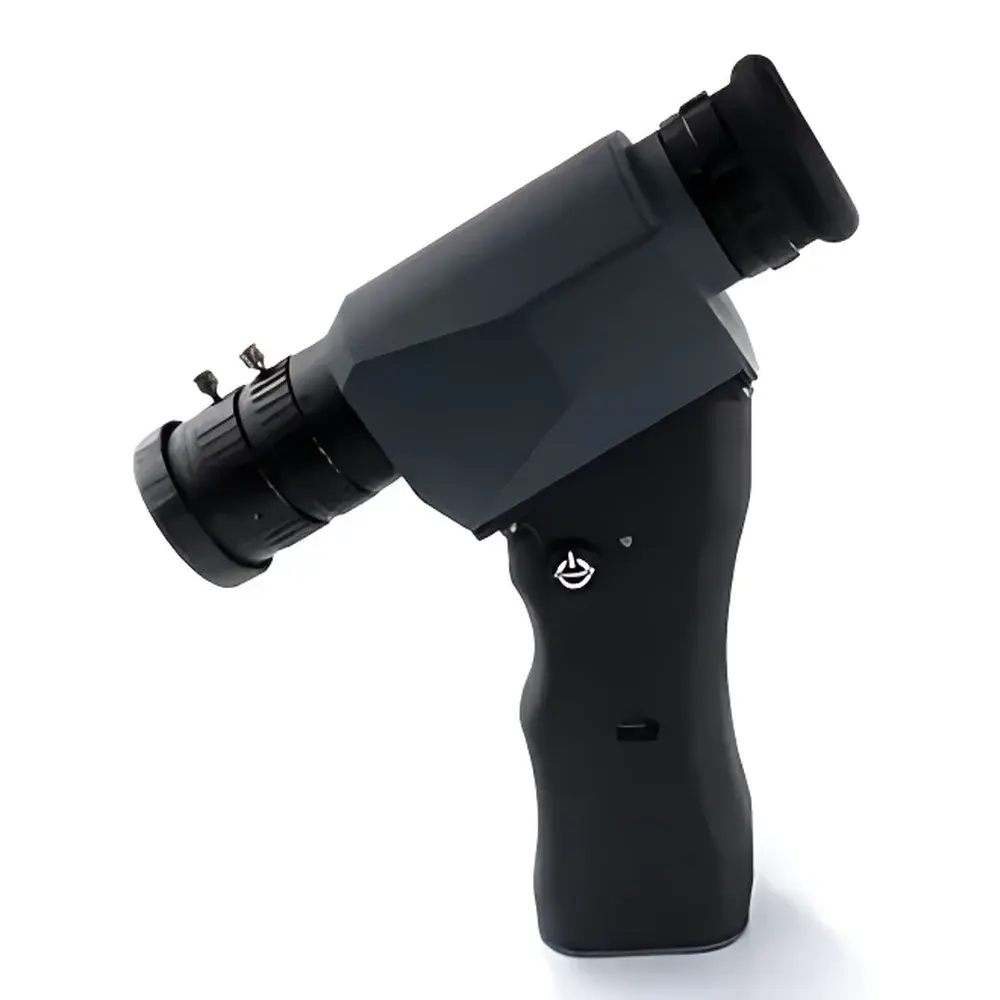
NewOpto IRviewer1700 Infrared Viewing Scope
| Brand | NewOpto |
|---|---|
| Origin | Zhejiang, China |
| Manufacturer Type | Authorized Distributor |
| Product Origin | Domestic (China) |
| Model | IRviewer1700 |
| Spectral Sensitivity Range | 350–1700 nm (extended to 2000 nm with optional filter configuration) |
| Peak Sensitivity | ~800 nm |
| Focal Range | 0.1 m to infinity |
| Resolution | 60 line pairs per millimeter (lp/mm) |
| Field of View | 40° (with standard Infragon 25 mm f/1.0 lens) |
| Magnification | Approx. 1:1 |
| Lens Mount | C-mount compatible (standard 25 mm Infragon f/1.0 lens included |
| Illumination | Integrated 900 nm LED illuminator |
| Compliance | Designed for alignment and visualization in laser safety-compliant workflows (IEC 60825-1 Class 1/Class 1M environments when used with appropriate attenuation) |
Overview
The NewOpto IRviewer1700 is a high-performance, handheld infrared viewing scope engineered for real-time visualization of near-infrared (NIR) radiation across a broad spectral band—from 350 nm in the near-ultraviolet through the visible spectrum and up to 1700 nm, with extended capability to 2000 nm using optimized filter configurations. Unlike thermal imaging systems that detect mid- or long-wave infrared (MWIR/LWIR) emissions via microbolometric sensors, the IRviewer1700 operates on the principle of intensified NIR photon detection: it employs a Gen II+ or Gen III image intensifier tube coupled with a custom Infragon aspheric objective lens (25 mm, f/1.0), enabling high-quantum-efficiency conversion of low-flux NIR signals into visible green phosphor output. This makes it particularly suitable for alignment, diagnostics, and qualitative inspection tasks where active illumination or spontaneous NIR emission (e.g., from laser diodes, fiber-coupled sources, or biological fluorophores) must be observed without contact or disruption.
Key Features
- Extended spectral response: 350–1700 nm baseline; configurable to 2000 nm with calibrated interference filters for specific laser lines (e.g., 1550 nm telecom, 1700 nm OCT sources)
- High optical throughput: f/1.0 Infragon 25 mm objective lens minimizes photon loss and supports operation under low-light NIR conditions
- Real-time analog visualization: No frame buffering or digital latency—ideal for dynamic laser alignment, free-space optical coupling, and pulsed source monitoring
- C-mount compatibility: Standard lens interface enables integration with industrial lenses, beam expanders, or collimators; optional 85299 C-mount adapter provided for legacy or third-party optics
- Integrated 900 nm LED illuminator: Enables active NIR illumination for contrast enhancement in low-emission scenarios, with adjustable intensity control
- Robust mechanical architecture: Aluminum alloy housing rated for laboratory and field deployment; compliant with IP54 dust/moisture resistance
Sample Compatibility & Compliance
The IRviewer1700 is designed for non-destructive, non-contact observation of NIR-emitting or NIR-reflecting samples—including semiconductor laser facets, single-mode and multimode optical fibers, photonic integrated circuits (PICs), biological tissue sections labeled with NIR fluorophores (e.g., IRDye 800CW), and passive optical components such as AR-coated lenses and dichroic mirrors. It does not require sample preparation or vacuum environments. The device conforms to IEC 62471 (Photobiological Safety of Lamps) and supports safe operation within Class 1 or Class 1M laser environments when used in conjunction with certified attenuators and beam blocks. While not a metrological instrument, its optical path is traceable to NIST-calibrated radiometric standards for relative intensity assessment during alignment procedures.
Software & Data Management
As an analog viewing instrument, the IRviewer1700 does not incorporate onboard digital capture or firmware-based data logging. However, it is fully compatible with external documentation workflows: the eyepiece output can be coupled to C-mount-compatible CCD/CMOS cameras (e.g., Thorlabs DCx series, FLIR Blackfly S) for time-synchronized video recording or still-image capture. When integrated into GLP/GMP-aligned facilities, users may apply audit-trail-enabled video acquisition software (e.g., LabVIEW Vision Assistant or MATLAB Image Acquisition Toolbox) to log timestamps, operator IDs, and environmental metadata. No FDA 21 CFR Part 11 compliance is required for this class of observational tool, though documentation protocols may reference ISO/IEC 17025 clause 7.7 for measurement traceability in calibration records.
Applications
- Laser system alignment: Visual confirmation of beam position, mode profile, and divergence for 780 nm, 808 nm, 980 nm, 1064 nm, 1310 nm, 1550 nm, and 1700 nm sources
- Fiber optic troubleshooting: Core-centering verification, splice loss estimation, and connector end-face inspection under NIR illumination
- Biomedical research: Real-time tracking of NIR-labeled antibodies or nanoparticles in ex vivo tissue models
- Defense & security: Covert illumination assessment, night vision aid verification, and optical countermeasure validation
- Materials science: Mapping of NIR reflectance heterogeneity in thin-film solar cells, graphene layers, and quantum dot coatings
- Telecom component testing: Visual inspection of PLC splitters, AWGs, and isolators operating at 1310/1550 nm windows
FAQ
Is the IRviewer1700 suitable for quantitative irradiance measurement?
No—it is a qualitative visualization tool. For radiometric quantification, pairing with a calibrated spectroradiometer (e.g., Ocean Insight HDX) is recommended.
Can it detect CO₂ laser emission at 10.6 µm?
No. The IRviewer1700 is sensitive only up to 2000 nm (2 µm); it cannot visualize mid- or far-infrared wavelengths.
What is the maximum safe input irradiance before tube saturation or damage?
With standard configuration, continuous exposure to >50 mW/cm² at 1064 nm requires neutral density filtering; consult the included Laser Safety Addendum for power-density thresholds by wavelength.
Does it support battery operation?
Yes—integrated rechargeable Li-ion battery provides ≥3.5 hours of continuous use; also supports USB-C powered operation.
Is calibration traceable to national standards?
Spectral sensitivity curves are validated against NIST-traceable tungsten-halogen and laser line sources; full calibration certificates available upon request (ISO/IEC 17025 accredited lab).



