
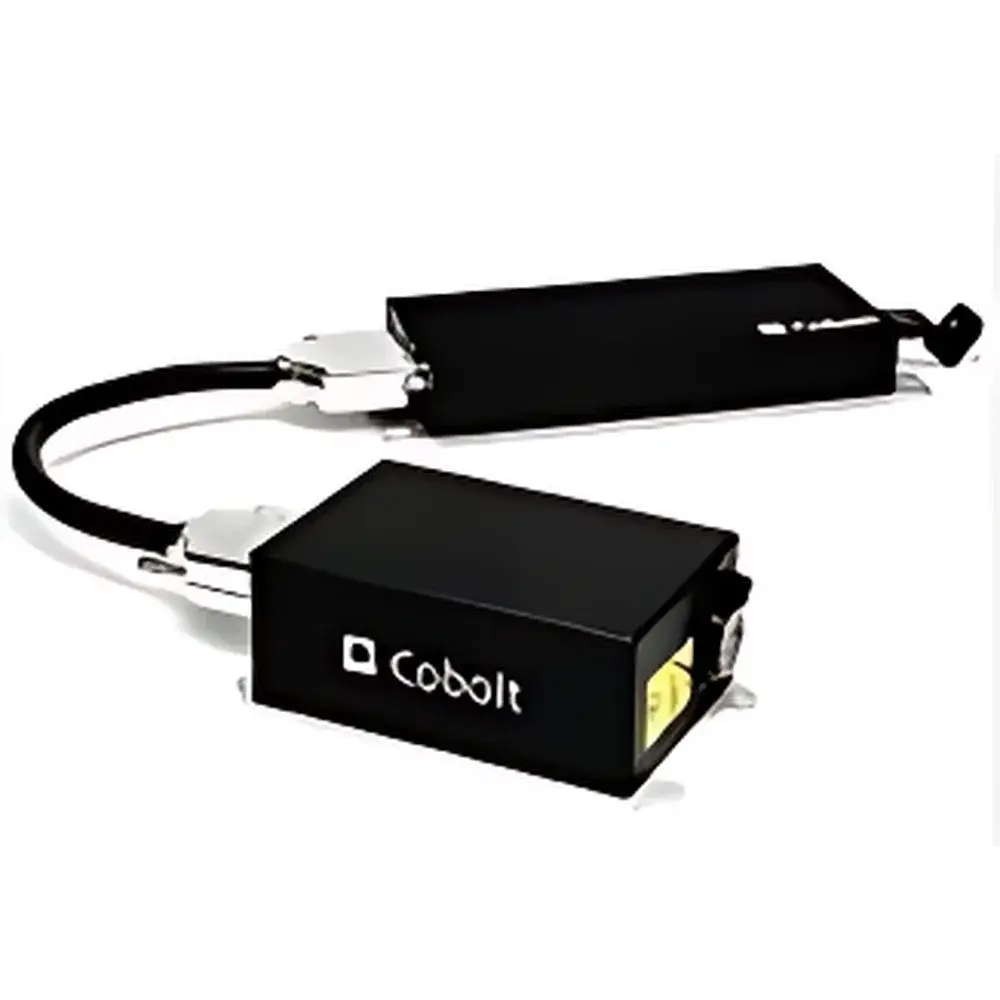
Cobolt 594 nm Single-Longitudinal-Mode DPSS Laser
| Brand | Cobolt |
|---|---|
| Origin | Sweden |
| Model | newopto |
| Output Power Options | 25 / 50 / 100 / 200 mW |
| Spectral Linewidth | <1 MHz (<0.01 pm) |
| Wavelength Stability | ±0.02 nm (typ. 2 pm over ±2°C and 8 h) |
| Spatial Mode | TEM₀₀, M² < 1.1 |
| Beam Diameter (at aperture) | 700 µm |
| Full-Angle Beam Divergence | <1.2 mrad |
| Intensity Noise (20 Hz–20 MHz, pk-pk) | <3% (typ. <2%) |
| Intensity Noise (20 Hz–20 MHz, rms) | <0.3% (typ. <0.2%) |
| Long-Term Power Stability (8 h) | <3% |
| Beam Pointing Stability | <10 µrad/°C (typ. 5 µrad/°C) |
| Polarization Ratio | >100:1 |
| Total System Power Consumption | <35 W (typ. <15 W) |
| Operating Temperature | 10–40 °C |
| Max. Laser Head Baseplate Temp. | 50 °C |
| Recommended Heat Sink Thermal Resistance | 0.5 K/W |
| Laser Head Dimensions | 103 × 60 × 40 mm³ |
| Controller Dimensions | 190 × 72 × 28 mm³ |
| Communication Interface | RS-232 or USB |
| Safety Compliance | CDRH Class 3B (key-switch enabled) or OEM auto-start mode |
| Warranty | 24 months |
Overview
The Cobolt 594 nm Single-Longitudinal-Mode (SLM) Diode-Pumped Solid-State (DPSS) Laser is a precision-engineered optical source designed for demanding scientific and industrial applications requiring exceptional spectral purity, amplitude stability, and beam quality. Operating at the helium-neon transition wavelength of 594 nm—strategically positioned between common visible laser lines—it delivers narrow-linewidth (<1 MHz), diffraction-limited (TEM₀₀, M² 100 m) are critical.
Key Features
- Ultra-narrow spectral linewidth: <1 MHz (<0.01 pm), enabling high-fidelity Raman shift discrimination and Doppler-sensitive measurements.
- Exceptional wavelength stability: ±0.02 nm maximum drift over ±2°C and 8-hour operation; typical drift ≤2 pm under controlled thermal conditions.
- Diffraction-limited spatial profile: TEM₀₀ mode with M² < 1.1 and beam divergence <1.2 mrad (full angle), optimized for efficient coupling into single-mode fibers and high-NA microscope objectives.
- Low-intensity noise performance: <0.3% rms (20 Hz–20 MHz), with typical values below 0.2%, minimizing signal-to-noise degradation in photon-counting and lock-in detection systems.
- Thermally robust mechanical design: Beam pointing stability <10 µrad/°C (typ. 5 µrad/°C) ensures alignment retention during environmental cycling from 10–40°C ambient range.
- Flexible integration architecture: Dual communication options (RS-232 or USB), CDRH-compliant key-switch safety interlock, or OEM auto-start configuration for embedded instrumentation.
- Compact modular form factor: Laser head (103 × 60 × 40 mm³) and separate controller (190 × 72 × 28 mm³) allow space-constrained mounting while maintaining thermal isolation and EMI shielding integrity.
Sample Compatibility & Compliance
This laser system is compatible with standard 1/2″ and 1″ kinematic mounts, SMF-28 or polarization-maintaining (PM) fiber pigtailing (optional), and external collimation or focusing optics for fluorescence excitation, holographic recording, or particle image velocimetry (PIV) illumination. It complies with IEC 60825-1:2014 and FDA 21 CFR Part 1040.10/1040.11 as a Class 3B laser product when configured with the CDRH key-switch option. All firmware and control logic support audit-trail-ready operation per GLP/GMP guidelines, with timestamped parameter logging and user-accessible configuration history. No hazardous substances are used in manufacturing; RoHS 2011/65/EU and REACH SVHC compliance is certified.
Software & Data Management
The Cobolt Control Suite (v4.x) provides native Windows/Linux drivers and Python SDKs for automated power ramping, modulation triggering (TTL/analog), and real-time monitoring of diode current, thermistor readings, and photodiode feedback. All communication protocols implement CRC-16 error checking and command acknowledgment handshaking to ensure deterministic behavior in multi-device lab networks. Data export supports CSV and HDF5 formats, with metadata embedding compliant with FAIR principles (Findable, Accessible, Interoperable, Reusable). Optional firmware upgrades include enhanced PID loop tuning profiles for ultra-low-noise operation and time-synchronized pulse modulation synchronized to external TTL triggers at up to 10 kHz repetition rate.
Applications
- Raman spectroscopy: High signal-to-background ratio excitation at 594 nm minimizes fluorescence interference in biological tissues and polymer samples while preserving resonance enhancement for carotenoid and heme detection.
- Flow cytometry: Stable, low-noise output enables precise multi-parameter cell sorting using tandem fluorophores (e.g., PE-Cy5, APC-H7) with minimal spectral crosstalk.
- Fluorescence lifetime imaging (FLIM): Sub-nanosecond pulse capability (via external modulation) supports time-correlated single-photon counting (TCSPC) with picosecond timing resolution.
- Holography and optical trapping: Coherence length >100 m supports large-volume digital holographic reconstruction and stable dual-beam optical tweezers configurations.
- Dynamic light scattering (DLS) and particle sizing: Low beam pointing drift and intensity noise reduce measurement variance in sub-100 nm colloidal dispersion analysis.
- Calibration reference sources: Used as traceable wavelength standards in metrology labs accredited to ISO/IEC 17025 for optical spectrum analyzer validation.
FAQ
What is the typical coherence length of this laser?
Typical coherence length exceeds 100 meters, calculated from the <1 MHz spectral linewidth using Lc = c / (π·Δν).
Can the laser be fiber-coupled directly from the factory?
Yes—permanent single-mode (SM) or polarization-maintaining (PM) fiber pigtailing is available as a factory-configured option with FC/APC or SMA905 connectors.
Is remote power modulation supported?
Yes—intensity can be modulated via analog voltage input (0–5 V) or TTL trigger (rising-edge active) with bandwidth up to 10 kHz, fully documented in the OEM interface manual.
How is thermal management implemented in compact setups?
The laser head requires an externally mounted heatsink with thermal resistance ≤0.5 K/W; integrated thermistors provide closed-loop temperature feedback to the controller’s TEC driver.
Does the system support FDA 21 CFR Part 11 compliance for regulated environments?
When deployed with the optional audit-log-enabled firmware and networked authentication module, full electronic record and signature functionality—including user role assignment, change tracking, and export-locking—is achievable.






