
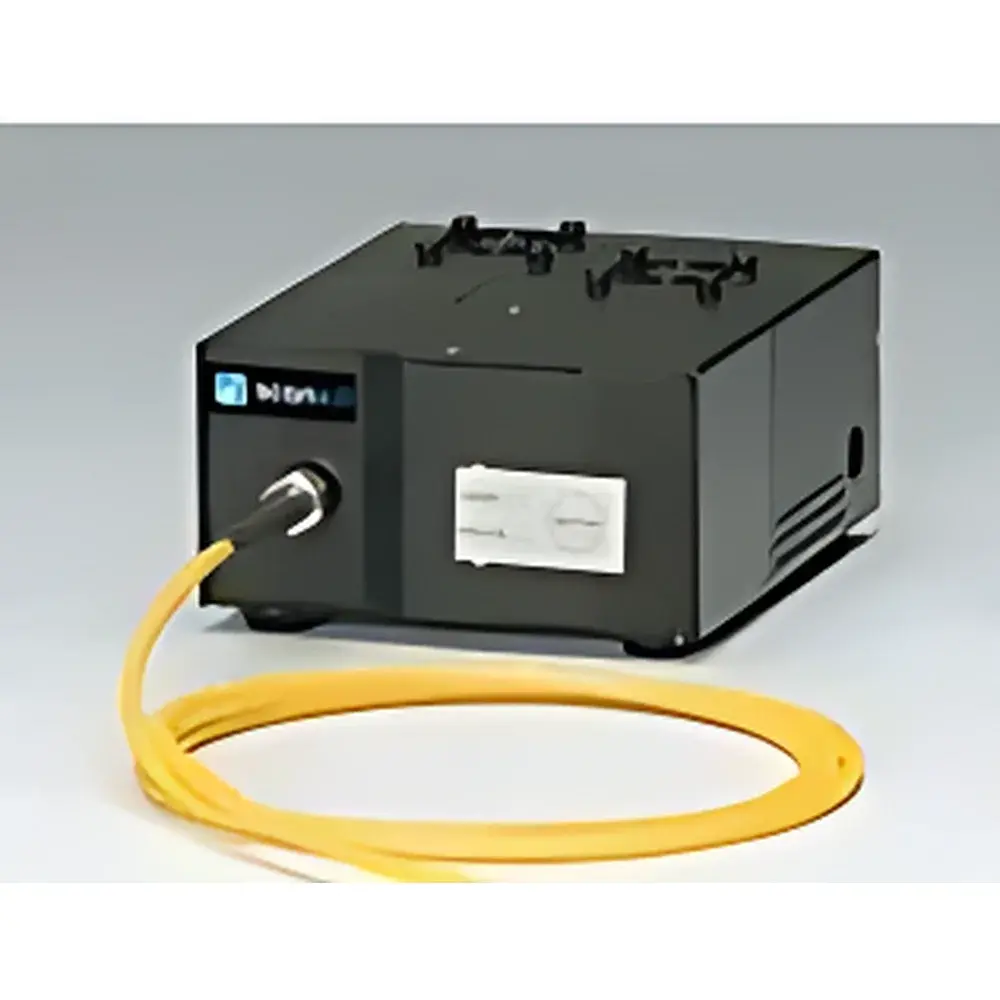
ScanSci ScanSource UV-Vis Broadband Light Source
| Brand | ScanSci |
|---|---|
| Model | ScanSource |
| Spectral Range | 200–1100 nm (standard), optional down to 180 nm |
| Lamp Types | Deuterium (D₂) + Tungsten-Halogen (W) |
| Deuterium Power | 30 W |
| Tungsten Power | 9 W |
| Output Stability (Fluctuation) | ≤2×10⁻⁵ A.U. |
| Long-Term Drift | ±0.3 %/h (D₂), ±0.25 %/h (W) |
| External Control | Shutter, Lamp On/Off, Main Power On/Off |
| Fiber Coupling | SMA 905 |
| Deuterium Lamp Lifetime | 2000 h |
| Tungsten Lamp Lifetime | 2000 h |
| Cooling | Active (fan-cooled) |
| Dimensions | 157 × 178 × 250 mm |
| Compliance | CE, RoHS |
Overview
The ScanSci ScanSource UV-Vis Broadband Light Source is a dual-lamp, stabilized illumination system engineered for high-fidelity spectroscopic applications across the ultraviolet, visible, and near-infrared spectral regions (200–1100 nm). It integrates a high-intensity deuterium arc lamp for deep-UV continuum emission (180–400 nm) and a tungsten-halogen lamp for stable, high-brightness output from 350 nm to 1100 nm. The two sources are optically combined into a single collimated output beam via precision dichroic optics, enabling seamless spectral coverage without mechanical reconfiguration. Designed specifically for integration with ScanSci’s family of miniature spectrometers, the ScanSource serves as the primary excitation or illumination source in reflectance, transmittance, absorbance, and fluorescence measurement configurations. Its low temporal fluctuation (≤2×10⁻⁵ A.U.) and tightly controlled thermal management ensure measurement repeatability required for quantitative optical characterization in research laboratories and quality control environments.
Key Features
- Dual-lamp architecture: Independently controllable deuterium (30 W) and tungsten-halogen (9 W) lamps provide continuous, overlapping spectral output from 200 nm to 1100 nm — extendable to 180 nm with optional D₂ lamp variant.
- Active stabilization: Real-time feedback circuitry maintains optical output stability within ±0.3 %/h (deuterium) and ±0.25 %/h (tungsten), minimizing baseline drift during extended acquisition sequences.
- Full external control interface: TTL-compatible digital inputs support remote operation of shutter actuation, individual lamp on/off states, and main power sequencing — essential for automated spectroscopy platforms and synchronized measurement protocols.
- SMA 905 fiber coupling: Standardized 1/4″ threaded connector ensures repeatable, low-loss coupling to optical fibers (core diameters ≥50 µm recommended) and compatibility with industry-standard spectrometer input slits and integrating spheres.
- Forced-air cooling system: Integrated temperature-regulated fan prevents thermal lensing and spectral shift, preserving radiometric consistency over multi-hour operational cycles.
- Compact benchtop form factor (157 × 178 × 250 mm): Optimized footprint supports integration into space-constrained optical tables, OEM instruments, and portable field-deployable systems.
Sample Compatibility & Compliance
The ScanSource is compatible with solid, liquid, and thin-film samples when used in conjunction with appropriate optical accessories — including integrating spheres (e.g., Labsphere ISN-400), transmission cuvette holders, diffuse reflectance probes, and fluorescence excitation/emission filters (e.g., Semrock bandpass filters). Its spectral irradiance profile meets the photometric requirements of ISO 13406-2 (for display calibration reference sources) and ASTM E308 (for colorimetric computation). While not intrinsically certified for regulated pharmaceutical or clinical use, its stable output and audit-ready control log (via optional RS-232 or USB command set) support GLP-compliant documentation workflows. The device complies with CE marking directives (2014/30/EU EMC and 2011/65/EU RoHS) and carries full electrical safety certification per IEC 61010-1.
Software & Data Management
The ScanSource operates in both standalone and host-controlled modes. When integrated with ScanSci spectrometer SDKs (C/C++, Python, LabVIEW), users can synchronize lamp activation, shutter timing, and integration time at the driver level — enabling dark-current subtraction, intensity normalization, and multi-spectral kinetic profiling. All control commands generate timestamped event logs, supporting traceability in ISO/IEC 17025-accredited testing labs. Optional firmware upgrades introduce SCPI-compliant command syntax, facilitating interoperability with third-party automation frameworks such as NI TestStand and MATLAB Instrument Control Toolbox. No proprietary cloud service or subscription model is required; all firmware and configuration tools are distributed as open binaries with full documentation.
Applications
- Absorbance spectroscopy: Quantitative analysis of chemical concentrations in solution (e.g., nucleic acid quantification at 260 nm, protein assays at 280 nm) using Beer-Lambert law-based calibration curves.
- Reflectance & transmittance mapping: Surface characterization of coatings, thin films, and semiconductor wafers via bidirectional reflectance distribution function (BRDF) or spectral transmittance ratio measurements.
- Fluorescence excitation: Broadband excitation of fluorophores with unknown or variable absorption maxima — particularly valuable in screening applications and lifetime decay studies requiring wide excitation bandwidth.
- Calibration reference source: Validation of spectrometer wavelength accuracy, stray light performance, and photometric linearity per NIST-traceable protocols (e.g., NIST SRM 2035).
- OEM instrument integration: Embedded illumination module for handheld analyzers, environmental sensors, and process monitoring systems requiring robust, maintenance-minimized broadband excitation.
FAQ
What is the typical warm-up time to achieve spectral stability?
The deuterium lamp requires approximately 30 minutes to reach thermal equilibrium and stabilize spectral output; tungsten-halogen reaches nominal stability within 5 minutes. Full system stability (both lamps) is achieved after 45 minutes under ambient conditions (23 ± 2 °C).
Can the deuterium and tungsten lamps be operated simultaneously?
Yes — the optical combiner enables concurrent operation. However, for maximum signal-to-noise ratio in UV-dominant measurements, sequential lamp activation is recommended to avoid halogen-induced background in the 200–350 nm region.
Is the output beam collimated or focused?
The output is quasi-collimated (divergence < 5 mrad) and optimized for fiber coupling. Free-space collimation optics (e.g., achromatic doublets) may be added externally for beam expansion or focusing.
Does the ScanSource support analog intensity modulation?
No — intensity control is digital (on/off only). Analog dimming is not implemented to preserve spectral fidelity and lamp lifetime; optical attenuation must be performed externally using neutral density filters.
What maintenance is required beyond lamp replacement?
No routine optical alignment or recalibration is needed. Lamp replacement intervals are monitored via internal hour counters; replacement kits include pre-aligned lamp modules with factory-set focus positions.




