
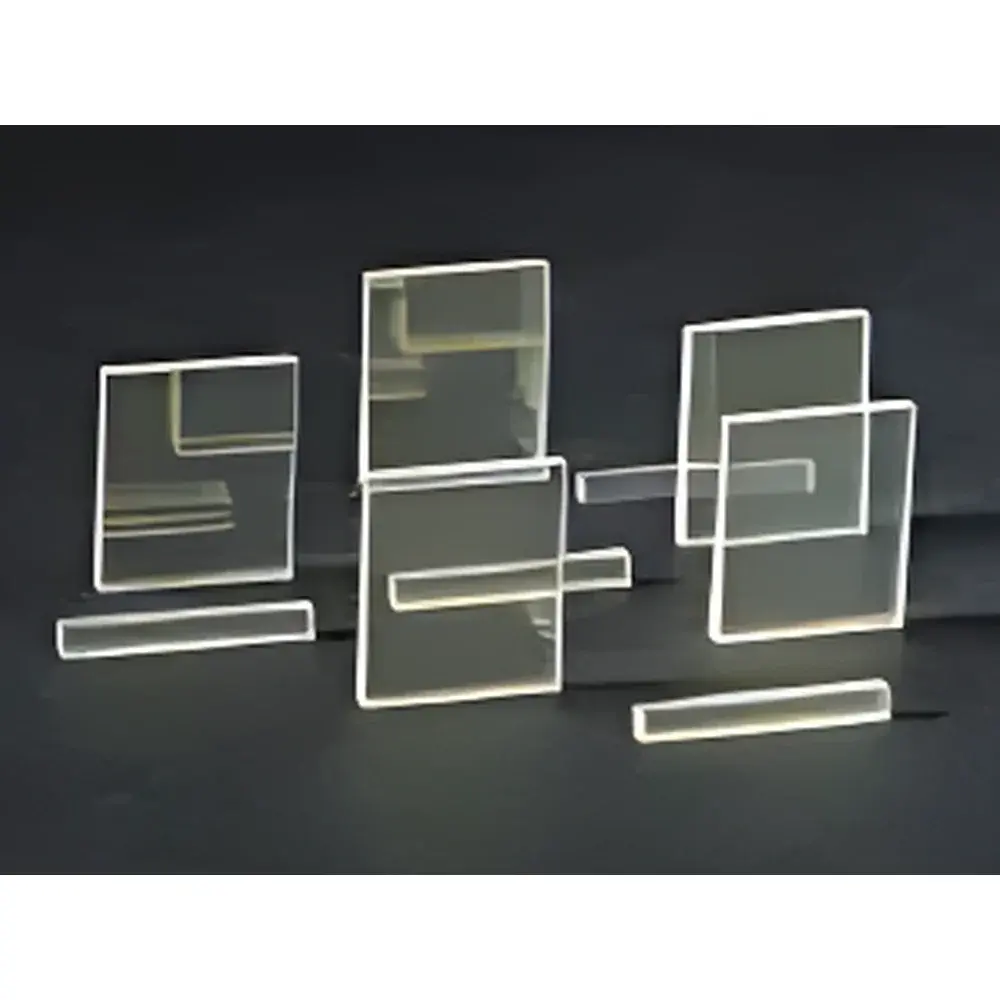
PD-LD VBG Volume Bragg Grating
| Brand | PD-LD |
|---|---|
| Origin | USA |
| Component Type | Optical Element |
| Available Configurations | Lensed VBG, Chirped VBG (Transverse & Longitudinal), Fixed-Reflectivity VBG, Variable-Reflectivity VBG |
| Center Wavelength Range | 400 nm – 2500 nm |
| Typical Center Wavelengths | 785 nm, 808 nm, 976 nm, 1064 nm |
| Wavelength Accuracy | ±0.5 nm |
| FWHM Line-width | ≤1.0 nm |
| Thermal Wavelength Drift | ≤0.01 nm/°C |
| Polarization Dependent Loss | ≤0.1 dB |
| Operating Temperature | –40°C to +130°C |
| Storage Temperature | –40°C to +130°C |
| Acceptance Angle | ±5° |
| Standard Dimensions | Single Emitter (1.5 mm × 2.0 mm), Diode Bar (1.5 mm × 15 mm), 2D Array (15 mm × 15 mm), Wafer Format (30 mm × 30 mm) |
Overview
The PD-LD VBG Volume Bragg Grating is a monolithic, photosensitive optical element fabricated in high-purity photothermo-refractive (PTR) glass. Unlike surface-relief gratings, VBGs rely on periodic modulation of the bulk refractive index—engineered via precise UV interference exposure and thermal development—to achieve highly selective spectral filtering through Bragg diffraction. This volumetric structure provides exceptional angular and spectral selectivity, minimal polarization-dependent loss, and intrinsic thermal stability—making it ideal for wavelength stabilization, narrowband spectral filtering, pulse compression, and spectral beam combining in demanding laser systems.
Key Features
- Monolithic PTR-glass construction ensures long-term environmental stability and resistance to laser-induced damage (LIDT > 5 J/cm² for nanosecond pulses at 1064 nm)
- Narrow spectral bandwidth (FWHM ≤ 1.0 nm) with high peak reflectivity (>99% achievable) and steep spectral edges
- Ultra-low thermal wavelength drift (≤ 0.01 nm/°C), enabling passive wavelength locking in uncooled diode lasers
- Low polarization-dependent loss (≤ 0.1 dB) and high wavefront fidelity (< λ/10 RMS over clear aperture)
- Multiple functional configurations: lensed VBGs integrate fast-axis collimation for direct coupling into single-emitter diodes; chirped VBGs support dispersion compensation in femtosecond amplifiers
- Scalable fabrication enables uniform performance across formats—from sub-millimeter single-emitter elements to 30 mm × 30 mm wafer-scale arrays
Sample Compatibility & Compliance
VBGs are compatible with free-space and fiber-coupled architectures operating from the visible (400 nm) through the near-infrared (2500 nm). They maintain specified optical performance under continuous-wave and pulsed (ns–fs) illumination when operated within ISO 10110–7 surface quality and IEC 60825–1 laser safety compliance limits. Devices meet MIL-STD-883H mechanical shock and thermal cycling requirements, and are qualified for use in Class 1000 cleanroom environments. No outgassing or organic binder materials are used—ensuring compatibility with ultra-high-vacuum (UHV) and space-qualified optical benches.
Software & Data Management
While VBGs are passive components, their integration into laser systems benefits from traceable calibration documentation provided with each unit—including spectral response maps (reflectivity vs. wavelength/angle), interferometric wavefront reports, and thermal coefficient validation data. PD-LD supplies NIST-traceable test reports aligned with ISO/IEC 17025 requirements. For OEM integration, spectral modeling files (e.g., RCWA or coupled-mode theory datasets) are available upon request to support system-level simulation in Zemax OpticStudio, LASCAD, or MATLAB-based control frameworks. All documentation complies with GLP audit trails and supports FDA 21 CFR Part 11 electronic record integrity where applicable.
Applications
- Diode Laser Stabilization: Lensed VBGs serve as external cavity feedback elements for single-mode semiconductor lasers, enabling <±5 pm wavelength stability without active temperature control
- Ultrafast Pulse Compression: Longitudinally chirped VBGs compensate for group-delay dispersion in Ti:sapphire and Yb-doped fiber amplifier chains
- Spectral Beam Combining: High-efficiency VBG stacks enable coherent and incoherent multiplexing of multiple pump diodes in DPSS and fiber laser architectures
- Raman Spectroscopy Sources: Narrow-linewidth, low-drift VBG-stabilized pumps improve signal-to-noise ratio and calibration repeatability in benchtop and portable analyzers
- Military & Aerospace Sensing: Used in ruggedized LIDAR receivers, atomic vapor filters, and satellite-based spectrometers requiring radiation-hardened, zero-maintenance spectral references
FAQ
What is the typical damage threshold for PD-LD VBGs under CW and pulsed operation?
For 1064 nm illumination, the average power density threshold exceeds 10 kW/cm² (CW), while the fluence limit is ≥5 J/cm² for 10 ns pulses at 10 Hz repetition rate. Exact values depend on coating configuration and beam profile—full LIDT characterization reports are supplied per batch.
Can custom center wavelengths be manufactured outside the standard catalog bands?
Yes. PD-LD supports bespoke VBG design and fabrication from 400 nm to 2500 nm, including non-standard wavelengths such as 638 nm, 1550 nm, and 2050 nm, subject to minimum order quantity and lead-time confirmation.
Are VBGs suitable for use in vacuum or cryogenic environments?
Absolutely. The all-glass, binder-free structure exhibits no outgassing (per ASTM E595) and maintains mechanical integrity down to 4 K. Thermal expansion mismatch with common mounts (e.g., Invar, Kovar) is accounted for in mounting interface design guidance.
How does acceptance angle affect alignment sensitivity in VBG-based external cavities?
The ±5° acceptance angle defines the full angular range over which Bragg condition is maintained within ±0.2 nm wavelength shift. For precision locking, angular alignment tolerance is typically ±0.3°—achievable using kinematic mounts with sub-arcsecond resolution.





