
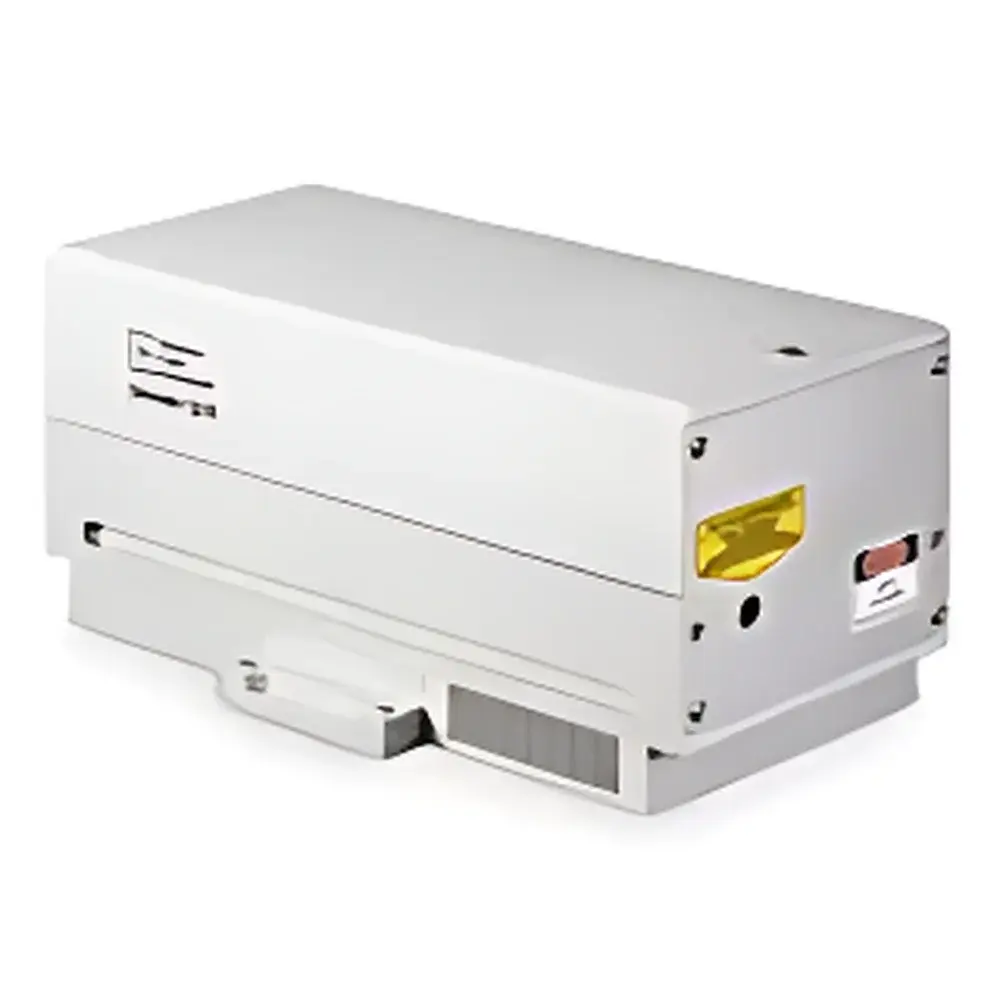
NewOpto Quantas Q1/Q2 Series Nd:YLF Diode-Pumped Q-Switched Laser (1053 nm)
| Brand | NewOpto |
|---|---|
| Origin | USA |
| Manufacturer Type | Authorized Distributor |
| Origin Category | Imported |
| Model | Quantas Q1-1053 / Q2-1053 |
| Light Source Type | Infrared Pulsed Solid-State Laser |
| Illumination Mode | External Illumination |
| Wavelength | 1053 nm (1047 nm optional) |
| Fundamental Output Energy | 5–70 mJ |
| Harmonic Outputs | 527 nm (2–35 mJ), 351 nm (1–20 mJ), 263 nm (0.6–11 mJ), 211 nm (0.15–3.5 mJ) |
| Repetition Rate | 10 Hz (factory-fixed) |
| Pulse Width | < 8 ns |
| Pulse-to-Pulse Energy Stability | < 1 % rms (Q1), < 0.7 % rms (Q2) |
| Power Drift | ±3% |
| Beam Profile | Near TEM₀₀, >75% Gaussian |
| Beam Divergence | < 3 mrad (Q1A) to < 1.5 mrad (Q1C/Q1D) |
| Beam Diameter | 1.2–3.0 mm |
| Polarization | Linear, horizontal |
| Optical Jitter | < 1 ns rms |
| Laser Head Dimensions | 113 × 230 × 112 mm (Q1), 113 × 400 × 112 mm (Q2-1053) |
| Harmonic Generator | 113 × 242 × 112 mm |
| Controller Unit | 85 × 165 × 50 mm |
| Power Adapter | 50 × 125 × 32 mm |
| Operating Environment | 15–30°C, 10–80% RH (non-condensing), 90–230 VAC, 30 W, 47–63 Hz |
Overview
The NewOpto Quantas Q1 and Q2 series Nd:YLF diode-pumped, Q-switched lasers deliver high-stability, nanosecond-pulsed output at the fundamental wavelength of 1053 nm—optimized for precision photonic applications requiring temporal coherence, narrow spectral bandwidth, and excellent beam quality. Based on neodymium-doped yttrium lithium fluoride (Nd:YLF) crystal architecture, these lasers leverage end-pumping with high-brightness laser diodes and electro-optic Q-switching to generate transform-limited pulses with sub-8 ns duration. The 1053 nm emission line aligns closely with the gain peak of Nd:YLF and exhibits low thermal lensing compared to Nd:YAG, enabling superior long-term power stability and reduced thermal distortion in demanding experimental configurations. Optional harmonic generation modules extend operational flexibility to 527 nm (second harmonic), 351 nm (third), 263 nm (fourth), and 211 nm (fifth harmonic), supporting multi-wavelength spectroscopic and ablation protocols without requiring separate laser systems.
Key Features
- Diode-pumped solid-state (DPSS) architecture with integrated temperature stabilization for <±3% power drift over 8-hour operation
- Q-switched pulse generation with <8 ns pulse width and <1 ns rms optical jitter—critical for time-resolved diagnostics such as time-of-flight mass spectrometry (TOF-MS) and pump-probe experiments
- Multiple output energy configurations: Q1 models offer 5–40 mJ (fundamental), Q2 delivers up to 70 mJ; harmonic outputs scale proportionally with high conversion efficiency
- Near-diffraction-limited beam profile (>75% Gaussian content, M² < 1.2) and low divergence (<1.5 mrad for Q1C/Q1D variants) ensure efficient coupling into fibers, spectrometers, and vacuum chambers
- Externally triggerable design supports synchronization with gated detectors, delay generators, or data acquisition systems compliant with IEEE 1588 or NIST-traceable timing standards
- Compact modular layout: laser head, harmonic generator, controller unit, and universal AC adapter are mechanically and electrically decoupled—facilitating integration into OEM instruments and cleanroom-compatible optical tables
Sample Compatibility & Compliance
The Quantas laser system is engineered for compatibility with standard optical breadboards (M6/M4 tapped holes), vacuum feedthroughs (CF-35/CF-63 compatible mounting flanges available upon request), and common spectroscopic interfaces (e.g., SMA905, FC/PC fiber couplers). All harmonic modules employ dielectric-coated, angle-tuned BBO or LBO crystals meeting ISO 10110 surface quality specifications (scratch-dig 10-5). The system complies with IEC 60825-1:2014 Class 4 laser safety requirements; full interlock circuitry (including shutter control, key switch, and emergency stop) meets EN 61496-1 functional safety standards. For regulated laboratory environments, optional audit-trail-enabled firmware supports GLP/GMP workflows under FDA 21 CFR Part 11 when paired with validated third-party data acquisition software.
Software & Data Management
Operation is managed via a dedicated USB-connected controller unit running embedded real-time firmware (v3.2+). The accompanying Quantas Control Suite (Windows/Linux) provides GUI-based parameter configuration—including repetition rate override (when externally triggered), pulse energy monitoring with 16-bit ADC resolution, and harmonic selection logic. All operational logs (timestamped pulse count, internal temperature, diode current, and energy monitor readings) are exported in CSV/JSON format with UTC timestamps. Remote command-line interface (CLI) support enables integration into Python- or LabVIEW-driven automation sequences using SCPI-like syntax. No cloud connectivity or telemetry is enabled by default; all data remains local unless explicitly exported by the user.
Applications
- Light-Induced Breakdown Spectroscopy (LIBS): High peak power (≥1 GW) at 1053 nm enables robust plasma initiation on conductive and non-conductive samples, including metals, ceramics, and geological matrices
- Laser Ablation ICP-MS: Stable pulse-to-pulse energy ensures reproducible aerosol generation for isotopic ratio analysis per ASTM D7088 and ISO/IEC 17025-accredited labs
- Matrix-Assisted Laser Desorption/Ionization (MALDI): Tunable UV harmonics (211–351 nm) match optimal absorption bands of common matrices (e.g., sinapinic acid, α-cyano-4-hydroxycinnamic acid)
- Flash Photolysis & Ultrafast Kinetics: Sub-ns jitter and external triggering enable precise pump-probe delays down to 100 ps with commercial delay generators
- Pulsed Laser Deposition (PLD): Uniform fluence distribution and low beam divergence support stoichiometric thin-film growth of complex oxides (e.g., YBCO, STO) in UHV chambers
- Remote Sensing & LIDAR: Eye-safe 1053 nm fundamental output is suitable for atmospheric backscatter profiling under ITU-R P.1817-1 guidelines for outdoor deployment
FAQ
Is the 1047 nm wavelength option factory-configurable or field-upgradable?
The 1047 nm line requires crystal orientation adjustment and cavity re-alignment; it is only available as a factory-set option at time of order and cannot be retrofitted.
What cooling method does the laser employ?
Passive conduction cooling via aluminum chassis; no forced air or liquid cooling is required—suitable for vibration-sensitive interferometric setups.
Can the Q2-1053 model operate at repetition rates other than 10 Hz?
Yes—while factory-set to 10 Hz, the Q2 supports external TTL triggering from 1 Hz to 20 Hz with full energy retention and jitter performance maintained.
Are harmonic modules interchangeable between Q1 and Q2 laser heads?
No—harmonic generators are mechanically and optically matched to specific laser head versions; Q2-1053 requires its dedicated harmonic module due to beam diameter and divergence differences.
Does the system include alignment tools or beam diagnostics?
A calibrated photodiode-based energy monitor and IR-viewing card are included; optional add-ons include a CCD-based beam profiler (Ophir NanoScan) and autocorrelator for pulse width verification.






