
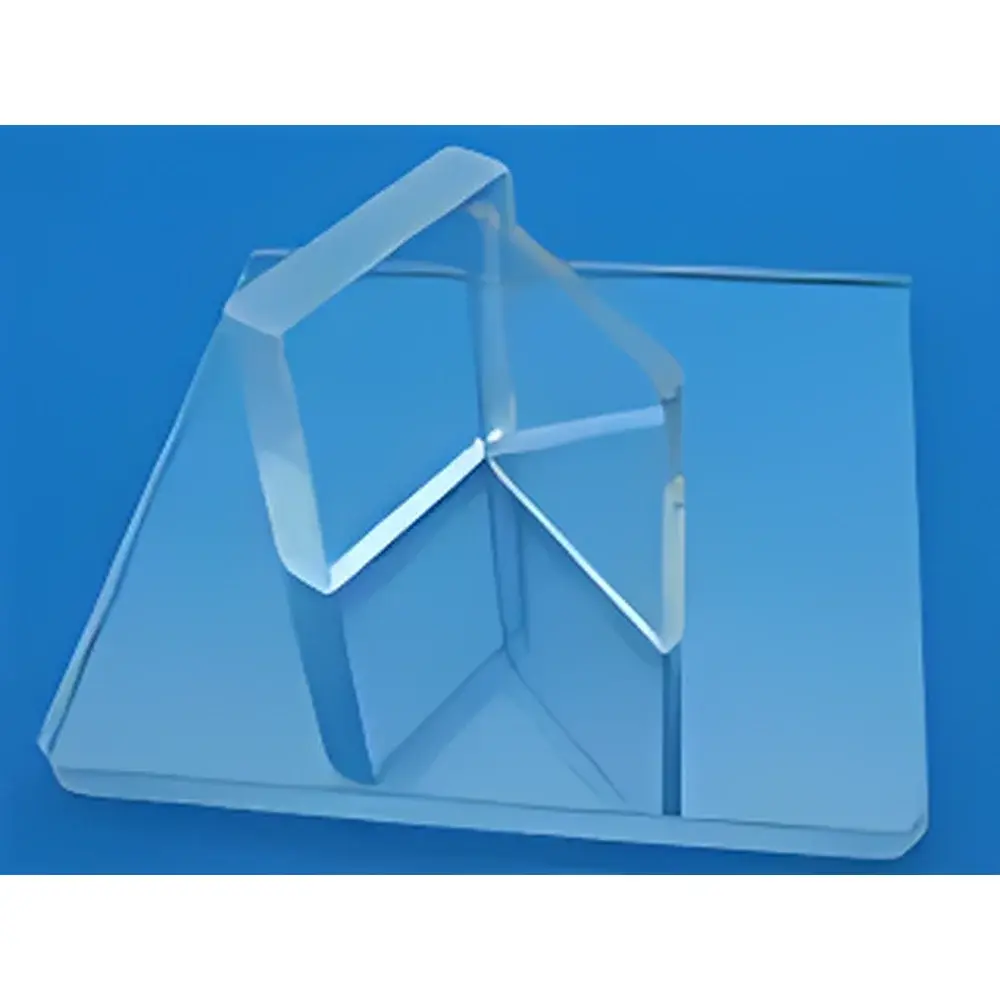
THz Waveplate – NewOpto THz Quarter- and Half-Wave Retarders for Polarization Control in Terahertz Spectroscopy
| Brand | NewOpto |
|---|---|
| Origin | Russia |
| Model | THz Waveplate |
| Retardation Types | λ/2, λ/4 |
| Operating Wavelength Range | 30–1000 µm |
| Substrate Material | THz-Grade Crystal Quartz |
| Orientation | x-cut |
| Orientation Tolerance | ±10 arcmin |
| Standard Dimensions | 20×20 mm, 50×50 mm |
| Max. Dimensions | 60×60 mm |
| Dimensional Tolerance | ±0.25 mm |
| Thickness Tolerance | ±5.0 µm |
| Clear Aperture | ≥90% |
| Parallelism | ≤5 arcmin |
| Surface Quality | 60/40 (scr/dig) |
| Wavefront Distortion (WFD) | λ/2 @ 633 nm |
Overview
NewOpto THz Waveplates are precision-engineered birefringent retarders designed for polarization state manipulation in the terahertz (THz) spectral range (0.3–10 THz, corresponding to 30–1000 µm). Based on high-purity, low-absorption crystal quartz optimized for THz transmission, these waveplates operate on the principle of controlled phase retardation between orthogonal polarization components via uniaxial birefringence. A λ/2 (half-wave) plate introduces a π-phase shift, enabling rotation of linear polarization by twice the angle between the incident polarization axis and the plate’s fast axis. A λ/4 (quarter-wave) plate imparts a π/2 phase delay, converting linearly polarized THz radiation into circularly polarized light—and vice versa—critical for ellipsometric measurements, polarization-sensitive detection, and coherent control experiments. Unlike broadband polymer or multilayer designs, quartz-based THz waveplates offer superior thermal stability, low dispersion across wide bandwidths, and minimal group delay variation—making them suitable for time-domain spectroscopy (THz-TDS), pump-probe setups, and synchrotron-based beamlines where polarization fidelity must be preserved under high-average-power or pulsed excitation.
Key Features
- Material-optimized design using THz-grade crystalline quartz with <1 dB/cm absorption coefficient at 1 THz and negligible phonon absorption up to 3 THz
- Precision x-cut orientation ensures optimal alignment of optical axis relative to propagation direction for consistent retardation performance
- Retardation accuracy validated at reference wavelength (633 nm) with wavefront distortion ≤λ/2, enabling interferometric-grade alignment in hybrid visible-THz optical paths
- Surface quality rated 60/40 (scr/dig) per MIL-PRF-13830B, minimizing scatter-induced signal loss in low-photon-flux THz detection
- Parallelism ≤5 arcmin guarantees collimation integrity over full clear aperture (≥90%), essential for maintaining beam overlap in dual-polarization interferometers
- Available in standard 20×20 mm and 50×50 mm formats; custom sizes up to 60×60 mm support integration into large-aperture THz imaging systems and vacuum-compatible cryogenic stages
Sample Compatibility & Compliance
These waveplates are compatible with both continuous-wave (CW) THz sources (e.g., photomixers, quantum cascade lasers) and pulsed THz systems (e.g., fiber-coupled Ti:sapphire-based TDS). Their solid-state quartz construction ensures mechanical robustness under vacuum (<10⁻⁵ mbar), temperature cycling (−40°C to +80°C), and non-condensing humidity environments. While not certified to ISO 9001 or ISO/IEC 17025 as a measurement standard, the manufacturing process adheres to traceable dimensional and surface metrology protocols aligned with ASTM E1316 (Standard Terminology for Nondestructive Examinations) and ISO 10110-7 (optical element surface imperfection specification). For regulated applications involving GLP/GMP-compliant THz characterization workflows, users may implement in-house calibration using calibrated polarimeters and THz electro-optic sampling systems.
Software & Data Management
As passive optical components, THz waveplates require no embedded firmware, drivers, or software interfaces. However, they integrate seamlessly into automated polarization control architectures when paired with motorized rotation stages (e.g., Thorlabs K10CR1, Newport CONEX-AG-PS100) and LabVIEW- or Python-controlled polarization analysis suites. Users can define retardation setpoints, track angular encoder feedback, and log polarization state transformations (via Stokes vector reconstruction) within existing data acquisition frameworks compliant with IEEE 1588 (PTP) time synchronization for multi-channel THz experiments. Audit trails for stage positioning and environmental monitoring (temperature/humidity) may be archived in accordance with FDA 21 CFR Part 11 requirements when deployed in pharmaceutical or biomedical THz inspection systems.
Applications
- Polarization-resolved THz time-domain spectroscopy (TRTS) for anisotropic material characterization (e.g., layered perovskites, chiral biomolecules)
- Circular dichroism (CD) measurements in the far-infrared regime for protein secondary structure analysis
- Calibration of THz polarimeters and vector network analyzers (VNA) operating above 0.5 THz
- Generation and analysis of orbital angular momentum (OAM) modes in structured THz beams
- Real-time polarization modulation in lock-in amplified THz imaging for enhanced contrast in security screening and non-destructive evaluation (NDE)
- Integration into ultrafast pump-THz probe geometries requiring sub-100-fs timing stability and polarization purity
FAQ
What is the maximum average power handling capability of these THz waveplates?
Crystal quartz exhibits high laser-induced damage threshold (LIDT) in the THz regime; typical CW power limits exceed 500 mW/mm² at 1 THz with proper beam homogenization and cooling. For femtosecond-pulsed sources, LIDT is pulse-energy dependent—consult application-specific testing reports for fluence thresholds.
Can these waveplates be used at cryogenic temperatures?
Yes. Quartz maintains structural integrity and birefringence stability down to 4 K. Thermal contraction mismatch is minimized through x-cut geometry and optional low-outgassing mounting fixtures.
Is retardation wavelength-dependent, and how is it characterized?
Retardation scales inversely with wavelength (δ = 2π·Δn·d/λ). Full spectral retardation curves are provided upon request based on interferometric measurement using Fourier-transform THz spectrometers.
Do you supply mounting cells or kinematic holders?
NewOpto offers optional SM1-threaded mounts with adjustable tilt and azimuth for alignment-critical setups. Custom vacuum-compatible holders are available under NRE agreement.




