
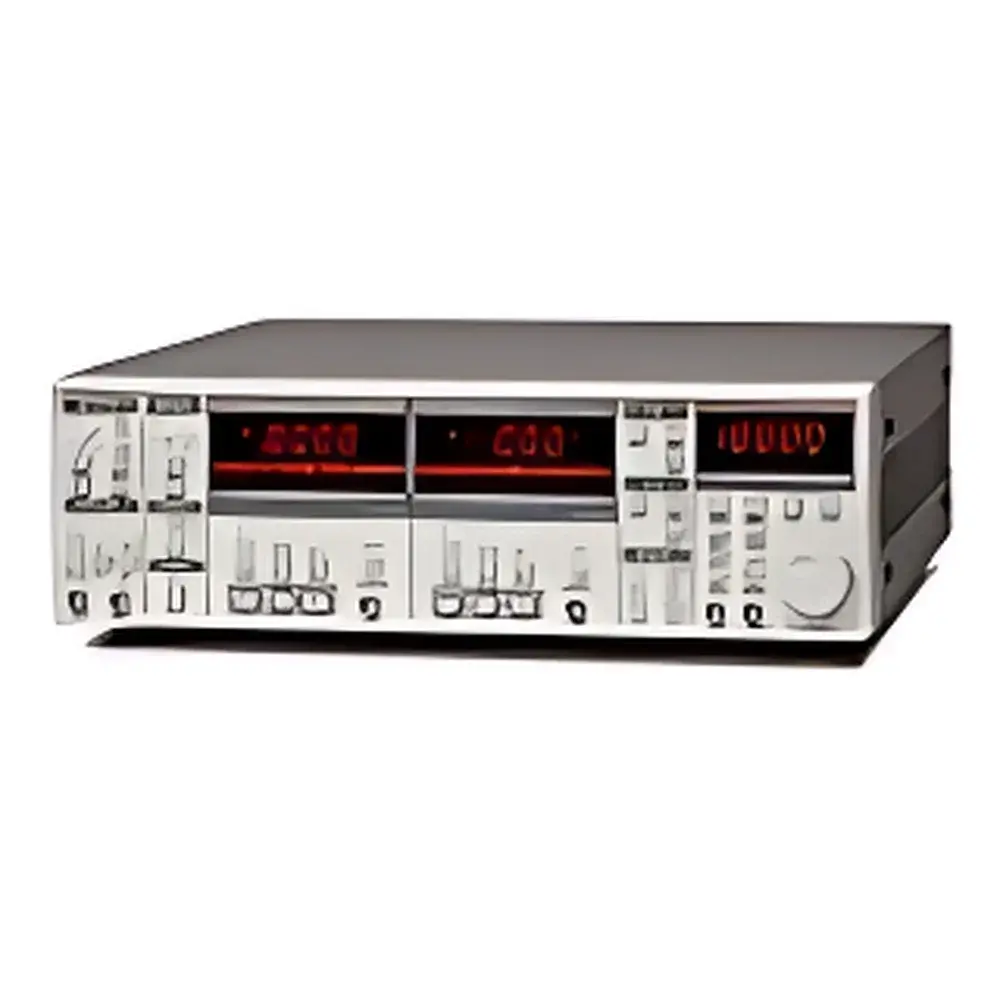
NewOpto SR810 / SR830 Lock-In Amplifiers
| Brand | NewOpto |
|---|---|
| Origin | USA |
| Model | SR810 / SR830 |
| Frequency Range | 1 mHz to 102.4 kHz |
| Dynamic Reserve | >100 dB |
| Phase Resolution | 0.01° (front panel), 0.008° (computer interface) |
| Time Constants | 10 μs to 30 ks (6/12/18/24 dB/oct rolloff) |
| Input Sensitivity | 2 nV to 1 V (voltage), 10⁶ or 10⁸ V/A (current) |
| Voltage Noise | 6 nV/√Hz @ 1 kHz |
| Current Noise | 0.13 pA/√Hz @ 1 kHz (10⁶ V/A), 0.013 pA/√Hz @ 100 Hz (10⁸ V/A) |
| Gain Accuracy | ±1 % (±0.2 % typical) |
| Stability | <5 ppm/°C |
| Reference Output Distortion | –80 dBc (<10 kHz), –70 dBc (>10 kHz) |
| Internal Oscillator Accuracy | 25 ppm + 30 μHz |
| Harmonic Detection | up to nF ≤ 102 kHz (n < 19,999) |
| Data Buffer | SR810 — 8 k points |
| Interface Standard | IEEE-488.2 (GPIB) and RS-232 |
| Power | 40 W, 100–240 VAC, 50/60 Hz |
| Dimensions | 43.2 × 13.3 × 49.5 cm (W × H × D) |
| Weight | 10.4 kg (23 lbs) |
| Warranty | 1 year parts and labor |
Overview
The NewOpto SR810 and SR830 Lock-In Amplifiers are precision analog-digital hybrid instruments engineered for ultra-low-noise, high-sensitivity measurement of periodic signals buried in noise—common in optical modulation spectroscopy, photothermal detection, scanning probe microscopy, and quantum device characterization. Operating on the principle of synchronous demodulation, these amplifiers extract signal amplitude (R) and phase (Θ) relative to a reference frequency by multiplying the input with sine and cosine components of the reference and applying low-pass filtering. This technique achieves effective bandwidths as narrow as millihertz while rejecting out-of-band noise, enabling detection of signals down to the nanovolt level—even when the signal-to-noise ratio is below –100 dB. Designed for laboratory-grade stability and reproducibility, both models feature synthesized internal oscillators, digital phase-locked loop architecture, and temperature-compensated analog front ends to ensure long-term measurement integrity across demanding experimental conditions.
Key Features
- Wide dynamic frequency range: 1 mHz to 102.4 kHz—covering ultra-slow thermal drift measurements through fast optical modulation protocols.
- Dynamic reserve exceeding 100 dB without prefiltering—critical for applications involving strong interfering harmonics or ambient electromagnetic noise.
- High-resolution phase control: 0.01° resolution at the front panel and 0.008° via GPIB/RS-232 interfaces, with absolute phase error <1° and relative phase error <0.001°.
- Dual-channel capability (SR830 only): Simultaneous real-time acquisition of X/R and Y/Θ outputs, supporting vector analysis and quadrature nulling techniques.
- Configurable time constants from 10 µs to 30 ks with selectable filter slopes (6–24 dB/oct), including synchronous filters optimized for frequencies below 200 Hz.
- Auto-functions for gain, phase, dynamic reserve, and DC offset—reducing operator dependency and accelerating setup repeatability.
- Low-noise front end: 6 nV/√Hz voltage noise at 1 kHz; current inputs support transimpedance gains of 10⁶ or 10⁸ V/A with correspondingly low current noise floors (0.13 pA/√Hz and 0.013 pA/√Hz).
- IEEE-488.2 (GPIB) and RS-232 interfaces enable full remote control, automated data logging, and integration into LabVIEW, Python (PyVISA), or MATLAB environments.
Sample Compatibility & Compliance
The SR810/SR830 accept single-ended or differential voltage inputs (10 MΩ || 25 pF, AC/DC coupled) and high-gain current inputs referenced to virtual ground (1 kΩ input impedance). Their design supports direct interfacing with photodiodes, bolometers, lock-in thermography sensors, and cryogenic preamplifiers—including compatibility with optional NewOpto SR550/SR552/SR554 remote preamps via dedicated bias supply. The instruments comply with CE marking requirements for electromagnetic compatibility (EMC Directive 2014/30/EU) and low-voltage safety (LVD Directive 2014/35/EU). While not certified for IEC 61000-4 immunity testing per se, their 100 dB CMRR at 10 kHz (rolling off at 6 dB/oct above) and integrated 50/60 Hz and 100/120 Hz line notch filters make them robust in standard university and industrial lab environments. For regulated QC/QA workflows, analog output drift (<5 ppm/°C) and digital display stability meet GLP-aligned traceability expectations; however, full 21 CFR Part 11 compliance requires external audit-trail software layers.
Software & Data Management
Both models include onboard 4½-digit LED displays with 40-segment bar graphs for X, R, Y, Θ, noise, and auxiliary channels—with scaling, offset, and expand (×10/×100) functions accessible locally. The SR810 features an 8,192-point internal buffer; the SR830 provides two independent 16,384-point buffers, allowing parallel capture of primary and secondary signal paths. Data acquisition rates reach 512 Hz for buffered reads and 256 kHz for analog X/Y outputs—enabling real-time feedback in closed-loop systems. GPIB and RS-232 interfaces support SCPI command sets for scripting-based automation. Common integration pathways include National Instruments DAQmx drivers, Keysight IO Libraries Suite, and open-source PyVISA libraries. All settings—including harmonic order, time constant, filter slope, and reference source—are fully scriptable and recallable, facilitating SOP-driven operation in multi-user facilities.
Applications
- Modulated spectroscopy: FTIR, photoacoustic, and pump-probe experiments requiring precise amplitude/phase tracking of weak absorption features.
- Nanoscale thermal imaging: Scanning thermal microscopy (SThM) and lock-in thermography with sub-mK sensitivity.
- Quantum transport measurements: AC conductance, Coulomb blockade, and gate-modulated tunneling in 2DEGs and superconducting qubit readout.
- Laser stabilization: Pound–Drever–Hall (PDH) error signal generation and cavity length feedback control.
- Materials characterization: Piezoelectric coefficient mapping, ferroelectric hysteresis, and dielectric loss tangent analysis.
- Biophotonics: Frequency-domain near-infrared spectroscopy (FD-NIRS) and diffuse optical tomography signal recovery.
FAQ
What is the difference between the SR810 and SR830 models?
The SR830 adds a second independent measurement channel (Y/Θ), dual 16k-point buffers, CH2 analog outputs, and expanded auxiliary I/O (four A/D and four D/A channels). The SR810 is a single-channel instrument with one 8k-point buffer and fewer auxiliary capabilities.
Can these lock-in amplifiers operate with an external reference source?
Yes—both models accept TTL or sine-wave references (≥400 mVpp) with full phase-locking capability. When using an external reference, all outputs (Sine Out, TTL Out, X/Y) remain phase-locked to that source.
Is harmonic detection supported beyond the fundamental frequency?
Yes—up to nth harmonic (n < 19,999) within the 102.4 kHz bandwidth, enabling detection of 2F, 3F, …, nF components critical for nonlinear optical response analysis.
How is phase stability maintained over temperature?
Analog circuitry employs temperature-compensated components and a low-drift architecture (<5 ppm/°C gain and phase drift), while digital demodulation eliminates long-term drift in displayed X/Y values.
Are calibration certificates available?
Factory calibration is performed per internal metrology procedures; NIST-traceable calibration certificates can be requested at time of order (additional lead time and fee apply).




