
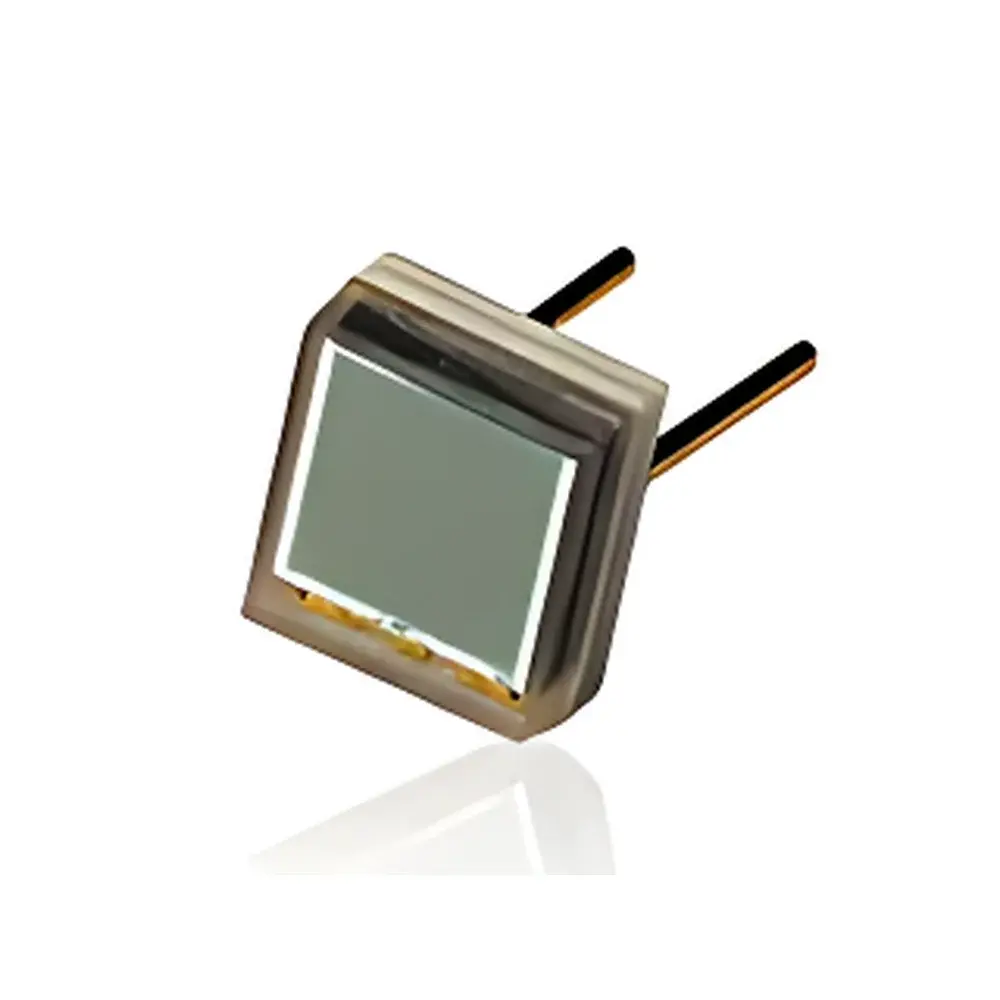
First Sensor THD Series Silicon Photomultiplier (SiPM) Modules
| Brand | First Sensor |
|---|---|
| Origin | Germany |
| Manufacturer Type | Authorized Distributor |
| Import Status | Imported |
| Model | THD Series |
| Pricing | Available Upon Request |
| Active Area | 1.2×1.2 mm² to 6.0×6.0 mm² |
| Pixel Size | 50×50 µm or 60×60 µm |
| Pixel Count | 576–10,000 |
| Trench Technology | Optional |
| Geometric Efficiency | 63–70% |
| Dark Rate | 100–500 kHz/mm² |
| Photon Detection Efficiency (PDE) | 40–50% @ peak wavelength (~420 nm) |
| Gain at 20% Overvoltage | 1×10⁶–1×10⁷ |
| Crosstalk | ≤35% |
| Total Harmonic Distortion (THD) | ≤25% |
Overview
The First Sensor THD Series Silicon Photomultiplier (SiPM) modules represent a high-performance solid-state alternative to traditional vacuum photomultiplier tubes (PMTs). Engineered for single-photon detection in low-light conditions, these devices leverage avalanche photodiode (APD) arrays operating in Geiger mode, integrated with on-chip quenching resistors and optimized microcell architecture. Unlike analog PMTs, SiPMs deliver digital photon counting capability with intrinsic immunity to magnetic fields, compact form factor, and low-voltage operation (typically 24–30 V). The THD series is fabricated using silicon-on-insulator (SOI) and deep-trench isolation processes—where applicable—to suppress optical crosstalk and enhance photon detection efficiency (PDE) across the blue-to-near-UV spectral range (350–500 nm). These modules are designed for integration into precision optical measurement systems requiring high temporal resolution, excellent linearity over dynamic ranges up to 10⁶ photons per nanosecond, and stable performance under varying thermal conditions.
Key Features
- Solid-state photon-counting architecture with single-photon sensitivity and sub-nanosecond timing resolution (FWHM < 100 ps typical)
- Multiple active area options: 1.2×1.2 mm², 3.0×3.0 mm², and 6.0×6.0 mm² — enabling scalable signal collection without compromising spatial resolution
- Uniform 50×50 µm or 60×60 µm microcell pitch ensures consistent gain and PDE across the entire photosensitive surface
- Select models incorporate deep-trench isolation technology, reducing inter-pixel optical crosstalk to ≤20% and improving pulse shape fidelity
- High geometric fill factor (up to 70%) and PDE of 40–50% at 420 nm support efficient light harvesting in fluorescence and scintillation applications
- Low dark count rate (DCR) of 100–500 kHz/mm² at room temperature (20 °C), with minimal temperature coefficient (<0.5%/°C)
- Gain tunability via bias voltage adjustment (20% overvoltage yields 1×10⁶–1×10⁷), facilitating calibration traceability and system-level gain matching
- Robust epoxy-encapsulated ceramic package compatible with reflow soldering and long-term operational stability in controlled laboratory environments
Sample Compatibility & Compliance
The THD Series SiPM modules are compatible with standard scintillation materials including LYSO, BGO, NaI(Tl), and plastic scintillators, as well as fluorescent dyes (e.g., fluorescein, rhodamine B) and quantum dots emitting in the 400–450 nm band. Their spectral response profile aligns with common UV-enhanced optical filters and dichroic beam splitters used in confocal microscopy and time-resolved spectroscopy setups. All units comply with RoHS Directive 2011/65/EU and REACH Regulation (EC) No. 1907/2006. Electrical safety follows IEC 61010-1:2012 for laboratory equipment. While not certified for medical device integration out-of-the-box, the modules meet essential requirements for inclusion in Class IIa diagnostic instruments under MDR 2017/745 when embedded within fully validated subsystems.
Software & Data Management
First Sensor provides reference firmware libraries for FPGA- and microcontroller-based readout (e.g., Xilinx Zynq, STM32H7), supporting both analog summing output and digital event streaming via LVDS or SPI interfaces. Raw waveform acquisition enables offline pulse-height analysis, time-over-threshold (ToT) discrimination, and timestamp correlation for time-of-flight (ToF) applications. When integrated with third-party DAQ platforms such as National Instruments PXIe or Keysight U1051A, the modules support automated calibration routines compliant with ISO/IEC 17025 traceability frameworks. Audit trails, user access controls, and data integrity safeguards can be implemented in alignment with FDA 21 CFR Part 11 requirements when deployed in regulated QC/QA workflows.
Applications
- Time-resolved fluorescence spectroscopy: Sub-nanosecond decay kinetics analysis in protein folding studies and molecular binding assays
- Positron emission tomography (PET) detector development: High-density SiPM arrays for DOI-capable detector modules
- Flow cytometry and cell sorting: Multiparametric detection of weak autofluorescence and tandem dye emissions
- Laser-induced breakdown spectroscopy (LIBS): Gated detection of atomic emission lines with nanosecond temporal resolution
- Quantum optics experiments: Hanbury Brown–Twiss interferometry and antibunching verification
- Industrial process monitoring: Real-time turbidity and particle concentration sensing in pharmaceutical liquid filling lines
FAQ
What is the recommended operating temperature range for stable PDE performance?
The THD modules exhibit optimal PDE stability between –10 °C and +40 °C; active thermoelectric cooling is advised for applications requiring DCR below 200 kHz/mm².
Can these SiPMs be used with standard PMT socket adapters?
No — unlike vacuum PMTs, THD modules require low-noise DC bias supplies and impedance-matched 50-Ω signal termination; mechanical mounting uses 4×M2 threaded holes per module footprint.
Is photon detection efficiency (PDE) specified at a particular wavelength and overvoltage?
Yes — all PDE values are measured at 420 nm under 20% overvoltage relative to breakdown voltage (Vbd), with ±3% uncertainty (k=2) per First Sensor calibration protocol.
Do trench-isolated variants support higher count-rate linearity?
Yes — trench technology reduces afterpulsing probability and crosstalk-induced pile-up, extending linear dynamic range by up to 2.5× compared to non-trenched equivalents.
Are evaluation kits available for rapid prototyping?
Yes — First Sensor offers the THD-EVK-01 evaluation kit, including bias supply, USB-controlled digitizer, and MATLAB/Python SDK with real-time histogramming and coincidence logic.



