
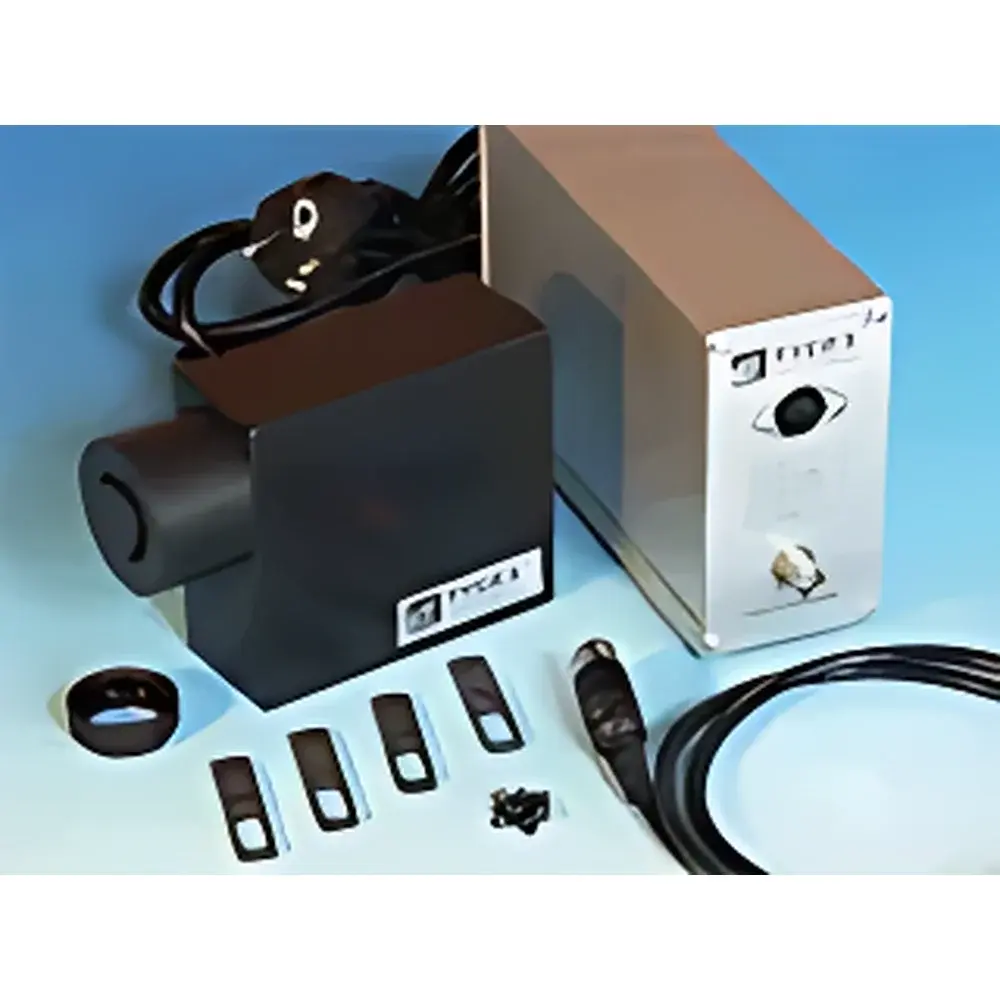
TYDEX THz Optical Components
| Brand | TYDEX |
|---|---|
| Origin | Russia |
| Product Line | Optics for Terahertz (THz) Applications |
| Component Type | THz Optical Elements |
Overview
TYDEX THz Optical Components represent a comprehensive, internationally recognized portfolio of precision-engineered optical elements designed specifically for the 0.1–10 THz spectral range. Developed and manufactured in Russia by TYDEX LLC—a pioneer in terahertz photonics—these components leverage low-absorption substrate materials including high-resistivity float-zone silicon (HRFZ-Si), crystalline quartz (CQ), polyethylene (HDPE), TPX (polymethylpentene), and KBr, each selected for optimal transmission, dispersion control, and thermal stability in THz systems. Unlike near-infrared or visible optics, THz components must address challenges such as strong water vapor absorption, material dispersion anomalies, and diffraction-limited beam propagation; TYDEX’s designs are rigorously modeled using rigorous coupled-wave analysis (RCWA) and finite-difference time-domain (FDTD) simulations to ensure phase fidelity, minimal insertion loss, and high surface quality (λ/10 @ 633 nm). These elements serve as foundational building blocks in time-domain spectroscopy (TDS), continuous-wave (CW) imaging, heterodyne detection, and free-space THz metrology setups.
Key Features
- Material-optimized performance: HRFZ-Si lenses and windows exhibit <0.1 cm⁻¹ absorption coefficient below 3 THz; TPX and HDPE offer broadband transparency with low dispersion across 0.1–4 THz.
- Substrate versatility: Components fabricated on CQ (for UV-THz compatibility), HRFZ-Si (for high-power handling and low-loss focusing), HDPE (for cost-effective large-area polarizers/filters), and KBr (for mid-IR/THz dual-band applications).
- Precision fabrication: All plano-convex, meniscus, and Fresnel lenses feature surface roughness <5 nm RMS and centering accuracy ≤15 arcsec; waveplates and phase transformers maintain retardance uniformity ±λ/30 over active aperture.
- Coating technology: Single- and double-sided anti-reflection (AR) coatings deposited via electron-beam evaporation achieve <2% reflectance per surface across target bands (e.g., 0.3–3 THz for HRFZ-Si AR at 45° incidence).
- Modular integration: Standardized mounting interfaces (e.g., SM1-threaded housings, kinematic mounts compatible with Thorlabs and Newport rails) enable rapid system prototyping and alignment repeatability.
Sample Compatibility & Compliance
TYDEX THz components are routinely deployed in research-grade and industrial THz platforms compliant with ISO/IEC 17025 calibration frameworks. Their mechanical and optical specifications align with ASTM E2980-22 (Standard Guide for Characterization of THz Optical Materials) and support GLP/GMP-aligned instrumentation validation workflows. All HRFZ-Si substrates meet SEMI F47 purity standards (resistivity >10 kΩ·cm); polymer-based elements (TPX, HDPE) are certified RoHS-compliant and non-hygroscopic. Golay cell-compatible accessories—including GC-1P, GC-1T, and GC-1D detector modules—integrate seamlessly with TYDEX’s low-pass and band-pass filters to satisfy signal-to-noise ratio (SNR) requirements defined in IEC 61000-4-3 for electromagnetic immunity testing environments.
Software & Data Management
While TYDEX optical components are passive elements, their performance parameters—including transmission spectra, phase delay maps, and polarization extinction ratios—are fully documented in machine-readable format (CSV, SDF) and integrated into common optical design suites (Zemax OpticStudio, CODE V, FRED). TYDEX provides wavelength-calibrated reference datasets traceable to NIST-traceable FTIR measurements (Bruker Vertex 80v), enabling accurate system-level modeling of beam propagation, étendue matching, and aberration compensation. For users operating under FDA 21 CFR Part 11 or EU Annex 11 requirements, TYDEX delivers full manufacturing records—including lot-specific interferometric surface maps, coating thickness profiles, and spectral verification reports—with audit-ready metadata (date/time stamps, operator ID, environmental conditions).
Applications
- Terahertz Time-Domain Spectroscopy (THz-TDS): HRFZ-Si lenses (e.g., LHS-HRFZ-SI-D25.4-T16) and AR-coated windows (W-HRFZ-SI-D50.8-T0.5) enable collimation and coupling with sub-50 fs laser pulses; spectral splitters (SS-HRFZ-SI-D25.4-T1-NIR) facilitate pump-probe path separation.
- Active Imaging & Security Screening: Large-aperture HDPE polarizers (POL-HDPE-CA100-OD136.2-T6.3) and TPX beam splitters (BS-HRFZ-SI-D76.2-T6) support real-time reflection-mode scanners compliant with ECAC Doc 30 Part 2 screening thresholds.
- Quantum Cascade Laser (QCL) Systems: Band-pass filters (BPF10.0-47/60) and THz mirrors (MR-QG-D76.2-T6.35-С) provide narrowband spectral selection and cavity feedback control for CW sources operating at 2.5–5.0 THz.
- Fundamental Metrology: Achromatic phase transformers and waveplates (e.g., APC-CQ-CA25.4-OWR60-300-L/4) enable polarization state generation and analysis in quantum-optical THz experiments requiring Stokes parameter reconstruction.
- Plasma Diagnostics & Fusion Research: High-damage-threshold CQ windows (W-CQ-D100-T9) and THz diffractive optics withstand pulsed THz emission from plasma-based sources in tokamak edge-localized mode (ELM) monitoring systems.
FAQ
What is the typical surface quality specification for TYDEX THz lenses?
All precision-ground HRFZ-Si and CQ lenses meet λ/10 surface flatness (measured at 633 nm) and <5 nm RMS roughness, verified via white-light interferometry per ISO 10110-5.
Are TYDEX THz components suitable for ultra-high-vacuum (UHV) environments?
Yes—HRFZ-Si, CQ, and KBr components are UHV-compatible (outgassing rate <1×10⁻⁹ Pa·m³/s·cm² per ASTM E595); polymer elements (TPX, HDPE) are restricted to dry nitrogen or clean-air enclosures.
How are transmission bands validated for THz band-pass filters?
Each BPF lot undergoes FTIR characterization from 0.1–10 THz using a Bruker Vertex 80v equipped with a bolometer detector and Martin-Puplett interferometer; spectral data includes ±0.5 GHz resolution and temperature-stabilized (23±0.2°C) measurement conditions.
Do TYDEX waveplates support broadband quarter-wave operation across multiple THz harmonics?
Yes—broadband achromatic waveplates (e.g., APC-CQ-CA25.4-OWR60-300-L/4) maintain <±5° retardance deviation over 0.3–3.0 THz, validated via rotating analyzer ellipsometry.
Can TYDEX components be customized for non-standard apertures or coatings?
TYDEX offers OEM engineering services including custom diameters (up to Ø200 mm), aspheric profiles, multi-layer AR stacks (e.g., dual-band 1.55 µm + 1–3 THz), and diamond-turned diffractive structures—lead time typically 8–12 weeks from drawing approval.



