
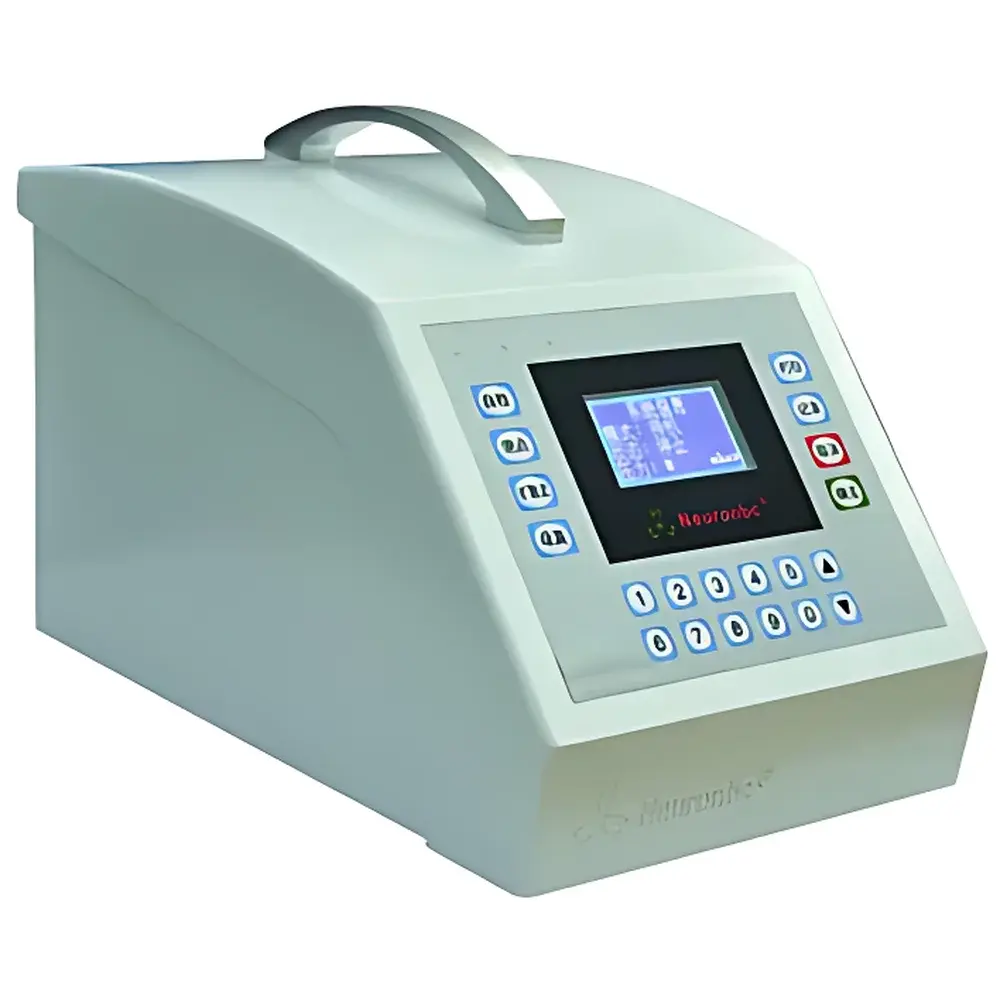
NeuronBC Integtest V1.2 Filter Integrity Tester
| Brand | NeuronBC |
|---|---|
| Origin | Beijing, China |
| Model | BP1.2 |
| Power Supply | 100–240 VAC, 50 Hz, 120 W |
| Operating Pressure Range | 100–8000 mbar (max. 115 psi) |
| Bubble Point Accuracy | ±75 mbar |
| Diffusion Flow Accuracy | ±4% |
| Bubble Point Range | 590–6900 mbar |
| Diffusion Flow Range | 1–180 mL/min |
| Environmental Operating Conditions | 5–40 °C, 10–80% RH |
| Dimensions (L×W×H) | 400 × 240 × 270 mm (main unit) + 220 mm (height with printer module) |
| Weight | 7.5 kg |
| Display | 3.2″ monochrome LCD |
| Language | Chinese only |
| Data Storage | 20 test records |
| Test Modes | Automated bubble point, semi-automated diffusion flow |
| Filter Compatibility | Single- and multi-cartridge filters (≤3 cartridges, ≤20-inch length), syringe filters, capsule filters, flat-sheet filters, and cylindrical membrane filters (symmetric & asymmetric membranes) |
| Cleanroom Suitability | ISO Class B (or equivalent) environments |
| Regulatory Alignment | Designed to support ASTM F838-22, ISO 13408-2, USP <1207>, and EU Annex 1 requirements for filter validation and integrity testing |
Overview
The NeuronBC Integtest V1.2 Filter Integrity Tester is an engineered solution for quantitative verification of sterilizing-grade membrane filter integrity in pharmaceutical, biotechnology, and medical device manufacturing environments. It operates on the principle of gas diffusion measurement and pressure decay analysis—core methods defined in USP , ISO 13408-2, and ASTM F838-22—to assess pore structure continuity and detect defects exceeding the manufacturer-specified maximum pore size. Unlike qualitative visual bubble point detection, the Integtest V1.2 delivers traceable, repeatable, and auditable results suitable for GMP-regulated workflows. Its dual-mode architecture supports both fully automated bubble point determination and semi-automated diffusion flow testing, enabling users to select the appropriate method based on filter type, wetting fluid, and process validation requirements. The system’s pressure control subsystem maintains stable upstream pressure within ±10 mbar during hold phases, ensuring compliance with the pressure stability criteria outlined in Annex 1 of the EU GMP Guidelines.
Key Features
- Integrated self-diagnostic routine that verifies pneumatic integrity, detects air source instability, and flags leaks in tubing, fittings, or filter housing prior to test initiation—reducing false failures and rework.
- Upstream volume compensation algorithm for diffusion flow testing, allowing accurate normalization of measured gas flow against actual filter membrane surface area and gas-permeable volume.
- Modular pressure manifold design accommodating single-core and multi-cartridge configurations (up to three 20-inch cartridges), with quick-connect ports compatible with standard 1/8″ NPT and M12 fittings.
- Onboard thermal printer producing time-stamped, tamper-evident hardcopy reports containing test parameters, raw pressure/time data, pass/fail status, operator ID (if entered), and system serial number.
- Rugged aluminum chassis with ESD-safe enclosure, rated for continuous operation in ISO Class B cleanrooms; fanless thermal management ensures particulate-free operation near aseptic processing zones.
Sample Compatibility & Compliance
The Integtest V1.2 is validated for use with hydrophilic and hydrophobic membranes—including PVDF, PTFE, nylon, and mixed cellulose ester—across syringe filters (4–25 mm diameter), capsule filters (≤10 inches), flat-sheet filters (up to 47 mm), and cylindrical cartridge filters (polypropylene or stainless-steel housings, ≤20 inches, ≤3 cores). It supports both aqueous (e.g., water, buffer) and organic (e.g., IPA, ethanol) wetting fluids, provided vapor pressure and surface tension are within instrument calibration limits. All test protocols align with regulatory expectations for filter qualification per FDA Guidance for Industry (2022), EMA CPMP/Q5A(R2), and ICH Q5B, supporting audit readiness under 21 CFR Part 11 when paired with documented procedural controls and electronic signature protocols.
Software & Data Management
While the Integtest V1.2 operates via embedded firmware without PC connectivity, its internal memory retains up to 20 complete test records—including timestamp, pressure profile snapshots, calculated diffusion rate, bubble point value, and pass/fail logic—each retrievable via the front-panel interface. All stored data are write-once, non-erasable entries with immutable timestamps generated by an onboard real-time clock (RTC) backed by a long-life lithium battery. The system logs all critical events (e.g., power cycles, pressure faults, self-test outcomes) in a separate diagnostic log accessible to service personnel. For full 21 CFR Part 11 compliance, laboratories must implement complementary procedural controls—including operator training records, change control documentation for firmware updates, and periodic verification of RTC accuracy against UTC reference sources.
Applications
- Pre-use post-sterilization integrity testing of vent and process filters in bioreactor and filling line applications.
- Post-use integrity verification of sterilizing filters following filtration campaigns, especially where extractables or particulate challenges may affect membrane integrity.
- Filter qualification support during process validation, including correlation studies between bubble point and microbial retention performance per ASTM F838.
- QC release testing of pre-sterilized filter assemblies supplied by vendors under contractual quality agreements.
- Troubleshooting filter wetting issues via comparative diffusion flow analysis across multiple batches or wetting procedures.
FAQ
Does the Integtest V1.2 support automated data export to LIMS or ELN systems?
No. The device lacks USB, Ethernet, or RS-232 interfaces; data transfer requires manual transcription from printed reports or on-screen review.
Can it perform water intrusion tests (WIT) on hydrophobic filters?
No. The Integtest V1.2 is configured exclusively for gas-based integrity methods (bubble point and diffusion flow); it does not support liquid-pressure-driven WIT protocols.
Is firmware upgrade capability available?
Yes—firmware updates are performed via proprietary service mode using a dedicated programming jig and require authorized NeuronBC field service personnel.
What calibration standards are required for routine verification?
Users must perform daily system suitability checks using a certified reference pressure transducer (±0.25% FS accuracy) and verify diffusion flow output with a NIST-traceable soap film flowmeter before first use each shift.
Does the instrument meet ISO 17025 requirements for accredited testing labs?
The hardware and firmware are designed to support ISO/IEC 17025:2017 Clause 6.4 (equipment) and 6.5 (traceability), but formal accreditation requires lab-specific uncertainty budgets, inter-laboratory comparisons, and documented metrological validation per ILAC-G8:2022.
Related Products






