
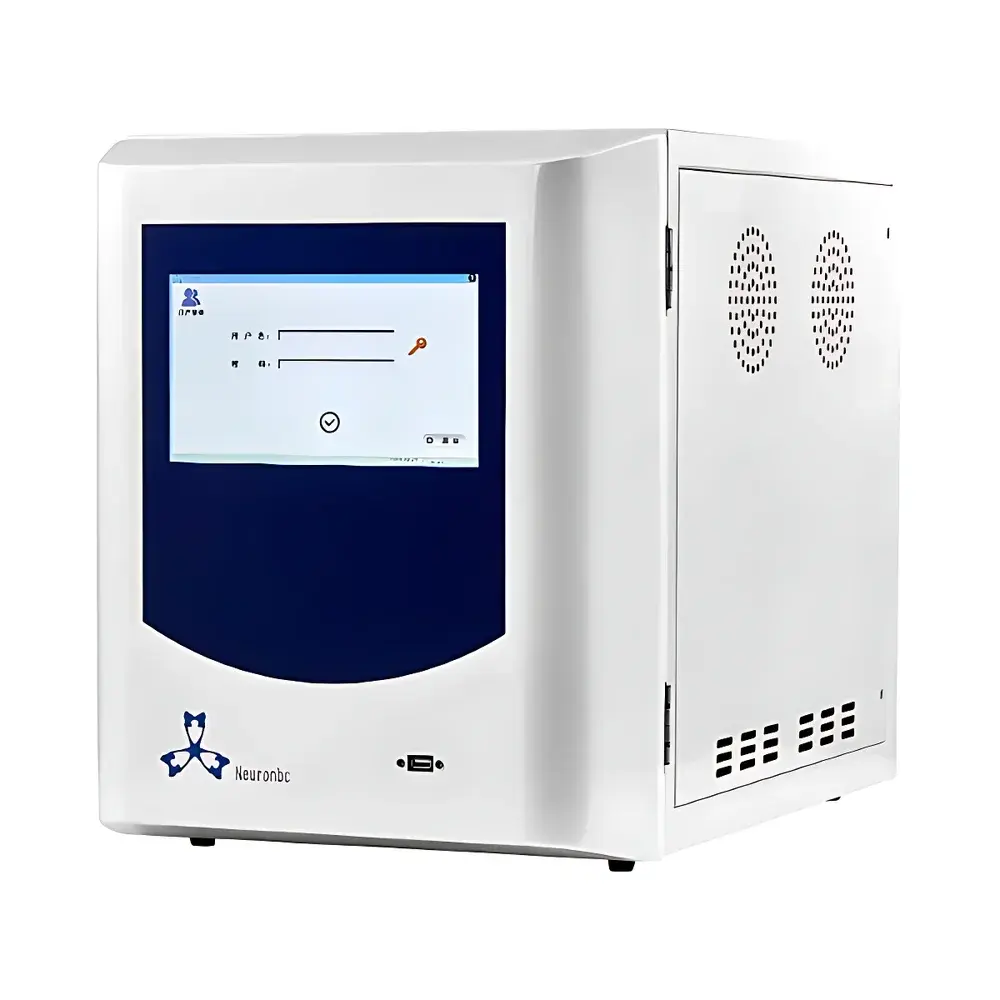
NeuronBC TA-200 High-Range Total Organic Carbon Analyzer
| Brand | NeuronBC |
|---|---|
| Origin | Beijing, China |
| Model | TA-200 |
| Price | USD 25,000 (FOB) |
| Measurement Range | 0.1–30,000 mg/L TOC |
| Detection Principle | Catalytic Combustion Oxidation + Non-Dispersive Infrared (NDIR) Detection |
| Sample Throughput | ≤60 samples/hour |
| Oxidation Temperature | 680–900 °C (adjustable) |
| NDIR Detector Resolution | 24-bit |
| Control System Architecture | 32-bit embedded signal processing |
| Gas Flow Monitoring | Integrated mass flow sensor with auto-leak detection |
| Sample Introduction | Programmable syringe pump with 0.1–5 mL injection volume |
| Compliance | Designed to meet ISO 8466-2, EPA Method 415.3, and ASTM D7573 requirements |
Overview
The NeuronBC TA-200 High-Range Total Organic Carbon Analyzer is an engineered solution for precise, reliable quantification of total organic carbon in complex aqueous matrices. It employs high-temperature catalytic combustion oxidation (680–900 °C) followed by non-dispersive infrared (NDIR) detection—a methodology validated under EPA Method 415.3 and aligned with ISO 8466-2 for calibration linearity and ASTM D7573 for performance verification in industrial and environmental applications. Unlike low-range TOC analyzers optimized for ultrapure water, the TA-200 is specifically configured for high-concentration samples—such as municipal wastewater effluents, pharmaceutical process streams, industrial cooling water, and contaminated groundwater—where organic load exceeds 1,000 mg/L. Its robust thermal architecture ensures complete oxidation of refractory compounds (e.g., humic substances, surfactants, and polymeric residuals), minimizing residual carbon carryover and enabling repeatable analysis across heterogeneous sample types.
Key Features
- Modular hardware architecture enables field-replaceable modules—including combustion furnace, NDIR detector, TIC reaction chamber, and refrigerated moisture trap—reducing mean time to repair (MTTR) and supporting long-term serviceability.
- Integrated 24-bit NDIR detection system provides extended dynamic range (0.1–30,000 mg/L TOC) with <±2% RSD repeatability at 100 mg/L and <±5% RSD at 10,000 mg/L (n=6, certified reference standards).
- Intelligent thermal management: independently controlled heating and Peltier-based cooling within the TIC reaction chamber enables simultaneous dehydration, condensate level monitoring, and CO₂ gas stream conditioning—optimizing signal-to-noise ratio and minimizing baseline drift.
- Real-time flow integrity assurance via embedded mass flow sensors and automated leak-check routines executed prior to each analysis cycle; deviations >±3% trigger audible/visual alerts and abort sequence initiation.
- Adaptive sample introduction: programmable syringe pump supports variable injection volumes (0.1–5.0 mL) with pressure-compensated aspiration, ensuring consistent delivery regardless of viscosity or suspended solids content.
- 32-bit embedded control firmware with closed-loop feedback for furnace temperature, carrier gas flow, and detector stabilization—enabling stable operation under ambient fluctuations (15–35 °C, 30–80% RH).
Sample Compatibility & Compliance
The TA-200 accepts liquid samples with turbidity ≤500 NTU and total suspended solids (TSS) ≤100 mg/L without pre-filtration. Acidified samples (pH <2) are introduced directly; unacidified samples undergo automatic acidification and sparging for inorganic carbon (TIC) removal. It complies with regulatory data integrity expectations through audit-trail-enabled software (21 CFR Part 11-ready configuration available), full electronic record retention, and user-access-controlled method locking. Instrument qualification documentation supports IQ/OQ protocols per GMP Annex 15 and GLP principles. Routine verification follows USP and EP 2.2.44 guidelines for TOC system suitability.
Software & Data Management
NeuronBC TOC-Link™ v4.2 provides browser-based instrument control, real-time parameter visualization (oxidation temp, CO₂ peak area, flow rate, dew point), and automated calibration curve generation (linear, quadratic, or segmented). All raw detector signals, method parameters, and maintenance logs are timestamped and stored in encrypted SQLite databases. Export formats include CSV, PDF analytical reports, and XML-compliant audit trails. Remote diagnostics support is enabled via TLS 1.2-secured HTTP(S) interface, permitting secure off-site troubleshooting without exposing internal network infrastructure.
Applications
- Environmental monitoring: compliance testing of wastewater discharge permits (e.g., NPDES), landfill leachate characterization, and surface water trophic state assessment.
- Pharmaceutical manufacturing: bioburden risk assessment of purified water (PW) and water-for-injection (WFI) systems per EU GMP Annex 1 and FDA guidance.
- Power generation: boiler feedwater and condensate TOC trending to detect early-stage degradation of ion exchange resins or membrane fouling.
- Chemical process industries: real-time tracking of organic solvent carryover in rinse waters, catalyst deactivation indicators, and batch release testing.
- Academic research: carbon mass balance studies in anaerobic digestion, biofilm formation kinetics, and advanced oxidation process (AOP) efficiency evaluation.
FAQ
What is the minimum detectable TOC concentration for the TA-200?
The method detection limit (MDL) is 0.1 mg/L TOC under standard operating conditions (1 mL injection, 800 °C oxidation, 3× background noise threshold).
Can the TA-200 measure TOC in seawater or high-salinity brines?
Yes—salinity up to 35 g/L NaCl is supported via optional quartz combustion tube and enhanced corrosion-resistant gas path components.
Is the instrument compatible with LIMS integration?
It supports ASTM E1482-compliant HL7 and ASTM E2500-07 structured data export for seamless LIMS ingestion.
How often does the NDIR detector require recalibration?
Factory-calibrated NDIR cells maintain stability for ≥12 months; annual verification using certified CO₂ span gases (0–5,000 ppm) is recommended.
Does the system support unattended overnight operation?
Yes—automated shutdown, standby mode, and scheduled power-on functions are configurable via TOC-Link™ scheduler module.




