
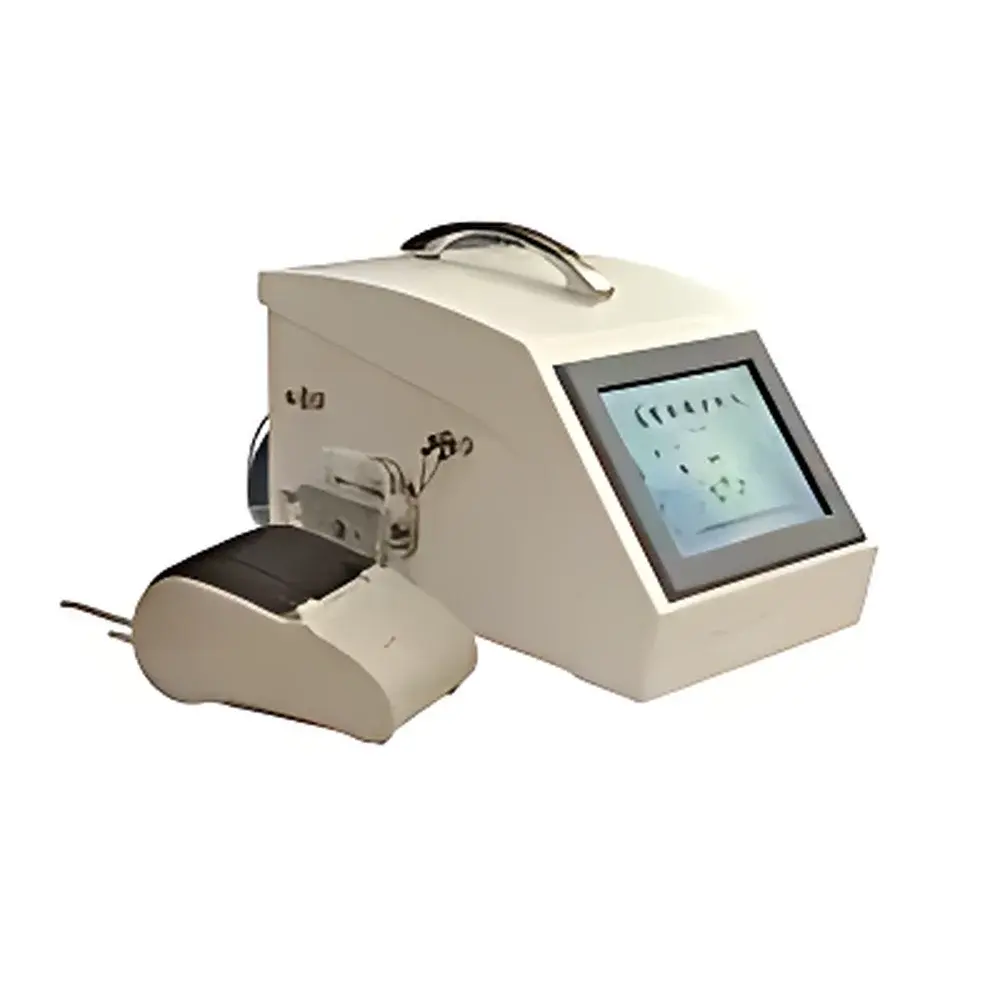
NeuronBC TA-1.0 Offline Total Organic Carbon (TOC) Analyzer
| Brand | NeuronBC |
|---|---|
| Origin | Beijing, China |
| Model | TA-1.0 |
| Instrument Type | Laboratory TOC Analyzer |
| Detection Principle | Direct Conductivity Method |
| Oxidation Method | UV Photocatalytic Oxidation (with TiO₂-coated quartz tube) |
| Measurement Range | 0.001–1.0 mg/L (1–1000 ppb) |
| Accuracy | ±3% |
| Resolution | 0.001 mg/L |
| Detection Limit | 0.001 mg/L |
| Repeatability | ±3% |
| Power Supply | 100–240 VAC, 50 Hz, 120 W |
| Sample Temperature Range | 1–99 °C |
| Data Storage | >5000 records |
| Audit Trail | 16-event log with timestamped traceability |
| User Access Control | 4-tier role-based authentication compliant with FDA 21 CFR Part 11 |
| Display | Color touchscreen interface |
| Dimensions (L×W×H) | 400 × 240 × 270 mm |
| Weight | 8.5 kg |
Overview
The NeuronBC TA-1.0 Offline Total Organic Carbon (TOC) Analyzer is a laboratory-grade instrument engineered for precise, regulatory-compliant quantification of total organic carbon in ultrapure water matrices. It operates on the principle of UV photocatalytic oxidation followed by direct conductivity detection—a method recognized in pharmacopeial standards including USP , EP 2.2.44, and ChP 2020 Edition for pharmaceutical water testing. In this process, organic compounds are mineralized to CO₂ under 185/254 nm UV irradiation in the presence of a TiO₂-coated rotating quartz reaction tube, ensuring high-efficiency oxidation of recalcitrant organics without chemical reagents. The resulting CO₂ dissolves in deionized water to form carbonic acid, inducing a measurable change in solution conductivity. This conductometric signal is linearly correlated to TOC concentration and calibrated against certified KHP standards. Designed exclusively for offline (batch) analysis, the TA-1.0 eliminates dependence on carrier gases, acid reagents, or persulfate oxidants—reducing operational complexity, consumables cost, and potential contamination risks inherent in online or combustion-based systems.
Key Features
- UV photocatalytic oxidation using dual-wavelength (185 nm + 254 nm) low-pressure mercury lamp integrated with a TiO₂-coated rotating quartz reactor—enhancing quantum yield and oxidation completeness for low-molecular-weight organics.
- Direct conductivity detection architecture with temperature-compensated high-stability electrode sensor, delivering resolution of 0.001 mg/L and measurement repeatability ≤ ±3% RSD across the full 1–1000 ppb range.
- Integrated peristaltic pumping system with inert fluid path (PTFE/PFA tubing), supporting programmable sample aspiration, rinse cycles, and delay coil residence time optimization for complete CO₂ equilibration.
- Full FDA 21 CFR Part 11 compliance: 4-level hierarchical user authentication, electronic signatures, immutable audit trail logging (16 distinct event types with timestamps and operator IDs), and secure data export via USB storage.
- Intuitive 7-inch color capacitive touchscreen HMI with embedded calibration wizards, system suitability test (SST) automation, and real-time graphical display of conductivity transients during oxidation.
- Onboard data management: storage capacity for ≥5000 test records with searchable metadata (sample ID, date/time, operator, result, status flag), configurable pass/fail limit alerts, and IQ/OQ/PQ documentation support packages.
Sample Compatibility & Compliance
The TA-1.0 is validated for use with pharmacopeial water types including Purified Water (PW), Water for Injection (WFI), and Ultra-Pure Water (UPW) per ISO 3696 Grade 1 and ASTM D1193 Type I specifications. Its low detection limit (0.001 mg/L) and narrow dynamic range make it especially suited for routine QC release testing and cleaning validation swab/rinse sample analysis in regulated biopharmaceutical manufacturing environments. All hardware and firmware design elements—including material compatibility (316L stainless steel fittings, PFA fluidic paths), electromagnetic immunity (IEC 61326-1), and electrical safety (IEC 61010-1)—conform to international laboratory equipment standards. The system supports GLP/GMP-aligned workflows through configurable electronic batch records, deviation tracking, and retrospective audit capability.
Software & Data Management
Firmware v3.2 embeds a deterministic real-time operating system enabling deterministic response timing (<5 min analysis cycle), automatic baseline drift correction, and adaptive gain adjustment for conductivity signal stability. Data integrity is enforced via SHA-256 hashing of all stored records and write-once-read-many (WORM) logic for audit logs. Export formats include CSV (for LIMS integration), PDF reports with digital signature fields, and encrypted binary archives compatible with enterprise document management systems. Optional PC-based NeuronLink™ software provides advanced statistical process control (SPC) charting, trend analysis across multiple instruments, and automated generation of validation protocols aligned with Annex 11 and ALCOA+ principles.
Applications
- Pharmaceutical water quality assurance: routine TOC testing of PW and WFI per USP and EU GMP Annex 1 requirements.
- Cleaning validation: quantitative assessment of residual organics on manufacturing equipment surfaces using rinse water or swab extract analysis.
- Electronics industry UPW monitoring: verification of organic contamination levels prior to wafer fabrication processes.
- Environmental laboratories: low-concentration TOC screening of groundwater, effluent, and reclaimed water where combustion-based methods exhibit excessive background interference.
- Method transfer support: compatibility with compendial TOC test procedures enables seamless alignment with existing SOPs and regulatory submissions.
FAQ
Does the TA-1.0 require external gas supplies or chemical oxidants?
No. It relies solely on UV photocatalysis with no need for oxygen, nitrogen, phosphoric acid, or sodium persulfate.
Is the instrument suitable for GMP-regulated environments?
Yes. It includes full 21 CFR Part 11 functionality, IQ/OQ/PQ documentation templates, and audit-ready electronic records.
What is the minimum sample volume required per analysis?
50 mL is recommended to ensure representative oxidation and stable conductivity measurement; autosampler compatibility supports unattended 48-sample runs.
Can the TA-1.0 be integrated into a LIMS environment?
Yes—via standard RS-232/USB CDC virtual COM port with ASCII-based command protocol and CSV export for direct ingestion.
How is system suitability verified?
Automated SST executes sucrose and 1,4-benzoquinone challenges per USP , calculating % recovery, % RSD, and oxidation efficiency in accordance with compendial acceptance criteria.
Related Products







