
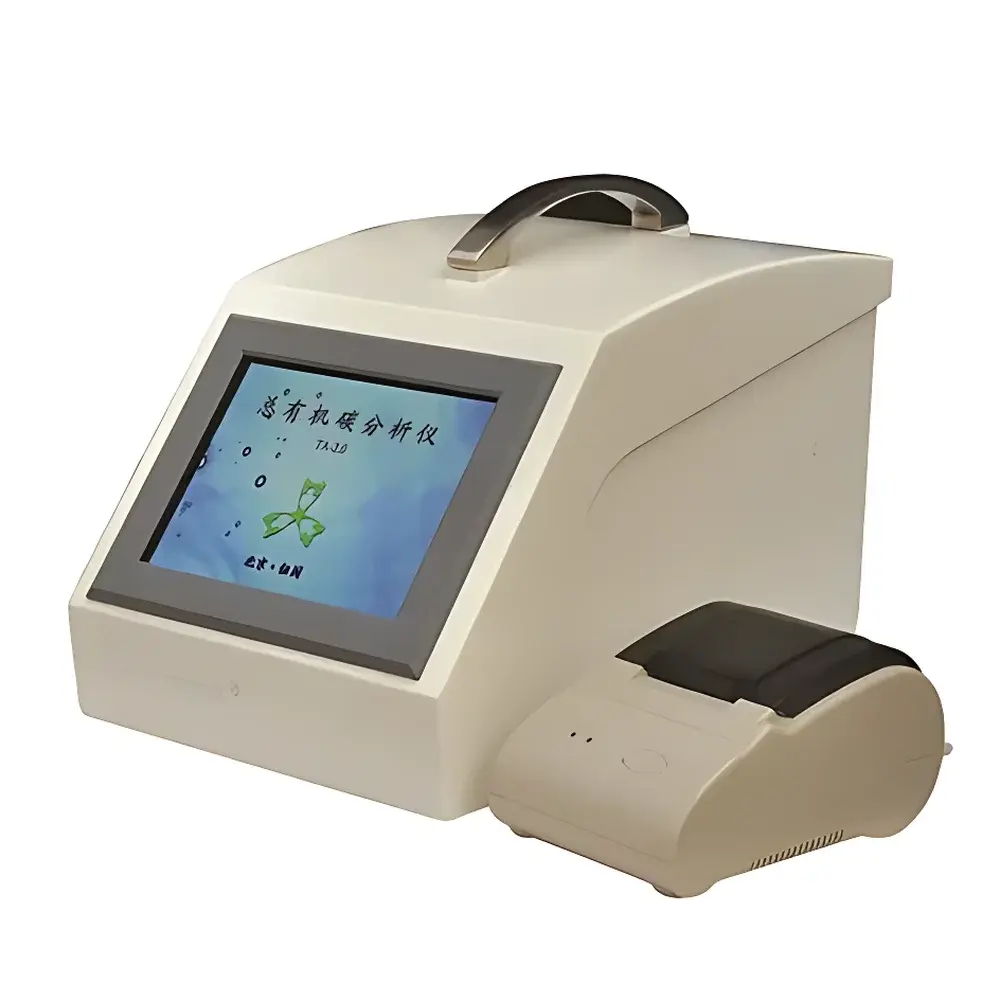
NeuronBC TOC-1.0 Offline Total Organic Carbon Analyzer
| Brand | NeuronBC |
|---|---|
| Origin | Beijing, China |
| Model | TOC-1.0 |
| Instrument Type | Laboratory Offline TOC Analyzer |
| Detection Principle | Direct Conductivity Method |
| Oxidation Method | UV Photocatalytic Oxidation (TiO₂-coated Rotating Quartz Tube + 185/254 nm UV Lamps) |
| Measurement Range | 1–1000 ppb (0.001–1.0 mg/L) |
| Accuracy | ±3% of reading |
| Detection Limit | 0.001 mg/L |
| Resolution | 0.001 mg/L |
| Repeatability | ±3% RSD |
| Sample Temperature Range | 1–99 °C |
| Power Supply | 100–240 VAC, 50 Hz, 120 W |
| Dimensions (L×W×H) | 400 × 240 × 270 mm |
| Weight | 8.5 kg |
| Data Storage | ≥5000 test records with time-stamped audit trail |
| Compliance | Meets Chinese Pharmacopoeia (ChP) 2020 Edition, USP <643>, EP 2.2.44, and FDA 21 CFR Part 11 requirements for electronic records and signatures |
Overview
The NeuronBC TOC-1.0 Offline Total Organic Carbon Analyzer is a dedicated laboratory-grade instrument engineered for precise, regulatory-compliant quantification of total organic carbon in high-purity water systems. It operates on the principle of ultraviolet photocatalytic oxidation followed by direct conductivity detection — a robust, reagent-free methodology widely adopted in pharmaceutical, biotechnology, and semiconductor industries for monitoring water quality in purified water (PW), water for injection (WFI), and ultrapure water (UPW) distribution loops. The system employs a TiO₂-coated rotating quartz reaction tube illuminated by dual-wavelength UV lamps (185 nm for hydroxyl radical generation and 254 nm for direct photolysis), ensuring complete oxidation of non-volatile and semi-volatile organic compounds to CO₂. The resulting CO₂ dissolves in the carrier water stream, inducing a measurable change in solution conductivity proportional to TOC concentration. This approach eliminates dependence on carrier gases (e.g., zero-air or nitrogen), acid reagents, or chemical oxidants — significantly reducing operational complexity, consumable costs, and maintenance overhead.
Key Features
- Reagent-free UV photocatalytic oxidation using a TiO₂-coated rotating quartz reactor for enhanced surface renewal and oxidation efficiency
- High-sensitivity direct conductivity detection with temperature-compensated electrode and low-noise signal processing
- Integrated peristaltic pump and delay coil for stable flow control and optimized CO₂ dissolution kinetics
- Color touchscreen HMI (4.3″) with intuitive navigation, real-time trend display, and on-device method configuration
- Full 21 CFR Part 11 compliance: role-based 4-tier user authentication, electronic signature support, and immutable 16-event audit trail with timestamped operator ID and action log
- Automated system suitability testing (SST) with built-in sucrose and 1,4-benzoquinone standards; pass/fail criteria configurable per USP or ChP
- Limit alarm function with visual/audio alerts and automatic flagging of out-of-spec results in data export
- Onboard data storage for ≥5000 analyses with full metadata (sample ID, operator, date/time, method, raw conductivity values)
Sample Compatibility & Compliance
The TOC-1.0 is validated for offline analysis of low-conductivity aqueous matrices including purified water, water for injection, and ultrapure water (resistivity ≥18.2 MΩ·cm). It meets the performance criteria specified in Chinese Pharmacopoeia (ChP) 2020 Edition Section IV General Chapters , United States Pharmacopeia (USP) , European Pharmacopoeia (EP) 2.2.44, and ISO 8573-7 for compressed gas purity assessment (when adapted for condensate analysis). All calibration, verification, and routine operation procedures are fully documented to support IQ/OQ/PQ execution in GMP environments. The instrument’s design supports cleaning validation workflows per FDA Guidance for Industry: Process Validation (2011) and EU Annex 15, with traceable sample handling, blank subtraction protocols, and recovery testing capability.
Software & Data Management
Data integrity is maintained through embedded firmware that enforces ALCOA+ principles (Attributable, Legible, Contemporaneous, Original, Accurate, Complete, Consistent, Enduring, Available). Raw conductivity signals, calculated TOC values, SST results, and operator actions are stored with cryptographic hashing to prevent tampering. Historical records are exportable via USB flash drive in CSV format — retaining all timestamps, user IDs, and audit trail references. Optional PC-based software provides advanced reporting (PDF/Excel), multi-instrument fleet monitoring, and integration with LIMS via ASTM E1384-compliant interface. Electronic signatures comply with 21 CFR Part 11 Subpart B requirements, including identity verification, signature association with record, and secure signature storage.
Applications
- Pharmaceutical water system qualification and routine monitoring (PW, WFI, UPW)
- Cleaning validation of process equipment and piping systems
- Environmental monitoring of cleanroom rinse waters and HVAC condensate
- Quality control of excipients and active pharmaceutical ingredients dissolved in purified water
- Supporting regulatory submissions requiring TOC data traceability under ICH Q5C, Q7, and Q9 frameworks
- Research and development of water purification technologies (e.g., EDI, UV, membrane filtration)
FAQ
Does the TOC-1.0 require external gas supply or chemical reagents for operation?
No. It uses only UV light and catalytic TiO₂ for oxidation, eliminating the need for oxygen, nitrogen, phosphoric acid, or persulfate solutions.
Can the instrument be validated per GMP requirements?
Yes. Full IQ/OQ/PQ documentation packages, including protocol templates, acceptance criteria, and raw data worksheets, are available upon request.
What is the minimum sample volume required per analysis?
25 mL is recommended for optimal precision and carryover control; the system accommodates standard 40-mL vials.
Is remote monitoring or LIMS integration supported?
Yes. RS-232 and USB interfaces enable bidirectional communication; optional Ethernet module supports Modbus TCP and ASTM E1384 data exchange.
How is system suitability verified?
Automated SST runs sucrose (TOC = 500 ppb) and 1,4-benzoquinone (TOC = 500 ppb) standards sequentially; recovery limits are user-definable per pharmacopeial guidelines.
Related Products







