
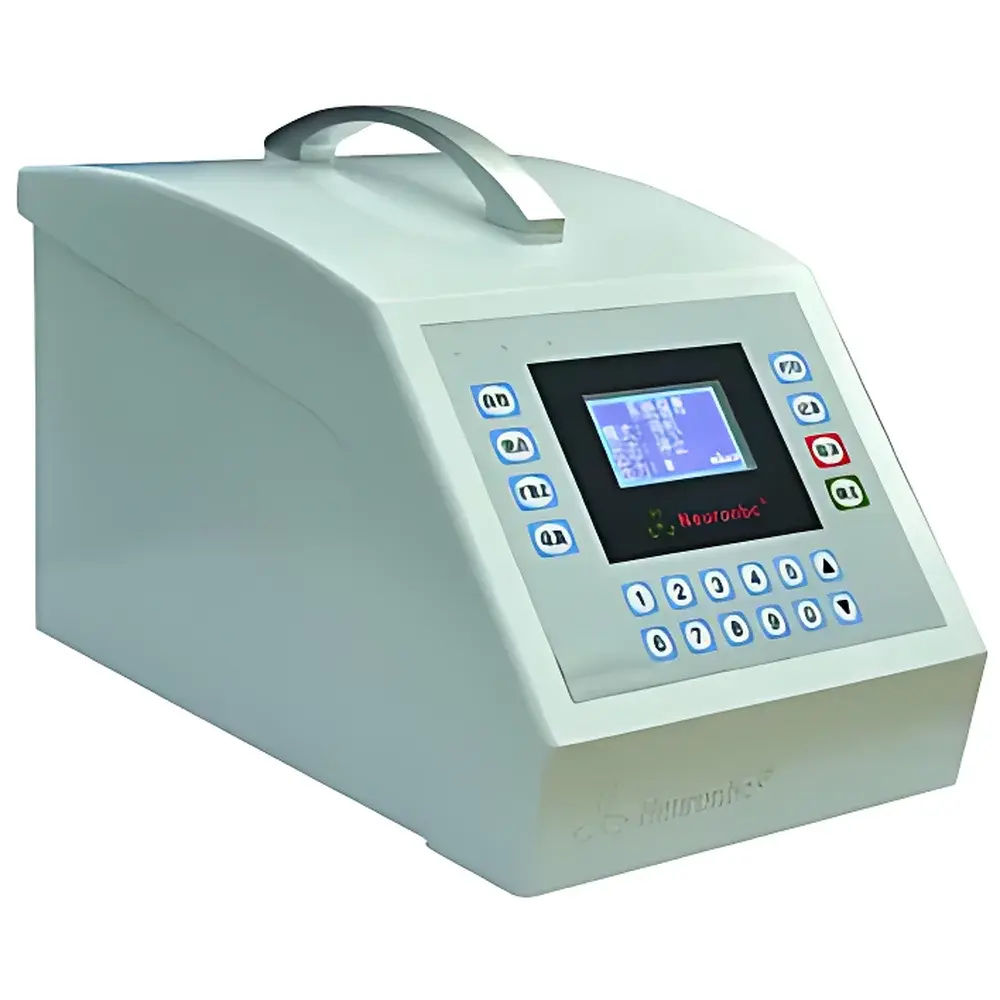
Nucleon Integtest V1.2 Filter Integrity Tester
| Origin | Beijing, China |
|---|---|
| Manufacturer Type | Authorized Distributor |
| Origin Category | Domestic (PRC) |
| Model | V1.2 |
| Power Supply | 100–240 VAC, 50 Hz, 120 W |
| Operating Pressure Range | 100–8000 mbar (max. 115 psi) |
| Bubble Point Accuracy | ±75 mbar |
| Diffusion Flow Accuracy | ±4% |
| Bubble Point Range | 590–6900 mbar |
| Diffusion Flow Range | 1–180 mL/min |
| Environmental Operating Conditions | 5–40 °C, 10–80% RH |
| Dimensions (L×W×H) | 400 × 240 × 270 mm (base) + 220 mm (height with display module) |
| Weight | 7.5 kg |
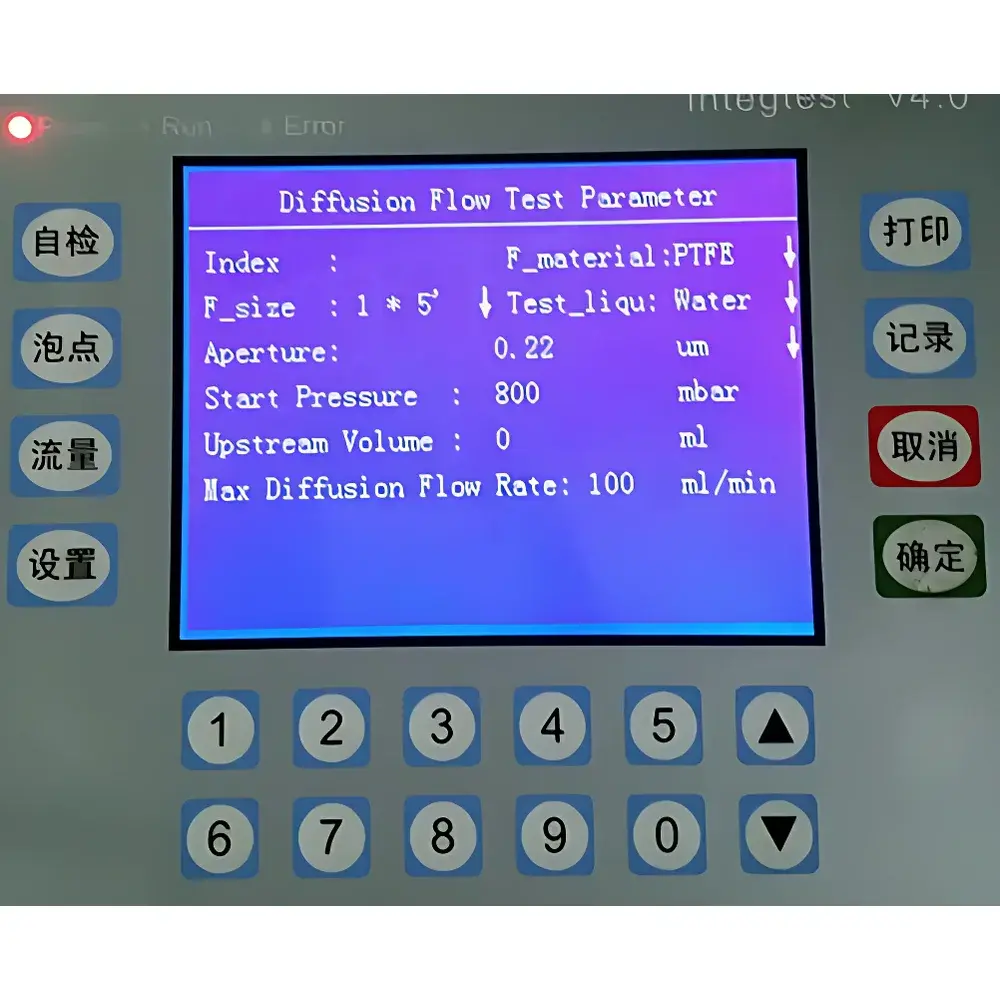
| Display | 3.2″ monochrome LCD |
| Data Storage | 20 test records |
| Language | Chinese only |
| Test Modes | Bubble Point (fully automated), Diffusion Flow (semi-automated), Hold Pressure (pressure decay) |
| Sample Compatibility | Symmetric & asymmetric membranes |
| Cleanroom Suitability | ISO Class B and above |
| Compliance | Designed to support execution of ASTM F838-22, USP <1207>, EP 2.6.27, and ISO 13408-2 integrity test protocols |
Overview
The Nucleon Integtest V1.2 Filter Integrity Tester is an engineered solution for deterministic, regulatory-compliant integrity assessment of sterilizing-grade membrane filters used in pharmaceutical, biotechnology, and medical device manufacturing. It operates on the fundamental principles of gas diffusion and capillary flow phenomena—specifically applying the bubble point test (based on Laplace’s law), pressure hold (decay) test, and diffusion flow test—to quantify pore size distribution and detect defects exceeding the maximum allowable pore diameter (e.g., 0.22 µm or 0.45 µm). The instrument is purpose-built for validation and routine release testing of final filtration steps under Good Manufacturing Practice (GMP) environments, aligning with critical requirements outlined in USP , European Pharmacopoeia Chapter 2.6.27, and ISO 13408-2. Its architecture supports both offline benchtop use and limited online integration via manual connection to filter housings, enabling pre-use/post-sterilization (PUPSIT) and post-use integrity verification.
Key Features
- Regulatory-aligned test execution: Fully automated bubble point determination with real-time pressure ramping and endpoint detection per USP criteria;
- Semi-automated diffusion flow mode with user-defined upstream volume input—enabling correction for system compressibility and accurate volumetric flow calculation;
- Integrated system self-diagnostic suite: Continuous monitoring of air supply stability, internal manifold seal integrity, and pressure transducer calibration drift—alerts generated for out-of-spec conditions prior to test initiation;
- Dual-height modular chassis design accommodates ergonomic operation in laminar flow hoods or isolators (ISO Class B); compact footprint minimizes cleanroom floor space utilization;
- Onboard thermal printer provides immediate hard-copy documentation with timestamp, operator ID (manual entry), test type, measured values, pass/fail status, and system diagnostic flags;
- Robust mechanical construction with stainless-steel pressure manifolds and chemically resistant elastomeric seals ensures long-term repeatability and compatibility with common sanitants (e.g., steam, VHP, IPA).
Sample Compatibility & Compliance
The Integtest V1.2 supports a broad spectrum of filter configurations without requiring hardware modification: single-element cartridges, multi-cartridge arrays (up to three 20-inch units), syringe filters (13–25 mm), capsule filters (10–100 cm²), flat-sheet membranes (e.g., for tangential flow filtration validation), and disk-style sterilizing filters. It is validated for symmetric (e.g., PVDF, PTFE) and asymmetric (e.g., polyethersulfone, cellulose ester) membrane structures. All test algorithms adhere to the physical models defined in ASTM F838-22 for bacterial retention correlation. While the device itself does not carry CE or FDA 510(k) certification, its operational methodology satisfies the technical expectations of FDA, EMA, and PMDA auditors during GMP inspections when deployed within a validated test method and documented quality system (e.g., compliant with ICH Q5A, Q5B, and Annex 1).
Software & Data Management
The embedded firmware implements audit-trail-capable data handling in accordance with ALCOA+ principles: each test record includes immutable metadata—date/time stamp, operator identifier (manually entered), filter identification, test parameters (target pressure, hold time, upstream volume), raw sensor outputs, calculated results, and pass/fail logic evaluation. Twenty test histories are retained locally with overwrite protection enabled upon full memory. No external PC interface or proprietary software is provided; however, printed reports meet minimum documentation requirements for GLP/GMP traceability. For facilities requiring electronic data archiving, manual transcription into LIMS or ELN systems is supported via standardized report formatting. The absence of network connectivity mitigates cybersecurity risks and simplifies 21 CFR Part 11 compliance when paired with procedural controls (e.g., dual-operator verification, logbook cross-referencing).
Applications
- Pre-sterilization integrity verification of vent filters in bioreactor and storage tank systems;
- Post-autoclave integrity confirmation of sterilizing filters prior to aseptic processing;
- Final filter release testing for bulk drug substance and sterile product manufacturing;
- Validation of filter compatibility with process fluids (e.g., protein solutions, buffers, solvents) via wetting agent selection and diffusion baseline establishment;
- Root cause analysis during filter failure investigations—correlating diffusion anomalies with membrane fouling or physical damage;
- Supporting annual requalification of filter systems as part of facility maintenance programs.
FAQ
Does the Integtest V1.2 support automated data export to LIMS or CSV files?
No. Data export is limited to thermal printouts. Electronic transfer requires manual entry or optical character recognition (OCR) of printed reports.
Can it perform water intrusion tests (WIT) for hydrophobic filters?
No. The V1.2 is configured exclusively for gas-based integrity methods (bubble point, diffusion flow, pressure hold) and does not support liquid intrusion or WIT protocols.
Is calibration traceable to national standards?
Yes—pressure transducers are factory-calibrated against NIST-traceable references; users must perform periodic verification using certified deadweight testers per internal SOPs.
What maintenance intervals are recommended?
Annual verification of pressure sensors and leak-checking of all pneumatic fittings is advised; O-rings should be replaced every 12 months or after 500 test cycles, whichever occurs first.
Does it comply with Annex 1 (2022) requirements for filter integrity testing?
Yes—the instrument enables execution of Annex 1-aligned test strategies, including PUPSIT implementation and risk-based test parameter justification, when integrated into a fully validated process and quality management system.







