
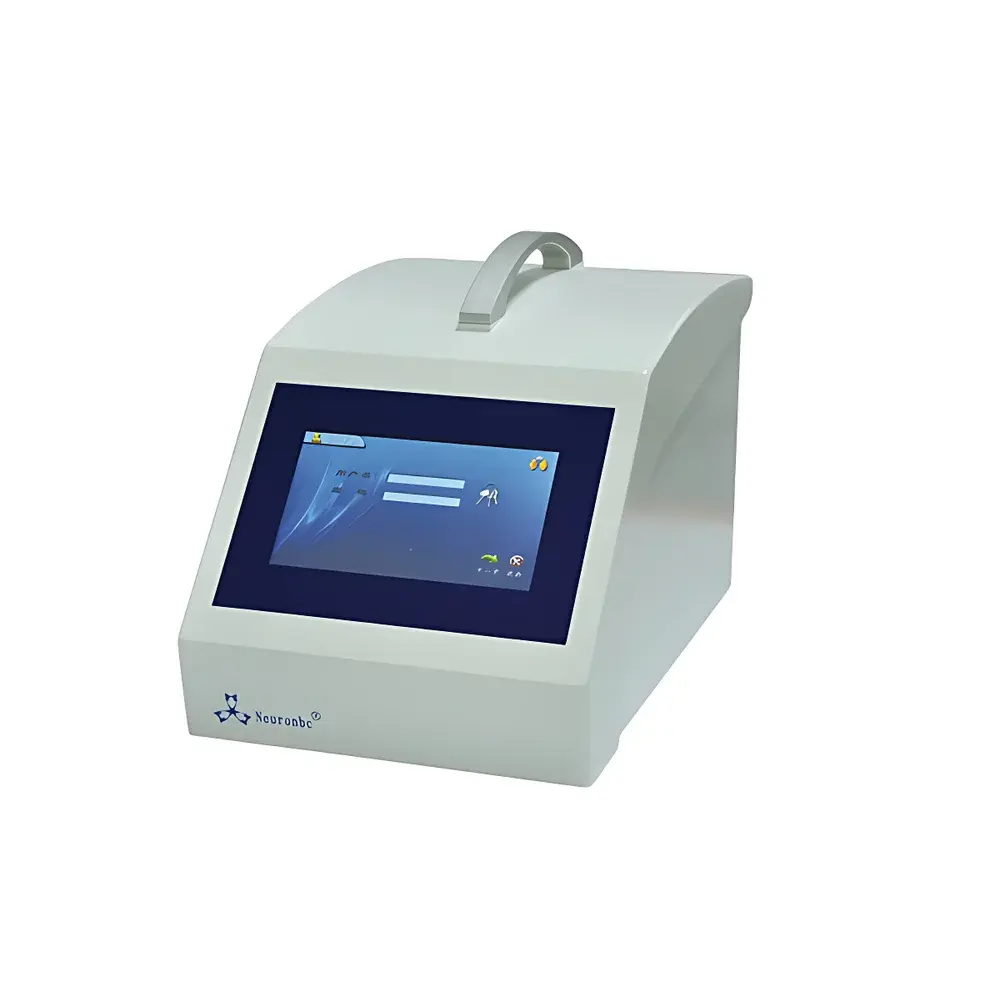
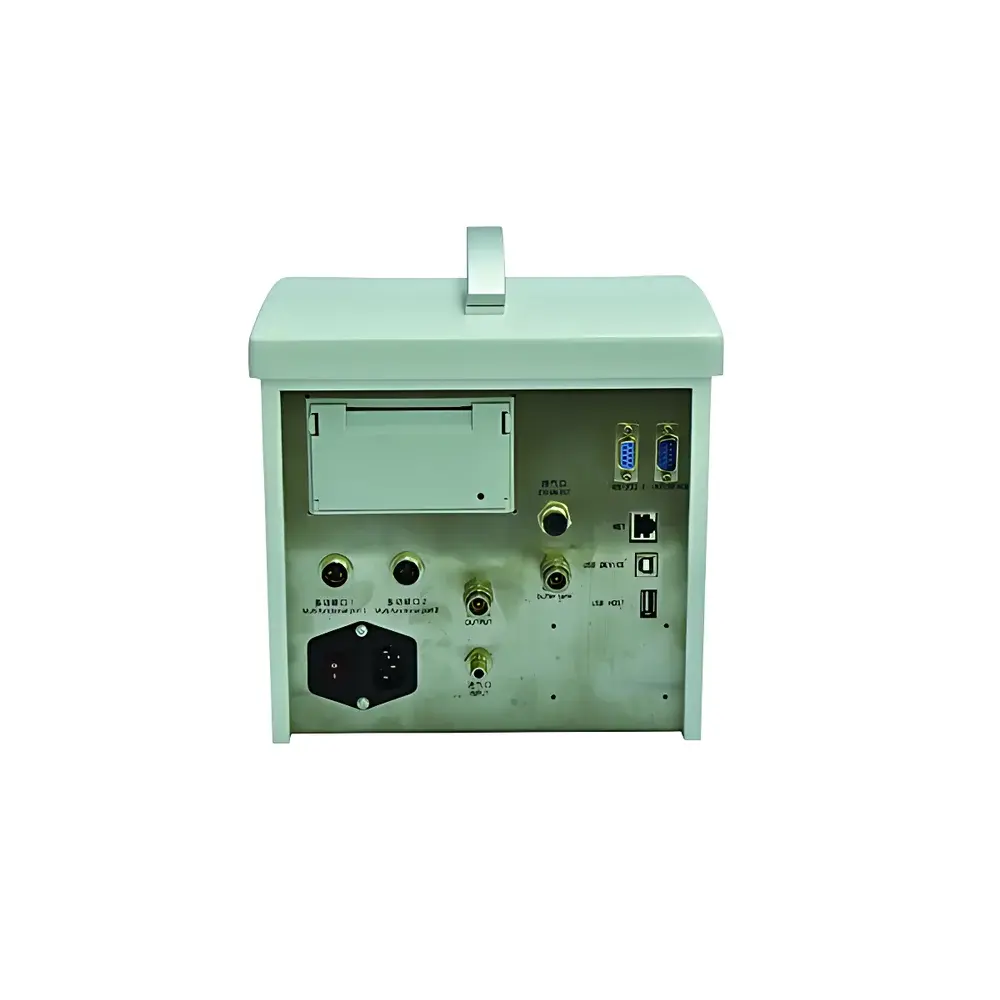
NeuronBC V6.5 Filter Integrity Tester
| Brand | NeuronBC |
|---|---|
| Model | V6.5 |
| Origin | Beijing, China |
| Power Supply | 100–240 VAC, 50 Hz, 120 W |
| Operating Pressure Range | 100–10,000 mbar (145 psi) |
| Environmental Operating Conditions | 5–40 °C, 10–80% RH |
| Dimensions (mm) | 400 (D) × 240 (W) × 270/220 (H1/H2) |
| Weight | 8 kg |
| Bubble Point Accuracy | ±50 mbar |
| Diffusive Flow Accuracy | ±4% |
| Water Intrusion Accuracy | ±0.01 mL |
| Net Volume Test Accuracy | ±4% |
| Bubble Point Range | 100–8,000 mbar |
| Diffusive Flow Range | 1–600 mL/min |
| Water Intrusion Range | 0.01–100 mL/min |
| Pre-stored Protocols | 80 |
| Event Log Capacity | ≥16 auditable events with timestamped traceability |
| User Access Levels | 4-tier role-based authentication with electronic signature support |
| Data Storage | ≥5,000 test records, USB backup of full datasets including real-time curves |
| Display | 7" high-resolution color touchscreen |
| Interface Options | RS232, USB, optional industrial fieldbus (e.g., Modbus TCP, Profibus DP) and analog I/O |
| Language Support | English / Chinese |
| Compliance | FDA 21 CFR Part 11, ALCOA+ principles, Annex 11 (EU GMP), ISO 13408-2, ASTM F838, USP <1207> |
Overview
The NeuronBC V6.5 Filter Integrity Tester is a fully integrated, regulatory-compliant instrument engineered for deterministic verification of liquid and gas filtration systems used in pharmaceutical, biotechnology, and sterile manufacturing environments. It implements multiple standardized integrity test methods—including manual and automated bubble point, enhanced bubble point, pressure hold (decay), diffusive flow (forward flow), water intrusion, and ultrafiltration membrane package testing—based on the physical principles of capillary flow, gas diffusion, and hydrophobic/hydrophilic membrane behavior. Designed to meet stringent requirements for data integrity and process validation, the V6.5 operates as both an offline benchtop unit and an online-integrated component within automated sterilization-in-place (SIP) or clean-in-place (CIP) control architectures. Its dual-height modular chassis accommodates complex multi-cartridge configurations up to 9-core, 20-inch filter housings—enabling comprehensive validation of large-scale terminal filtration assemblies without disassembly.
Key Features
- Multi-method integrity testing platform supporting all major pharmacopeial and regulatory protocols: USP , ISO 13408-2, ASTM F838, and EU GMP Annex 11.
- Four-tier hierarchical user management with password-protected login, role-based permissions, and electronic signature capability compliant with FDA 21 CFR Part 11 and EU Annex 11.
- Auditable, timestamped event logging for ≥16 critical actions—including user login/logout, method selection, parameter modification, test execution, result approval, and data export—ensuring ALCOA+ data governance.
- Onboard 7-inch high-resolution color touchscreen interface with intuitive workflow navigation; supports bilingual operation (English/Chinese) and customizable home-screen layouts.
- Configurable digital and analog I/O architecture: standard RS232 and USB ports plus optional industrial fieldbus integration (Modbus TCP, Profibus DP, CANopen) for direct linkage with PLCs, SCADA systems, or SIP controllers.
- Internal non-volatile memory stores ≥5,000 complete test records with full curve data; USB port enables encrypted backup of raw datasets, audit logs, and protocol configurations.
- Compact dual-height mechanical design (270 mm main housing + 220 mm auxiliary module) optimized for space-constrained cleanroom benches or mobile validation carts.
Sample Compatibility & Compliance
The V6.5 accommodates a broad spectrum of filtration formats across sterile and non-sterile processing lines: symmetric and asymmetric microporous membranes (0.1–5.0 µm), syringe filters, capsule filters, flat-sheet cassettes, cylindrical cartridge housings (≤9 cores, ≤20 inches), ultrafiltration membrane packages (hollow fiber and spiral-wound), UF columns, and irregularly shaped vent filters (e.g., tank breather elements). All test methods adhere to internationally recognized performance criteria defined in USP , ISO 13408-2, and ASTM F838. The system’s hardware architecture, firmware logic, and software architecture have been validated to satisfy FDA 21 CFR Part 11 requirements for electronic records and signatures—including audit trail immutability, user authentication integrity, and data retention fidelity. Optional battery backup ensures uninterrupted test continuity during brief power interruptions in GMP-critical zones.
Software & Data Management
Embedded firmware provides deterministic execution of pre-defined test sequences with real-time graphical display of pressure decay curves, flow rate profiles, and pass/fail thresholds. Up to 80 user-configurable test protocols can be stored onboard, each defining unique pressure ramp rates, stabilization durations, acceptance criteria, and reporting templates. All test data—including time-stamped raw sensor values, calculated parameters, operator ID, and environmental metadata—are written to internal flash memory with write-once-read-many (WORM) protection. Export functionality supports CSV and PDF formats via USB; optional PC software enables centralized database synchronization, trend analysis, and deviation investigation workflows aligned with CAPA and change control procedures. Full traceability is maintained through cryptographic hashing of audit logs and digital signing of final reports per 21 CFR Part 11 Subpart B.
Applications
The V6.5 serves as a primary tool for filter qualification, routine batch release verification, and periodic requalification in regulated biopharmaceutical settings. Typical use cases include: post-SIP integrity confirmation of sterilizing-grade filters in buffer and media preparation lines; pre-use integrity testing of vent filters on purified water storage tanks and compressed air receivers; validation of ultrafiltration/diafiltration cassettes in downstream purification suites; and end-of-life assessment of single-use bioreactor fluid path filters. Its compatibility with both hydrophobic (e.g., PTFE, PVDF) and hydrophilic (e.g., PES, nylon, cellulose acetate) membranes enables cross-platform deployment across upstream cell culture, downstream purification, and final fill-finish operations.
FAQ
Does the V6.5 support automated integration with PLC-based SIP systems?
Yes—via optional Modbus TCP or Profibus DP modules, enabling real-time command initiation, status feedback, and synchronized alarm handling within validated automation networks.
Can test data be exported in a format compatible with LIMS or MES platforms?
Yes—CSV exports contain structured fields for sample ID, operator, timestamp, method name, measured values, pass/fail status, and digital signature hash; custom XML mapping is available upon request.
Is calibration traceable to NIST or other national standards?
All pressure transducers are factory-calibrated against NIST-traceable references; certificate of calibration is provided with each instrument and includes uncertainty budgets per ISO/IEC 17025.
What level of cybersecurity hardening is implemented in the embedded OS?
The device runs a locked-down Linux kernel with disabled unnecessary services, encrypted local storage, and secure boot chain; no remote access ports are exposed by default.
How is long-term data integrity ensured during firmware updates?
Firmware upgrades execute via signed binary packages; critical audit logs and test records reside in a separate protected partition unaffected by update processes.






