
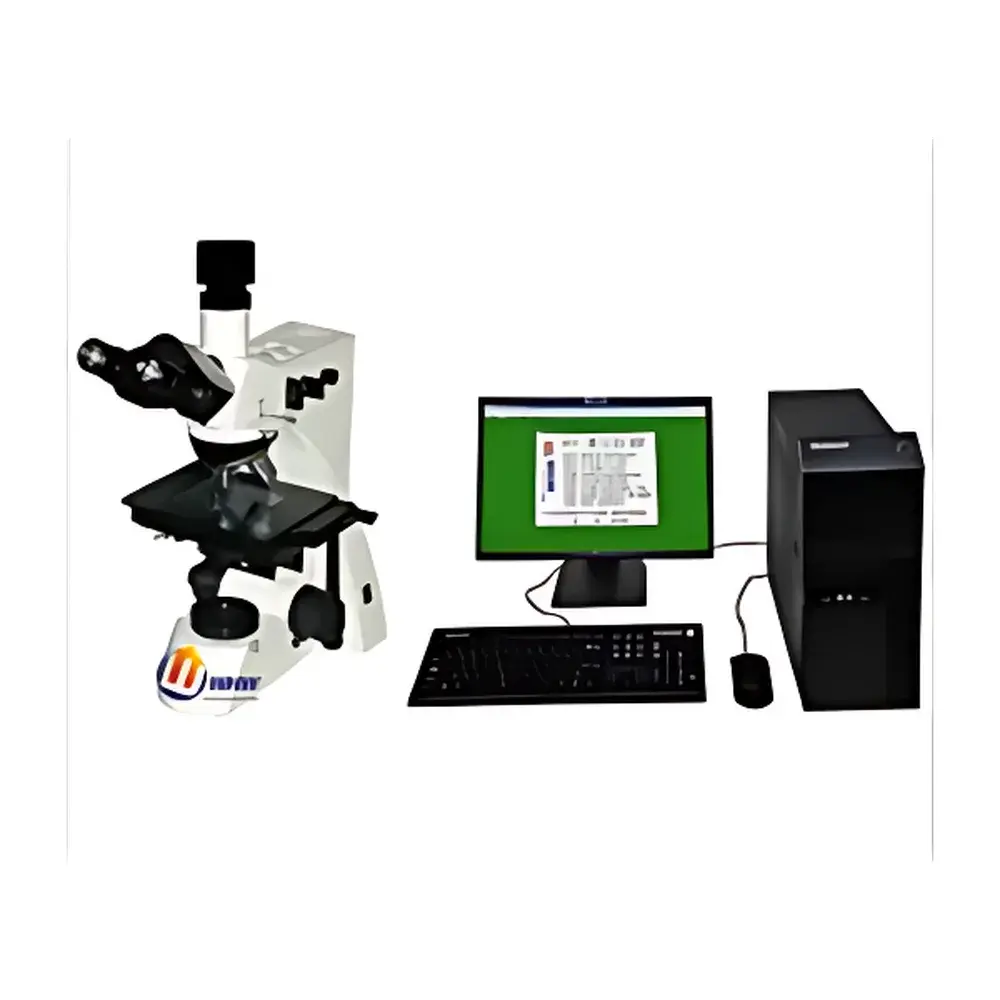
YANRUN MMAS-17 Upright Reflected/Transmitted Light Metallurgical Microscope with Integrated Image Analysis System
| Brand | YANRUN |
|---|---|
| Origin | Shanghai, China |
| Manufacturer Type | Direct Manufacturer |
| Product Type | Upright Metallurgical Microscope |
| Imaging Analysis System Included | Yes |
| Total Magnification Range | 50× to 500× |
| Eyepieces | Wide-Field WF10X (Φ18 mm) |
| Objective Lenses | PL 5X/0.12, PLL10X/0.25, PLL20X/0.40, PLL50X/0.70 (long working distance, achromatic, cover-slip free) |
Overview
The YANRUN MMAS-17 is an upright metallurgical microscope engineered for high-fidelity reflected-light (incident illumination) and transmitted-light (epi- and trans-illumination) observation of both opaque and transparent specimens. Designed specifically for metallographic analysis, the system integrates Köhler illumination architecture with long-working-distance (LWD) plan achromatic objectives and wide-field eyepieces to ensure uniform illumination, minimal chromatic aberration, and high-resolution imaging across the entire field of view. Its dual-path optical design supports rigorous microstructural evaluation in accordance with ASTM E3, ISO 643, and GB/T 13298–2015 standards for metallographic specimen preparation and assessment. The instrument serves as a foundational platform for quantitative microstructural characterization in quality control laboratories, R&D facilities, and academic metallurgy departments—where reproducible contrast, precise focus stability, and compliant documentation are critical.
Key Features
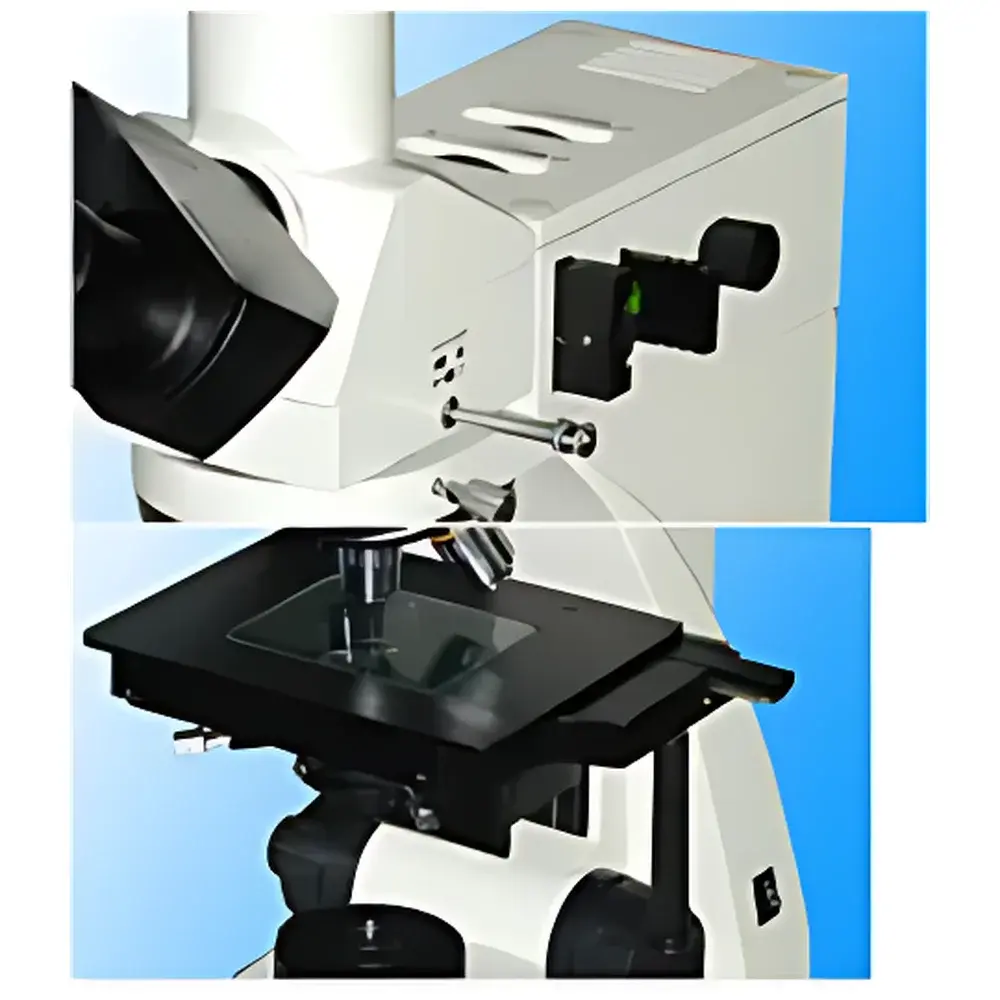
- Triple-port trinocular head with 30° inclination, built-in analyzer for polarized light observation, and diopter adjustment for monocular viewing calibration.
- Four-position objective turret with precision ball-bearing internal centering mechanism, ensuring repeatable alignment and minimal parallax during objective switching.
- Dual-illumination system: Reflected-light path equipped with 6 V / 20 W halogen lamp, continuously adjustable intensity, field and aperture diaphragms, rotating filter wheel (yellow, green, blue, ground glass), and push-pull linear polarizer; Transmitted-light path features integrated 6 V / 20 W halogen source, Abbe condenser (NA 1.25, height-adjustable), built-in field diaphragm, and blue filter/ground glass assembly.
- Large mechanical stage (210 × 140 mm) with 63 × 50 mm travel range, calibrated X-Y movement, and low-profile coaxial coarse/fine focusing mechanism (2 µm fine-focus graduation, tension-adjustable coarse drive, upper/lower limit stops, and focus lock).
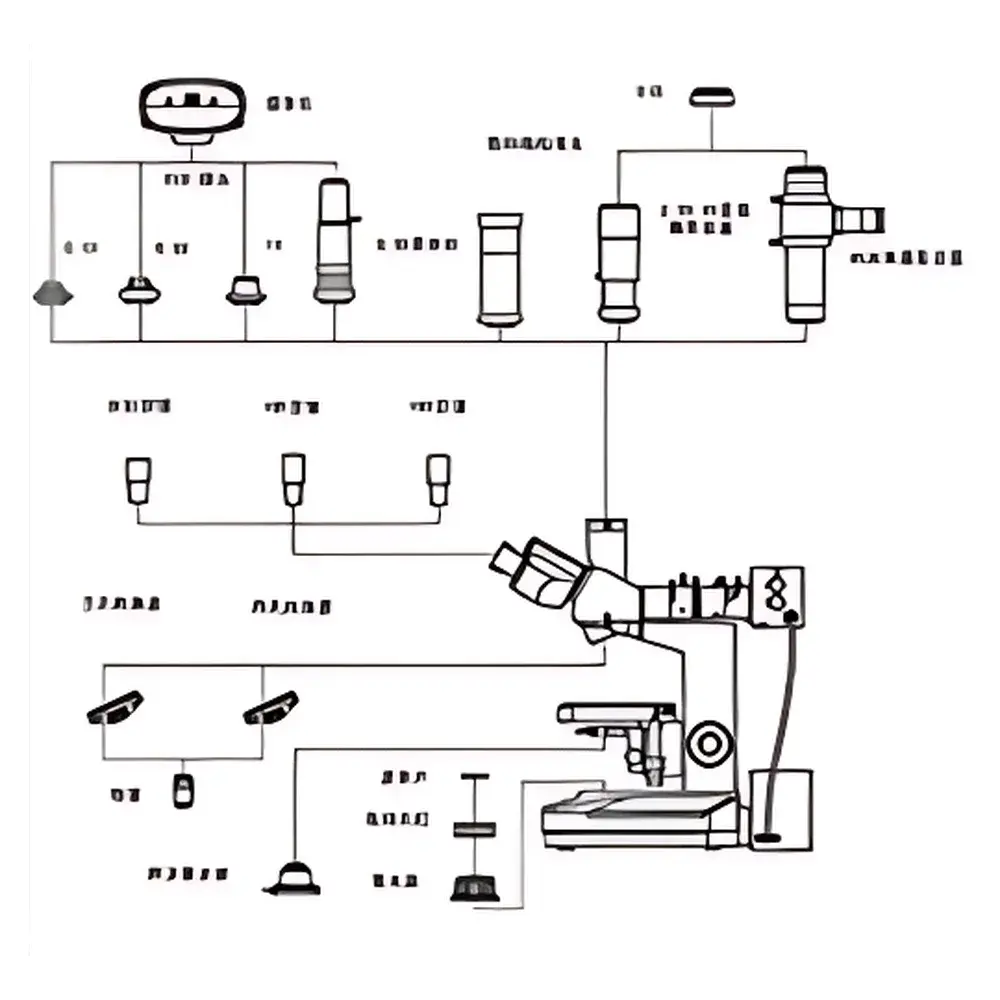
- Optical train optimized for digital imaging: C-mount interface compatible with industrial CMOS/CCD cameras; optional 0.4×, 0.5×, or 1× photo-adapter lenses with embedded reticle (0.1 mm/division) for calibrated measurement.
Sample Compatibility & Compliance
The MMAS-17 accommodates standard metallographic specimens (up to 30 mm thickness), polished cross-sections, coated layers, semiconductor wafers, ceramic fracture surfaces, and mineral thin sections. Its cover-slip-free LWD objectives eliminate immersion medium constraints and enable observation of rough, coated, or elevated topographies without contact risk. The system meets mechanical and optical requirements for ISO 10993-12 (biocompatibility testing support), ASTM E112 (grain size determination), and ASTM E1245 (inclusion rating). All illumination components comply with IEC 61000-3-2 harmonic emission limits and UL/CSA safety standards for laboratory equipment. When operated with validated MMAS software under controlled environmental conditions (20 ± 2°C, 40–60% RH), the system supports GLP-compliant data acquisition workflows.
Software & Data Management
The bundled MMAS image analysis software is a Windows-based, modular application developed for standardized metallographic evaluation. It includes over 400 preconfigured analysis modules aligned with national and industry standards (e.g., ASTM E112, E1245, E1382; ISO 643, 4967; GB/T 6394, 10561). Core capabilities include automated grain size classification, inclusion quantification (ASTM E45), phase area fraction calculation, linear intercept measurements, and second-phase particle distribution mapping. Software features full audit trail logging per FDA 21 CFR Part 11 requirements—including user login tracking, timestamped parameter changes, electronic signatures for report approval, and immutable export of raw image + metadata bundles (TIFF + XML). Data export supports CSV, PDF/A-2, and DICOM-SR formats for integration into LIMS or ELN systems. Optional modules include extended-depth-of-field (EDF) image stacking, multi-field mosaic stitching, and confocal-like Z-stack reconstruction using focus-series alignment algorithms.
Applications
- Metallographic QC in foundries and heat-treatment facilities: grain size verification, decarburization depth measurement, inclusion rating per ASTM E45.
- Failure analysis labs: crack propagation path mapping, intergranular corrosion assessment, weld zone microstructure evaluation.
- Advanced materials research: sintered powder metallurgy density analysis, additive manufacturing layer boundary inspection, thermal barrier coating delamination quantification.
- Electronics packaging: solder joint void fraction analysis, wire bond pull-test cross-section assessment, PCB microvia integrity screening.
- Geological and ceramic laboratories: mineral phase identification, porosity distribution in refractory bricks, fracture surface morphology correlation with mechanical test results.
FAQ
Does the MMAS-17 support oil-immersion objectives?
Yes—optional plan achromatic oil-immersion objectives (e.g., PLL100X/1.25 NA) are available and compatible with the standard nosepiece.
Is the MMAS software validated for regulated environments?
The software includes configurable 21 CFR Part 11 compliance features (electronic signatures, audit trails, role-based access); validation documentation and IQ/OQ protocols can be supplied upon request.
Can the system perform stereoscopic or 3D surface profiling?
While the base system is 2D-focused, the optional Z-stack module enables pseudo-3D topographic reconstruction via focus-series acquisition and surface mesh generation.
What camera interfaces are supported?
Standard C-mount output accepts USB3/UVC or GigE Vision cameras; SDKs for common machine vision platforms (e.g., Basler, FLIR, IDS) are provided for custom integration.
Is technical support available outside China?
YANRUN provides remote diagnostics, firmware updates, and English-language application engineering support through authorized regional partners in North America, Europe, and Southeast Asia.






