
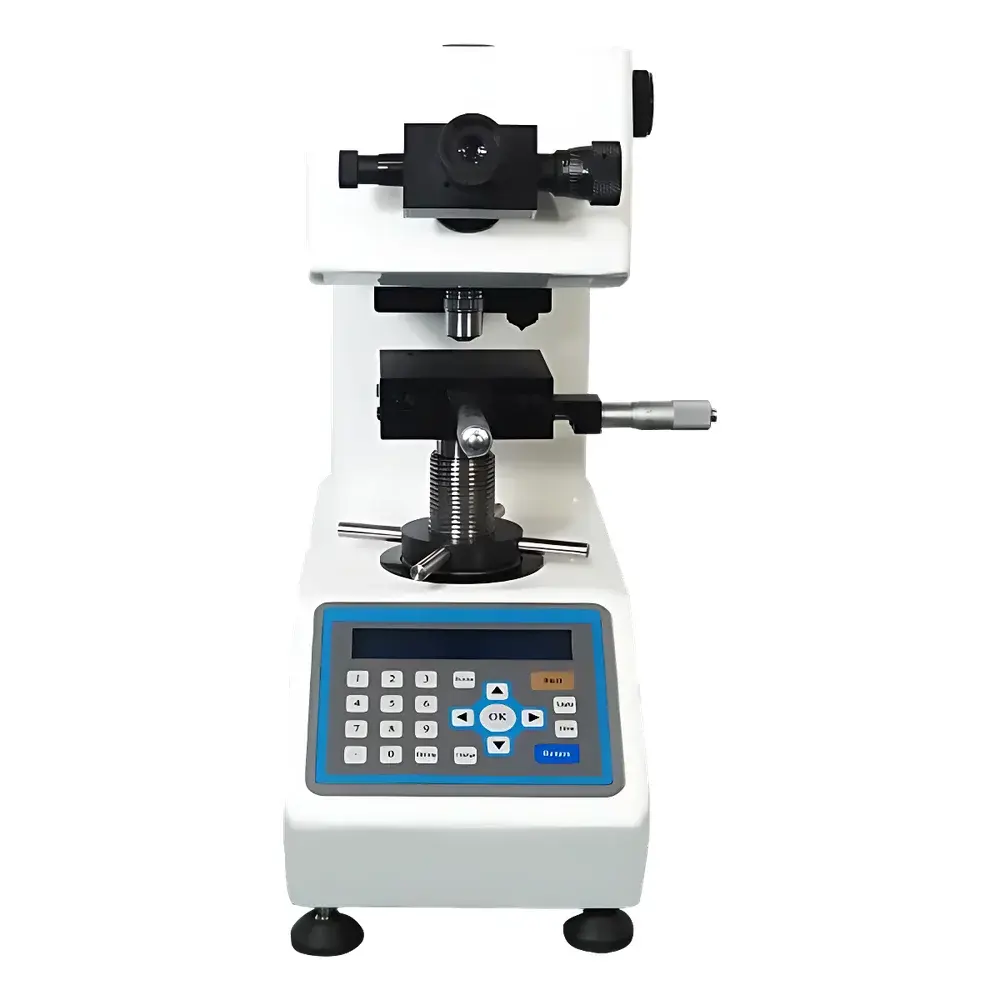
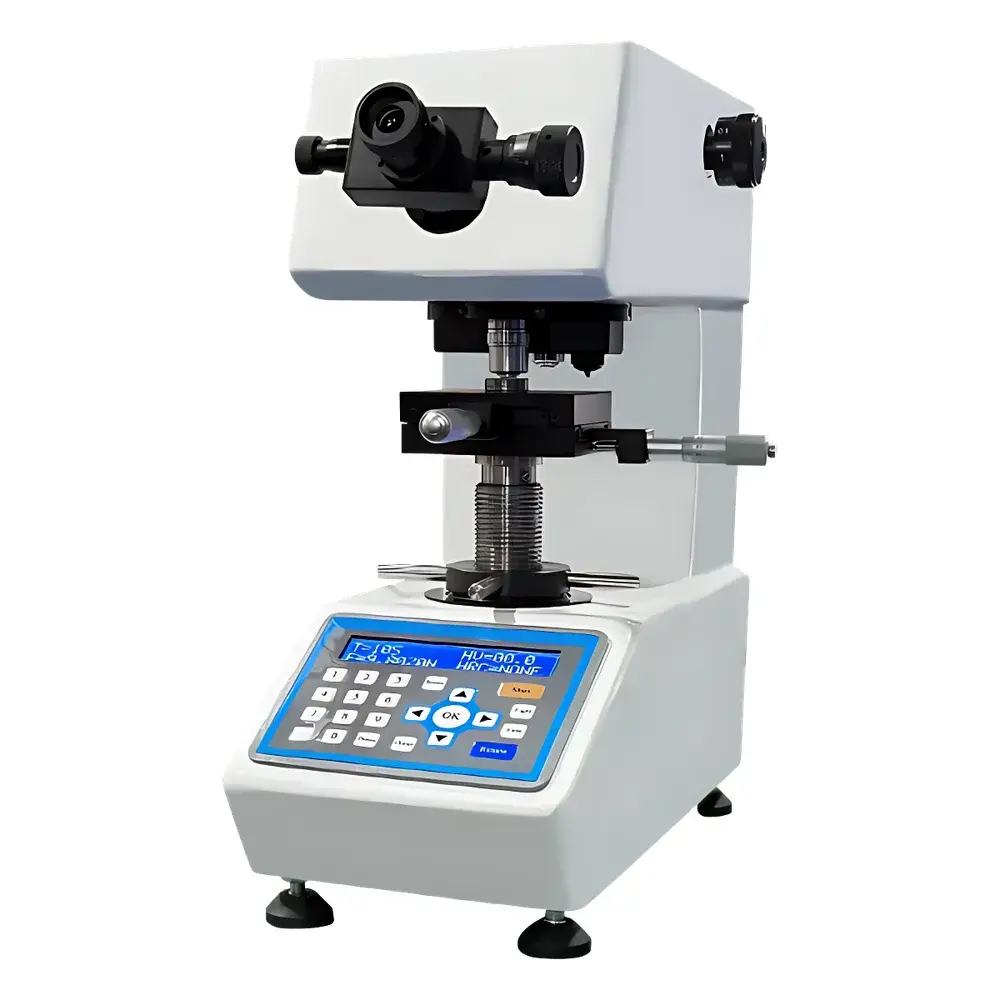
YANRUN HV-1000Z Automated Microhardness Tester
| Brand | YANRUN |
|---|---|
| Origin | Shanghai, China |
| Manufacturer Type | Direct Manufacturer |
| Instrument Type | Microhardness Tester |
| Model | HV-1000Z |
| Measurement Range | 0.001–6000 HV |
| Test Forces | 0.098–9.807 N (10–1000 gf), 8 selectable levels |
| Indentation Scales | HV0.01, HV0.025, HV0.05, HV0.1, HV0.2, HV0.3, HV0.5, HV1 |
| Optical Magnification | 100× (observation), 400× (measurement) |
| Minimum Detectable Indentation | 0.25 µm |
| X-Y Stage Travel | 25 × 25 mm |
| Maximum Specimen Height | 70 mm |
| Depth from Indenter to Chamber Wall | 110 mm |
| Load Application | Fully Automatic (loading/holding/unloading) |
| Dwell Time | 0–99 s (1 s increments) |
| Compliance | GB/T 4340 |
| Power Supply | AC 220 V / 50 Hz |
| Dimensions (L×W×H) | 440 × 220 × 460 mm |
| Net Weight | 25.0 kg |
Overview
The YANRUN HV-1000Z is an automated microhardness tester engineered for high-precision indentation hardness measurement at the microscale, operating on the principle of Vickers diamond pyramid indentation under controlled static load. It applies calibrated test forces ranging from 0.098 N (10 gf) to 9.807 N (1000 gf) and measures diagonal lengths of permanent impressions formed in metallic, ceramic, thin-film, and coated specimens using optical microscopy and digital image analysis. Designed for laboratory and quality control environments where surface integrity, case depth evaluation, and localized mechanical property mapping are critical, the HV-1000Z complies with ISO 6507-1 and GB/T 4340.1—ensuring traceability, repeatability, and alignment with international metrological practices for microhardness testing.
Key Features
- Fully automated loading, dwell, and unloading sequence with programmable dwell time (0–99 s in 1 s increments), minimizing operator influence and enhancing inter-test reproducibility.
- Motorized 8-position turret with precision 360° indexing mechanism, enabling seamless switching between Vickers and optional Knoop indenters without manual recalibration.
- Dual-magnification optical system: 10× eyepiece with 10× objective (100× total) for specimen navigation and 40× objective (400× total) for high-resolution indentation imaging; minimum resolvable indentation dimension: 0.25 µm.
- Integrated illumination subsystem with 0–100% continuous brightness adjustment and auto-on/auto-off functionality, reducing visual fatigue during extended operation and improving contrast consistency across sample types.
- Rigid cast-aluminum frame with precision trapezoidal lead screw Z-axis drive, delivering smooth vertical motion and long-term mechanical stability under repeated loading cycles.
- Modular hardware architecture featuring field-upgradeable firmware via DIP-switch configuration—enabling future functional expansion (e.g., enhanced data export protocols or GLP-compliant audit trail modules) without hardware replacement.
- High-efficiency triple-port optical path design achieving near-total light transmission (>98% effective absorption), optimized for low-noise digital image capture and edge-detection accuracy.
- Electronic hardness calculation engine utilizing floating-point arithmetic algorithms—reducing rounding error and aligning measured HV values more closely with theoretical indentation geometry models.
Sample Compatibility & Compliance
The HV-1000Z accommodates a broad range of material classes including case-hardened steels, nitrided surfaces, PVD/CVD coatings, sintered carbides, brittle ceramics (e.g., alumina, silicon carbide), optical glasses, and thin-section metallurgical specimens. With optional Knoop indenter installation, it supports Knoop hardness (HK) measurement per ASTM E384 for materials prone to cracking under Vickers loading—such as gemstones, quartz, and fine-grained refractories. All hardness determinations adhere to GB/T 4340 (equivalent to ISO 6507) requirements for test force application, indenter geometry, dwell time tolerance, and diagonal measurement uncertainty. The instrument’s mechanical design satisfies GLP-aligned environmental robustness criteria, including thermal drift mitigation and vibration-damped base construction.
Software & Data Management
Hardness data acquisition and reporting are managed through embedded firmware with real-time display of HV values, diagonal lengths, applied load, and dwell duration. Results are stored in non-volatile memory with timestamped entries, preventing data loss during power interruption. Export options include CSV-formatted files compatible with LIMS integration and statistical process control (SPC) platforms. While the base configuration does not include FDA 21 CFR Part 11-compliant electronic signatures or full audit trail functionality, the modular architecture supports future validation-ready software upgrades meeting GMP/GLP documentation requirements—including user access logs, change history tracking, and report watermarking.
Applications
- Quantitative assessment of carburized, nitrided, or induction-hardened case depths in aerospace and automotive components.
- Quality assurance of thin-film coatings (e.g., TiN, DLC, CrN) on cutting tools and medical implants.
- Mechanical property profiling across weld heat-affected zones (HAZ) and dissimilar metal interfaces.
- Research-grade hardness mapping of multiphase microstructures in advanced alloys and composite materials.
- Calibration verification of reference hardness blocks per ISO 6507-3 and national metrology institute (NMI) guidelines.
- Knoop hardness evaluation of brittle optical materials, geological specimens, and semiconductor substrates where crack propagation must be minimized.
FAQ
What standards does the HV-1000Z comply with?
It conforms to GB/T 4340.1–2012 (identical to ISO 6507-1:2018) for Vickers microhardness testing methodology, including indenter specification, force application tolerances, and measurement uncertainty protocols.
Can the instrument perform Knoop hardness testing?
Yes—when equipped with a certified Knoop diamond indenter (optional accessory), the HV-1000Z can execute ASTM E384-compliant Knoop tests on brittle or low-toughness materials.
Is the measurement process fully automated?
Yes: loading, dwell, unloading, turret rotation, focus adjustment (manual coarse/fine), and hardness calculation are all executed automatically upon test initiation.
What is the maximum specimen height the device accepts?
The stage accommodates specimens up to 70 mm in height, with a minimum clearance of 110 mm from the indenter centerline to the internal chamber wall.
Does the system support statistical analysis of multiple test points?
The onboard interface displays mean, standard deviation, and max/min values across user-defined test arrays; raw data export enables advanced statistical modeling in external software.



