
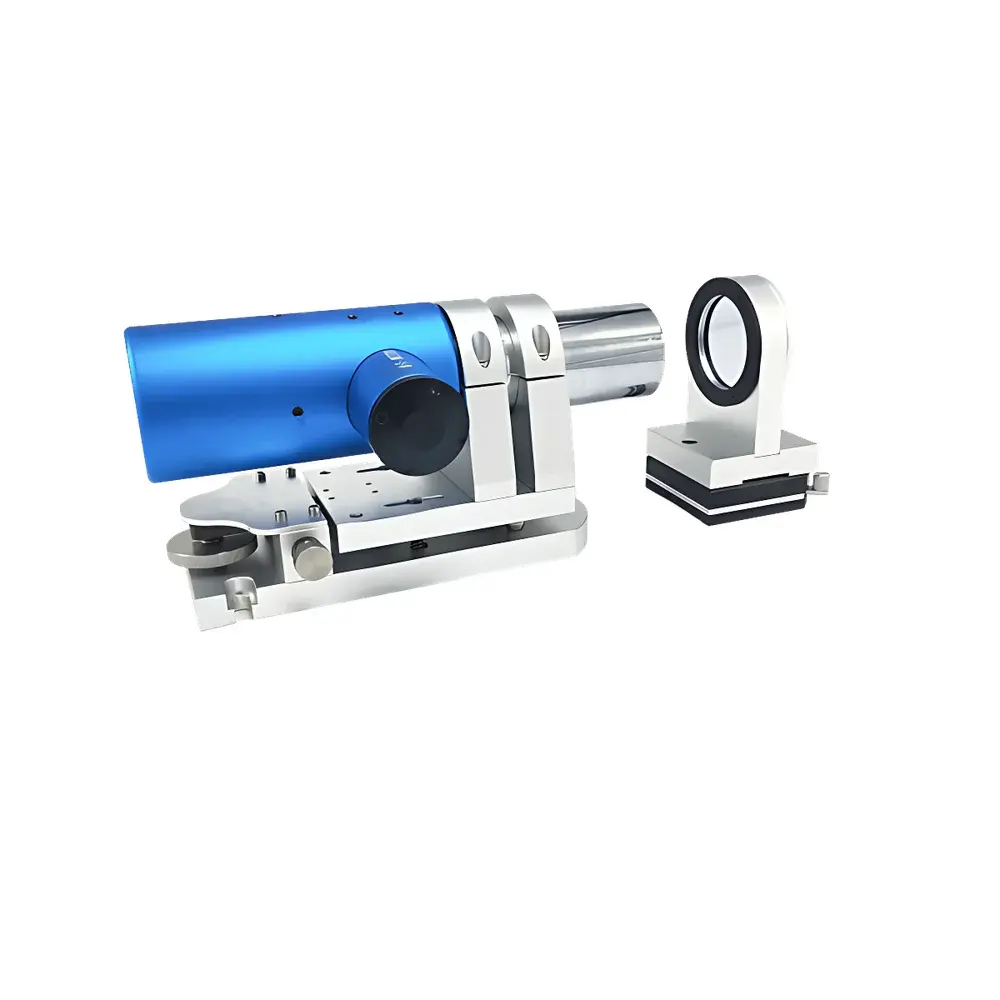
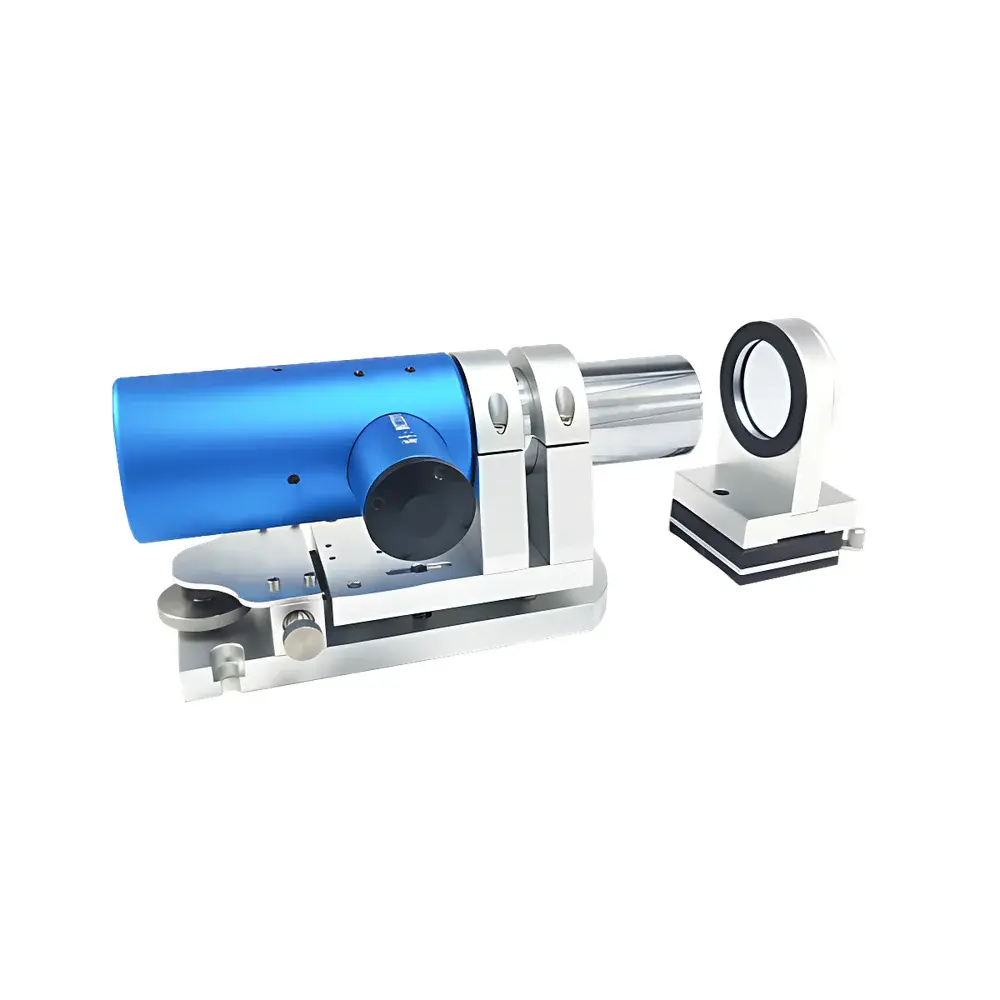
YANRUN MC030-MAT150/38/1 Dual-Axis Photoelectric Autocollimator
| Brand | YANRUN |
|---|---|
| Origin | Shanghai, China |
| Manufacturer Type | Manufacturer |
| Model | MC030-MAT150/38/1 |
| Focal Length | 150 mm |
| Aperture | 38 mm |
| Light Source | Imported Semiconductor LED |
| Measurement Range | 0–10 m |
| Detector | High-Precision Photodetector |
| Display Resolution | Adjustable from 1″ to 0.0001″ (arc sec) |
| Field of View (X/Y) | 4000″ × 3000″ (arc sec) |
| Accuracy (Center, ±1000″) | ±1″ (arc sec) |
| Frequency Response | ≤30 Hz |
| Interface | USB 2.0 |
| PC Requirements | Windows 7 or later (64-bit), ≥4th-gen Intel Core i3, ≥2.3 GHz |
| Dimensions | 225 × 135 × 125 mm (L×W×H) |
| Weight | 3.5 kg |
Overview
The YANRUN MC030-MAT150/38/1 Dual-Axis Photoelectric Autocollimator is an advanced angular metrology instrument engineered for high-precision, non-contact measurement of angular deviations in two orthogonal axes (X and Y). It operates on the fundamental optical principle of autocollimation: a collimated beam—generated by projecting a reticle through a lens system with a focal length of 150 mm—is reflected by a planar mirror and re-imaged onto a high-resolution photodetector located at the same focal plane. When the mirror rotates by angle α, the reflected image shifts by ΔS ≈ 2f·α (where f = 150 mm), enabling sub-arcsecond angular resolution via precise centroid detection. This system replaces subjective human observation found in classical optical autocollimators with deterministic, digital image acquisition and real-time coordinate analysis—eliminating parallax and observer fatigue while ensuring traceable, repeatable results under ISO 10110-5 and ISO 230-1 compliant conditions.
Key Features
- Dual-axis simultaneous measurement capability for X and Y angular displacement, supporting vectorial error decomposition and cross-coupling analysis.
- Adjustable display resolution spanning five orders of magnitude—from 1 arc second down to 0.0001 arc second—enabling flexible trade-offs between dynamic range and sensitivity per application requirement.
- Integrated semiconductor LED light source with >50,000-hour operational lifetime, stable spectral output, and no warm-up drift; certified to IEC 62471 for photobiological safety.
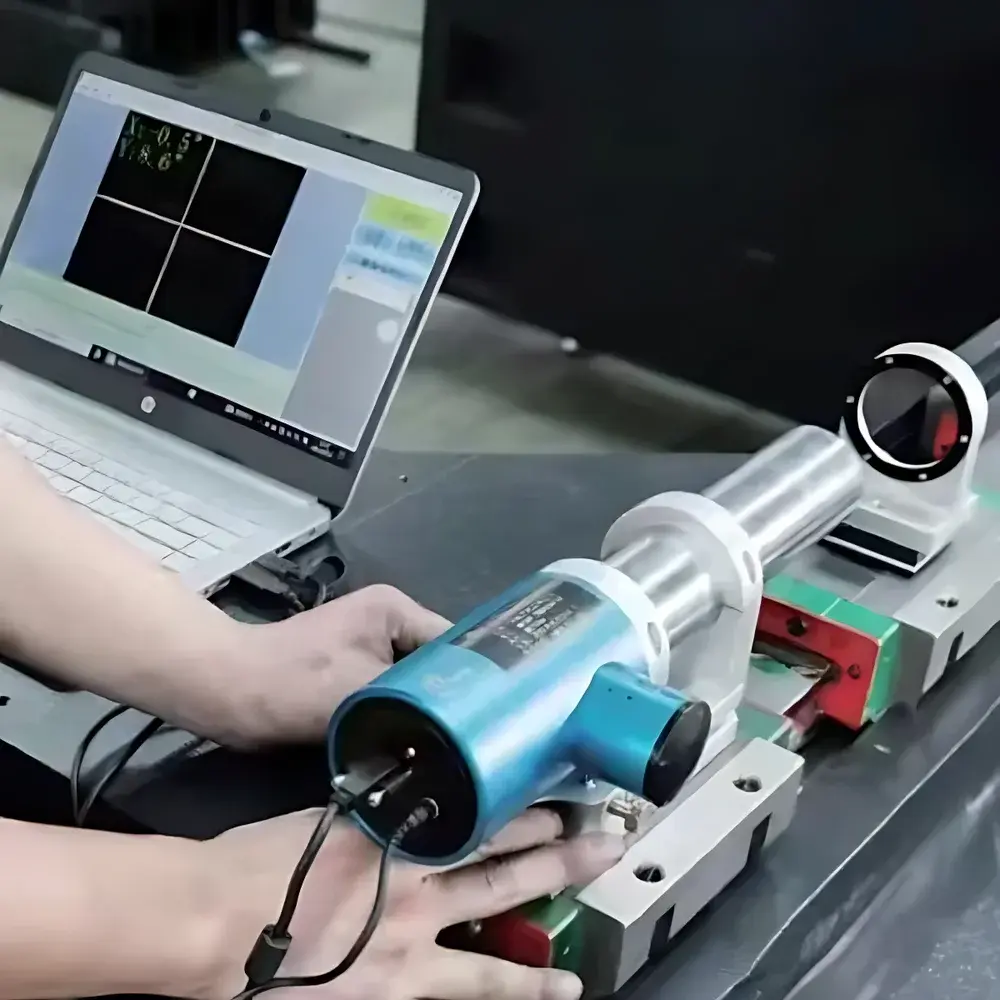
- Real-time electronic eyepiece visualization with live centroid tracking, eliminating reliance on manual reticle alignment and reducing operator-induced uncertainty.
- Compact monolithic housing (225 × 135 × 125 mm, 3.5 kg) optimized for portability without compromising mechanical rigidity or thermal stability—validated per ASTM E2919 for field-deployable metrology instruments.
- USB 2.0 interface compliant with USB-IF certification; driverless plug-and-play operation on Windows 7+ (64-bit) systems meeting minimum CPU and memory specifications for deterministic data throughput.
- Modular software architecture supporting optional analysis modules—including straightness, flatness, parallelism, verticality, and rotary table calibration—each implementing algorithms aligned with ISO 1101 geometric tolerancing standards.
Sample Compatibility & Compliance
The MC030-MAT150/38/1 is compatible with standard optical flats (λ/20 surface accuracy), precision-machined mirror mounts, and calibrated polygon mirrors (8-, 12-, 24-, and 36-face, Grade 0 or 1 per ISO 7736). Its 38 mm aperture and 150 mm focal length support working distances up to 10 m, accommodating large-scale machine tool guideways, aerospace structural assemblies, and optical benches. The instrument meets electromagnetic compatibility requirements per EN 61326-1 and carries China’s CNAS-accredited type examination report. All factory calibrations are performed in a temperature-controlled environment (20 ± 0.5 °C, humidity 45–55 % RH) with 24-hour thermal soak, and traceability is maintained to NIM (National Institute of Metrology, China) via accredited reference interferometers and angle comparators. For GLP/GMP-regulated environments, audit trails, user access control, and electronic signature support are available through optional software licensing.
Software & Data Management
The bundled YANRUN AutoAlign Suite runs natively on Windows platforms and provides full control over instrument configuration, real-time imaging, and multi-stage data processing. Each module implements standardized calculation routines: straightness evaluation per ISO 12181-1 (least-squares line fit with endpoint constraint); flatness per ISO 12180-1 (minimum zone or least-squares plane); parallelism and verticality using dual-line deviation synthesis. Raw pixel coordinates, timestamped measurements, and metadata (e.g., ambient temperature, operator ID, calibration certificate ID) are stored in encrypted binary format (.yac), exportable to CSV or Excel (.xlsx) with embedded formula validation. The software supports multi-language UI (English, Chinese, Russian, Korean), configurable reporting templates, and configurable pass/fail thresholds aligned with internal QA protocols or external standards such as ASME B89.3.7 or DIN 878. Audit log records all parameter changes, measurement initiations, and report generations—meeting FDA 21 CFR Part 11 requirements when deployed with validated Windows OS configurations.
Applications
This autocollimator serves as a primary angular reference in metrology laboratories, machine tool OEM final inspection lines, and aerospace component verification facilities. Typical use cases include: (1) Straightness verification of linear motion stages using bridge plate translation (per ISO 230-2 Annex B); (2) Flatness assessment of granite surface plates via grid-based scanning (e.g., 1000 mm × 1000 mm area with 100 mm step interval); (3) Parallelism and perpendicularity validation between orthogonal guideways in CNC machining centers; (4) Angular repeatability testing of precision rotary tables using polygon mirrors and index error mapping; (5) In situ alignment of laser cavities, interferometer arms, and synchrotron beamline optics. Its portability and USB-powered operation enable on-machine calibration without disassembly—reducing downtime and improving measurement uncertainty budgets in production environments.
FAQ
What is the recommended warm-up time before high-accuracy measurements?
A minimum 15-minute power-on stabilization period is required to achieve thermal equilibrium. For metrological-grade verification (e.g., ISO 10360-2 compliance), 24-hour constant-temperature acclimatization is mandatory.
Can the instrument measure angles beyond ±1000 arc seconds?
Yes—the field of view supports ±2000 arc seconds total range (±1000″ per axis), though specified accuracy of ±1″ applies only within the central ±1000″ region per ISO 10110-5 Annex A.
Is third-party calibration support available?
Yes—YANRUN maintains partnerships with CNAS-accredited calibration labs in Shanghai, Beijing, and Shenzhen; certificates include measurement uncertainty budgets per GUM (JCGM 100:2008).
Does the software support automated report generation with company branding?
Yes—customizable header/footer templates, logo insertion, and automatic inclusion of calibration status, operator ID, and environmental monitoring data are supported in licensed editions.
Are firmware updates provided post-purchase?
Yes—free lifetime firmware updates are delivered via secure download portal, including performance enhancements, bug fixes, and new module compatibility patches.



