
YANRUN HR-150DT Motorized Rockwell Hardness Tester
| Brand | YANRUN |
|---|---|
| Origin | Shanghai, China |
| Manufacturer Type | Direct Manufacturer |
| Product Category | Domestic |
| Model | HR-150DT |
| Instrument Type | Rockwell Hardness Tester |
| Hardness Range | HRA: 20–88 |
| HRB | 20–100 |
| HRC | 20–70 |
| Preliminary Test Force | 98.07 N (10 kgf) |
| Total Test Forces | 588 N (60 kgf), 980 N (100 kgf), 1471 N (150 kgf) |
| Maximum Specimen Height | 200 mm |
| Depth from Anvil Center to Front | 135 mm |
| Hardness Resolution | 0.5 HR |
| Dwell Time Adjustment | 0–99 s (1 s increments) |
| Compliance | GB/T 230.2, JJG 112 |
| Power Supply | 220 V AC |
| Weight | 70 kg |
| Dimensions (W×D×H) | 500 × 250 × 700 mm |
Overview
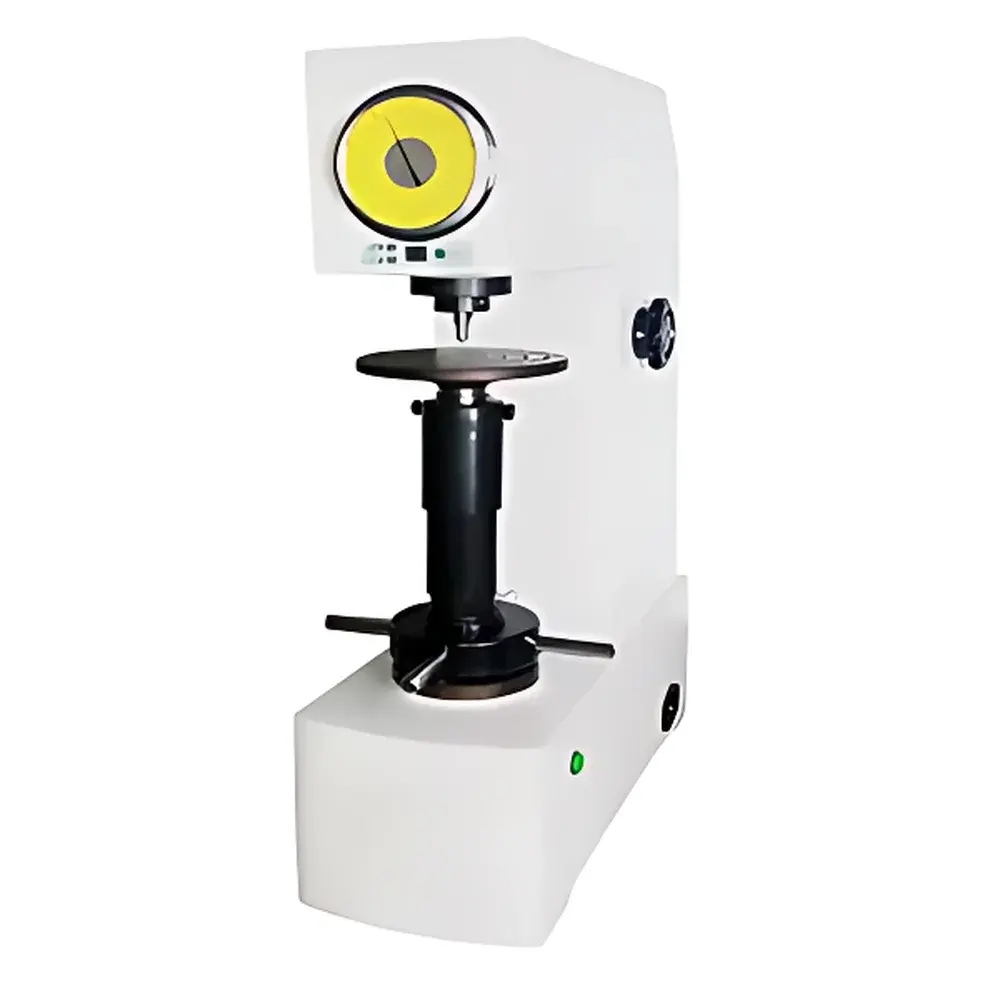
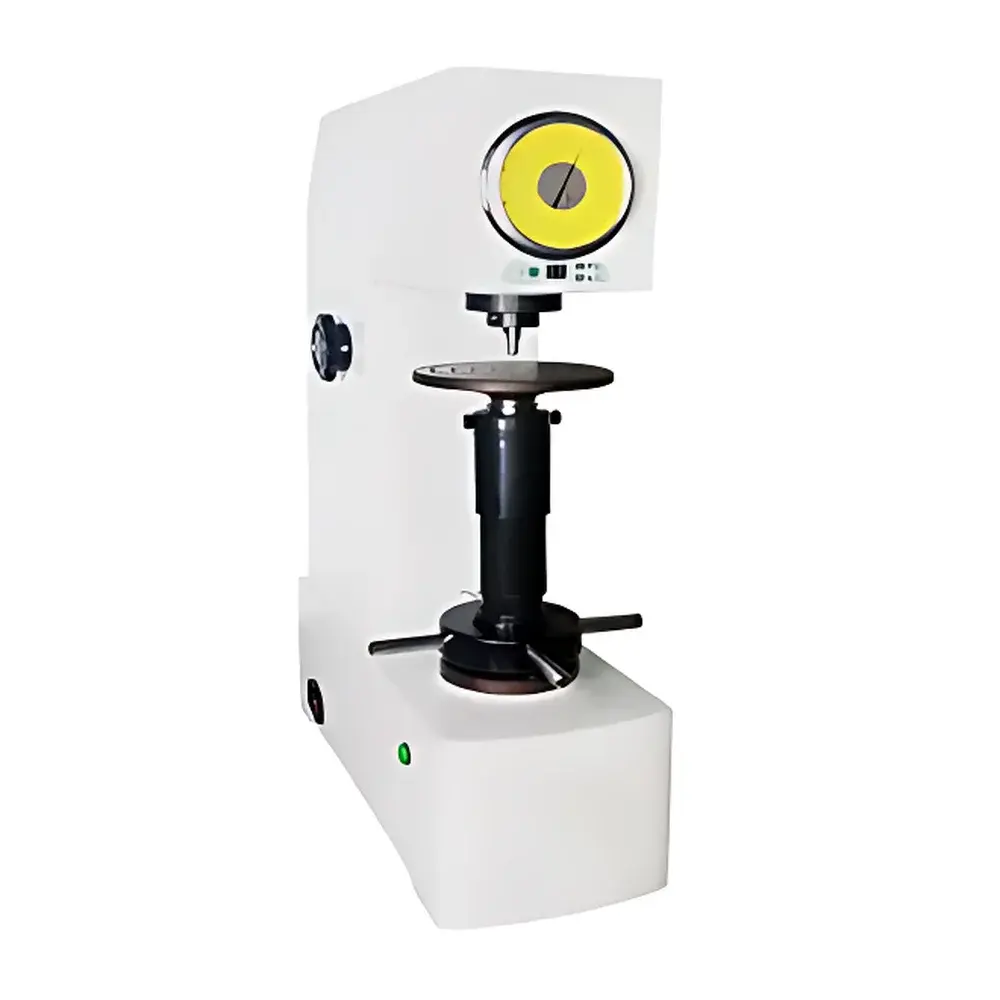
The YANRUN HR-150DT Motorized Rockwell Hardness Tester is a semi-automatic benchtop hardness testing system engineered for precision, repeatability, and long-term mechanical stability in industrial quality control and metrology laboratories. It operates on the fundamental Rockwell hardness principle—measuring the permanent depth deformation of a material under controlled incremental loading sequences: an initial minor load (98.07 N) establishes a zero reference, followed by application of a major load (588–1471 N), sustained for a user-defined dwell period (0–99 s), and subsequent unloading to the minor load level. The differential depth displacement—converted via calibrated mechanical amplification—is displayed directly on a high-contrast metal dial with 0.5 HR resolution. Designed for routine verification of heat-treated steels, case-hardened components, aluminum alloys, brass, and other metallic materials, the HR-150DT delivers consistent results compliant with internationally recognized hardness testing protocols.
Key Features
- Metal dial indicator with engraved scale and anti-parallax pointer—ensures accurate visual reading without digital dependency or battery reliance.
- Cast iron monolithic frame with reinforced wall thickness and optimized mass distribution—minimizes vibration transmission and eliminates structural creep during high-force indentation cycles.
- Fully motorized force application system—automates preload engagement, major load application, dwell timing, and unload sequence—reducing operator-induced variability and improving inter-operator reproducibility.
- Modular tooling interface supporting interchangeable indenters (120° diamond cone for HRA/HRC; 1.5875 mm tungsten carbide ball for HRB) and standardized anvil configurations (Φ150 mm large flat stage, Φ60 mm medium flat stage, V-block for cylindrical specimens).
- In-house precision-machined critical components—including lead screw (Ø42 mm), gear train, and load lever assembly—guarantee dimensional consistency and long-term interchangeability across service life.
- Custom electrostatic powder coating process—enables color-matching to laboratory equipment standards while providing corrosion resistance and abrasion durability.
Sample Compatibility & Compliance
The HR-150DT accommodates specimens up to 200 mm in height and 135 mm in depth from the anvil centerline, making it suitable for forged shafts, machined gears, bearing races, and sheet-metal stampings. Standard Rockwell scales include HRA, HRB, and HRC; optional scales (HRD, HRE, HRF, HRG, HRH, HRK) can be implemented via accessory indenter and load kit upgrades. All mechanical and metrological performance conforms to GB/T 230.2–2012 (equivalent to ISO 6508-2) for Rockwell hardness testing machines and JJG 112–2013 verification regulation for Rockwell hardness testers. The instrument supports GLP-aligned documentation practices through traceable calibration records and hardness block certification (high/medium/low certified reference blocks supplied with unit).
Software & Data Management
The HR-150DT is a standalone electromechanical instrument with no integrated digital output interface or embedded software. Hardness values are recorded manually from the analog dial. For laboratories requiring data capture, external documentation workflows—including manual entry into LIMS or Excel-based QA logs—are supported. While the system does not provide USB/RS-232 connectivity or comply with FDA 21 CFR Part 11 electronic record requirements out-of-the-box, its mechanical design allows integration into validated paper-based or hybrid QC processes compliant with ISO/IEC 17025 and GMP Annex 11 frameworks when paired with defined SOPs and audit-trail documentation procedures.
Applications
- Final inspection of quenched-and-tempered structural steels in automotive and aerospace component manufacturing.
- Verification of surface hardness gradients in carburized or nitrided parts per ASTM E18 and SAE AMS 2242.
- Routine quality assurance of non-ferrous alloys—including copper, brass, and aluminum extrusions—in metal fabrication facilities.
- Calibration lab verification of secondary hardness reference blocks against national standards.
- Educational use in materials science laboratories for hands-on instruction in indentation mechanics and hardness scale correlation.
FAQ
What Rockwell scales are standard on the HR-150DT?
HRA, HRB, and HRC are factory-configured and mechanically supported. Additional scales require optional indenter/load combinations and are subject to mechanical recalibration.
Is the HR-150DT compliant with international metrological standards?
Yes—it meets GB/T 230.2–2012, which aligns with ISO 6508-2, and is verified per JJG 112–2013. Calibration certificates for supplied hardness blocks are traceable to CNAS-accredited providers.
Can test data be exported digitally?
No. The instrument features analog readout only. Digital data acquisition requires manual transcription or third-party optical digitization solutions.
What maintenance is required for long-term accuracy?
Annual mechanical verification of force application accuracy, indenter geometry (via SEM or profilometry), and dial linearity using certified reference blocks is recommended per ISO 6508-2 Clause 7.2.
Does the machine support automated dwell time programming?
Yes—dwell time is fully adjustable from 0 to 99 seconds in 1-second increments via front-panel selector dial, with mechanical timer actuation ensuring repeatable hold duration independent of power fluctuations.
Related Products



