
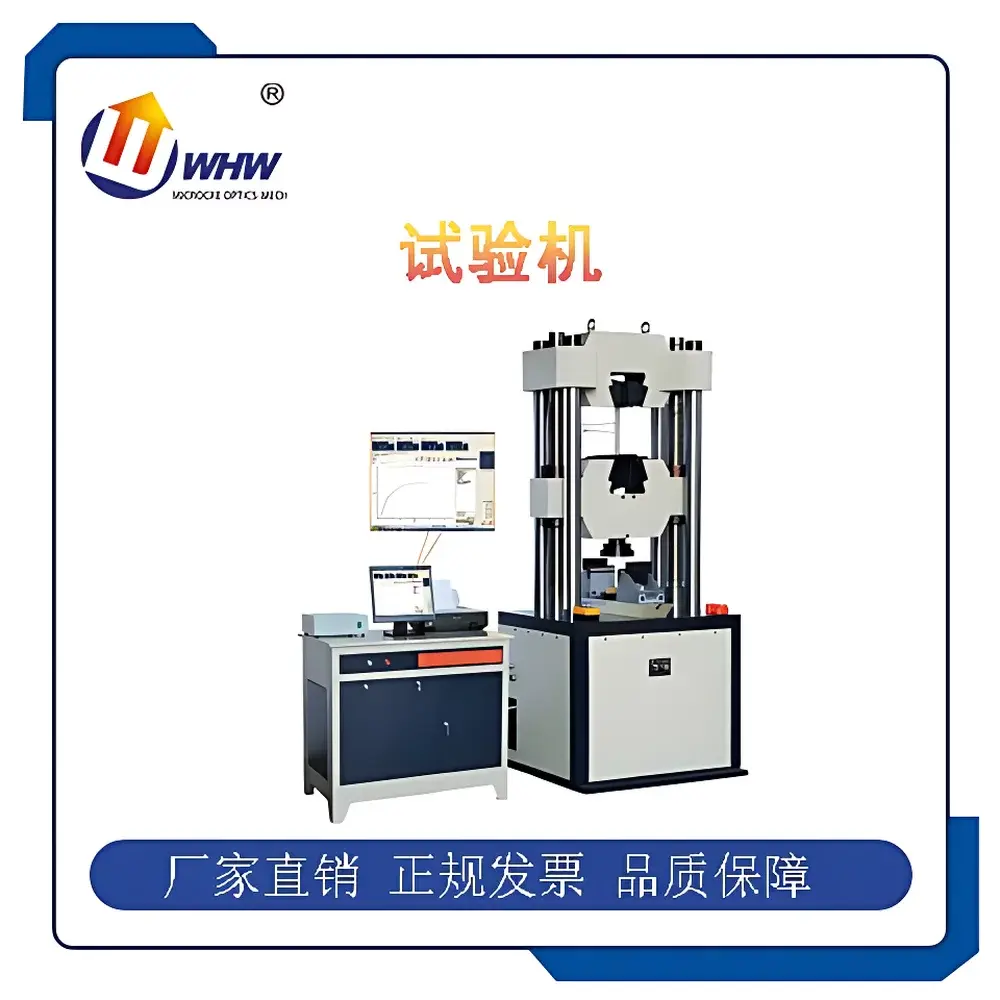
YANRUN MC009-WAW-600 Microcomputer-Controlled Electro-Hydraulic Servo Universal Testing Machine
| Brand | YANRUN |
|---|---|
| Origin | Shanghai, China |
| Manufacturer Type | Manufacturer |
| Model | MC009-WAW-600 |
| Load Range | 12–600 kN |
| Load Accuracy | ±1% or ±0.5% |
| Test Class | Class 1 or Class 0.5 |
| Force Resolution | 0.002 kN |
| Displacement Resolution | 0.01 mm |
| Deformation Measurement Accuracy | 0.005 mm |
| Control Modes | Constant Force / Constant Displacement / Constant Strain (0.4–100% FS) |
| Max Piston Speed | 50 mm/min |
| Tensile Space | 700 mm |
| Compression Space | 600 mm |
| Piston Stroke | 200 mm |
| Round Specimen Clamping Range | Φ13–Φ60 mm |
| Flat Specimen Clamping Thickness | 0–30 mm |
| Bend Span | 350 mm |
| Bend Roller Width | 140 mm |
| Bend Roller Diameter | Φ30 mm |
| Max Bending Deflection | 150 mm |
| Host Dimensions (W×D×H) | 1050×660×2250 mm |
| Oil Source Dimensions | 950×700×1150 mm |
| Weight | 2350 kg |
Overview
The YANRUN MC009-WAW-600 is a microcomputer-controlled electro-hydraulic servo universal testing machine engineered for high-fidelity mechanical property characterization of metallic and non-metallic materials under static loading conditions. Based on the Couette-type hydraulic actuation principle, it delivers precise force application via a bottom-mounted cylinder with gap-seal technology, enabling stable load generation across its full 12–600 kN range. The system operates in accordance with ISO 7500-1 (metallic materials — calibration of uniaxial testing machines), ASTM E4 (standard practices for force verification of testing machines), and ISO 6892-1 (tensile testing of metallic materials). Its dual-zone architecture separates tensile testing space (above the upper crosshead) from compression/bending zones (between lower crosshead and base table), supporting standardized specimen geometries per ASTM E8/E8M, ASTM C39, ISO 6892, and EN 10002-1. The integrated electro-hydraulic servo control ensures compliance with Class 0.5 or Class 1 accuracy requirements per ISO 7500-1, verified through traceable third-party calibration protocols.
Key Features
- Bottom-mounted hydraulic actuator with precision gap-seal cylinder design, minimizing internal leakage and enhancing long-term load stability.
- Four-closed-loop digital control system synchronizing test force, specimen deformation, crosshead displacement, and test progression—enabling true multi-parameter feedback regulation.
- High-resolution data acquisition: 1/500,000 A/D conversion resolution, full-scale unsegmented measurement across the entire 12–600 kN range.
- Dual-mode hydraulic power unit featuring variable-speed motor-driven high-pressure pump, servo valve modulation, and differential pressure valve group for fine-grained flow control.
- Robust mechanical architecture: heavy-duty welded frame, reinforced guide columns, and preloaded ball-screw transmission for crosshead positioning with <0.01 mm repeatability.
- Comprehensive hardware protection: automatic shutdown triggered by overloading (>103% FS) or piston overtravel (upper mechanical limit), safeguarding both operator safety and system integrity.
- Modular clamping system supporting round specimens (Φ13–Φ60 mm) and flat specimens (up to 30 mm thickness), with optional hydraulic or manual actuation configurations.
Sample Compatibility & Compliance
The MC009-WAW-600 accommodates standard and custom specimens per international material testing standards. It supports tensile testing of rods, wires, and plates; compression testing of concrete cylinders, ceramics, and structural composites; three-point and four-point bending per ASTM D790 and ISO 178; and shear testing using dedicated fixtures. All force transducers are calibrated against national metrological standards, with certificate traceability to CNAS-accredited laboratories. The system meets GLP requirements for audit-ready test execution, including electronic signature support, user-level access control, and tamper-evident data logging. Optional configuration enables compliance with FDA 21 CFR Part 11 for regulated pharmaceutical and biomedical device testing environments.
Software & Data Management
The embedded Windows-based control software provides real-time visualization of stress–strain curves, load–displacement plots, and time-history graphs. It supports automated test sequencing, programmable ramp-hold cycles, and multi-step control profiles (e.g., preload → hold → ramp → yield detection → plastic strain control). Raw data export is available in ASCII, CSV, and XML formats, compatible with MATLAB, Python pandas, and industry-standard LIMS platforms. Audit trail functionality records all user actions—including parameter modifications, calibration events, and test aborts—with timestamp, operator ID, and IP address metadata. Software validation documentation (IQ/OQ/PQ templates) is provided upon request for GMP-compliant deployment.
Applications
This system serves as a core instrumentation platform in metallurgical R&D labs evaluating yield strength, ultimate tensile strength, elongation at break, and Young’s modulus of steel alloys, aluminum extrusions, and titanium grades. In civil engineering laboratories, it performs compressive strength assessment of concrete (ASTM C39), mortar (ASTM C109), and geopolymer composites. Aerospace QA departments utilize it for qualification testing of fasteners, composite laminates, and additive-manufactured components per AMS and SAE specifications. Academic institutions employ the WAW-600 for teaching mechanical behavior fundamentals and validating constitutive models in solid mechanics courses.
FAQ
What is the maximum allowable specimen height for compression testing?
The effective compression space between the lower crosshead and the base plate is 600 mm, accommodating cylindrical or prismatic specimens up to this dimension.
Does the system support closed-loop strain control using extensometers?
Yes—external clip-on or video extensometers can be interfaced via analog or digital input channels, enabling true strain-controlled tests per ISO 6892-1 Annex A.
Is the hydraulic oil system compatible with ISO VG 46 or equivalent mineral oils?
The system is factory-configured for ISO VG 46 anti-wear hydraulic oil; alternative viscosities may be used only after consultation with YANRUN technical support and recalibration verification.
Can test reports be generated in bilingual (English/Chinese) format?
Report templates are fully customizable; bilingual output is supported through localized field mapping and Unicode-compliant font rendering.
What maintenance intervals are recommended for the servo valve and high-pressure filter?
Servo valve inspection is advised every 2,000 operating hours; high-pressure filter elements must be replaced every 500 hours or quarterly—whichever occurs first—to maintain flow fidelity and pressure response linearity.



