
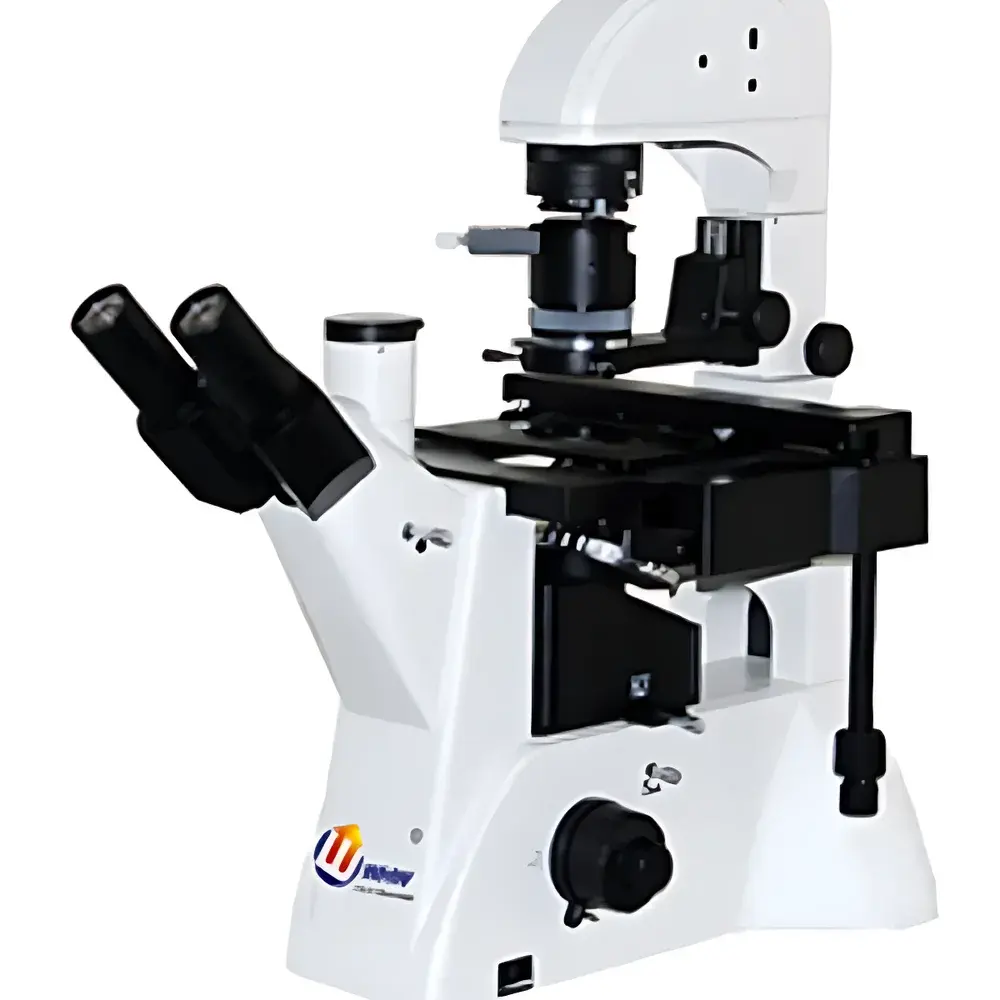
YANRUN BID-600 Inverted Transmitted DIC Biological Microscope
| Brand | YANRUN |
|---|---|
| Origin | Shanghai, China |
| Manufacturer Type | Direct Manufacturer |
| Product Category | Domestic (China-Made) |
| Model | BID-600 Inverted Transmitted Differential Interference Contrast (DIC) Biological Microscope |
| Instrument Type | Inverted Microscope |
| Eyepiece Configuration | Binocular |
| Optical Magnification Range | 50×–400× |
| Mechanical Tube Length | ∞ |
| Object Distance Conjugate | ∞ |
| Eyepieces | Widefield SWF10× (22 mm Field Number), Centerable |
| Eyepiece Port Diameter | Ø30 mm |
| Parfocal Distance | 10 mm |
| DIC Objectives | 5×/0.12 (WD 18.2 mm), 10×/0.25 (WD 20.2 mm), 20×/0.35 (WD 6 mm) |
| Brightfield Objectives (Cover Slip Thickness 1.2 mm) | 40×/0.6 (WD 3.5 mm) |
| Phase Contrast Objectives (Cover Slip Thickness 1.2 mm) | 10×/0.25 (WD 4.3 mm) |
| Nosepiece | Quintuple Revolving Nosepiece |
| Condenser | NA 0.30, Working Distance 55 mm |
| Stage Travel | 77 mm (Y) × 134.5 mm (X), Removable Vernier Scale |
| Focus Mechanism | Coaxial Coarse/Fine Adjustment, Fine Focus Graduation 0.002 mm per Division |
| Culture Dish Adapters | Three Interchangeable Plates (86×129.5 mm, 34×77.5 mm, 57×82 mm) |
| Illumination | 5 W White LED (CCT 5000–5500 K), Input Voltage 3.9–4.0 V DC |
| Photographic Port | Rear-Mounted C-Mount Interface, 100% Light Path Transmission |
Overview
The YANRUN BID-600 is an inverted transmitted-light biological microscope engineered for high-fidelity live-cell observation and quantitative phase-sensitive imaging. Its optical architecture supports three complementary contrast modalities—Differential Interference Contrast (DIC), brightfield, and phase contrast—enabling label-free visualization of unstained, transparent, or low-contrast specimens such as adherent mammalian cells, primary cultures, organoids, and early-stage embryos. The infinity-corrected optical pathway (mechanical tube length ∞, object conjugate distance ∞) ensures compatibility with standardized objective lenses and modular accessories while maintaining chromatic and spherical aberration correction across the full magnification range (50× to 400×). Designed specifically for long-term incubator-integrated workflows, the BID-600 features thermally stable illumination, low-heat LED lighting (5 W, 5000–5500 K CCT), and a rigid mechanical stage with precision coaxial focusing (0.002 mm fine focus graduation), all contributing to measurement repeatability and minimal thermal drift during time-lapse experiments.
Key Features
- Hinged binocular head with 45° inclination and adjustable interpupillary distance (53–75 mm) for ergonomic extended-use observation.
- Widefield SWF10× eyepieces (22 mm field number) delivering high-resolution, color-corrected viewing with parfocal alignment (10 mm parfocal distance) across all objectives.
- Quintuple revolving nosepiece accommodating five objectives simultaneously—including dedicated DIC, brightfield, and phase contrast optics—with automatic centering and repeatable positioning.
- Rotating swing-in/swing-out condenser system (NA 0.30, WD 55 mm) enabling unobstructed access to tall culture vessels (e.g., T-flasks, roller bottles, cylindrical bioreactors) without physical contact or contamination risk.
- Thermally optimized stage assembly featuring a fused silica glass plate to minimize thermal expansion-induced image shift during prolonged imaging sessions.
- Three interchangeable culture dish adapters supporting standard formats: Ø87.5 mm round dishes (86×129.5 mm plate), Ø68.5 mm dishes (34×77.5 mm plate), and rectangular multi-well plates (57×82 mm plate).
- Rear-mounted C-mount photographic port with 100% light path transmission—ensuring zero optical interference between eyepiece observation and camera acquisition, critical for synchronized dual-channel documentation.
Sample Compatibility & Compliance
The BID-600 is validated for use with standard tissue-culture substrates including glass-bottom dishes, polymer-based chamber slides, and polystyrene flasks. Its DIC-compatible objectives (5×/0.12, 10×/0.25, 20×/0.35) provide high-gradient optical sectioning capability without phototoxicity, making it suitable for GLP-compliant cell morphology assessment and QC release testing in biomanufacturing environments. While not certified to ISO 13485 or FDA 21 CFR Part 11 out-of-the-box, the system’s mechanical reproducibility, traceable calibration points (e.g., fine focus scale, stage vernier), and stable illumination output support audit-ready documentation when integrated into validated laboratory workflows. All optical components meet ISO 8578 (microscope terminology) and JIS B 7151 (optical performance testing) dimensional and labeling conventions.
Software & Data Management
The BID-600 operates as a hardware platform compatible with third-party imaging software suites—including NIS-Elements (Nikon), ZEN Blue (Zeiss), and open-source platforms such as MicroManager and Fiji/ImageJ—via its standardized C-mount interface and USB-powered LED driver. No proprietary firmware or vendor-locked acquisition software is embedded; instead, the microscope delivers raw optical data through passive analog/digital interfaces, preserving full metadata integrity (magnification, objective ID, illumination intensity) for downstream analysis. For laboratories requiring electronic record retention, integration with LIMS or ELN systems is achieved via external camera SDKs and timestamp-synchronized trigger I/O ports (available on optional accessory modules).
Applications
- Long-term time-lapse monitoring of stem cell differentiation and wound-healing assays under physiological CO2/humidity conditions.
- Quantitative morphometric analysis of neuronal growth cones and dendritic spine dynamics using DIC-enhanced edge contrast.
- In-process quality control of monoclonal antibody-producing CHO cell lines during bioreactor harvest cycles.
- Non-invasive evaluation of embryoid body formation and gastruloid symmetry breaking in developmental biology studies.
- Pre-screening of transfection efficiency and CRISPR-Cas9 editing outcomes prior to fixation and immunostaining.
FAQ
Is the BID-600 compatible with motorized stage or autofocus add-ons?
Yes—its Ø30 mm eyepiece port and standardized dovetail mounting rails support third-party motorized XY stages and piezoelectric Z-drives from Thorlabs, Prior Scientific, and ASI.
Can DIC contrast be used with plastic-bottom cultureware?
DIC performance is optimal with glass-bottom dishes; however, high-refractive-index polymer substrates (e.g., ibidi µ-Slides) yield acceptable gradient contrast at 10× and 20× magnifications.
Does the LED illumination support intensity modulation for fluorescence compatibility?
The base model provides fixed-intensity white LED output; however, optional PWM-controlled drivers (sold separately) enable 0–100% dimming for hybrid brightfield/DIC–fluorescence co-imaging setups.
What is the maximum working distance achievable with the 20× DIC objective?
The 20×/0.35 DIC objective maintains a 6 mm working distance—sufficient to accommodate 1 mm-thick glass-bottom dishes and 0.5 mm-thick silicone gaskets commonly used in microfluidic cell culture devices.
Are calibration certificates available for metrological traceability?
YANRUN provides factory calibration reports for stage travel accuracy (±1.5 µm), focus scale linearity (R² > 0.999), and LED spectral stability (±2% CCT deviation over 10,000 hours), compliant with ISO/IEC 17025 guidelines upon request.
Related Products



