
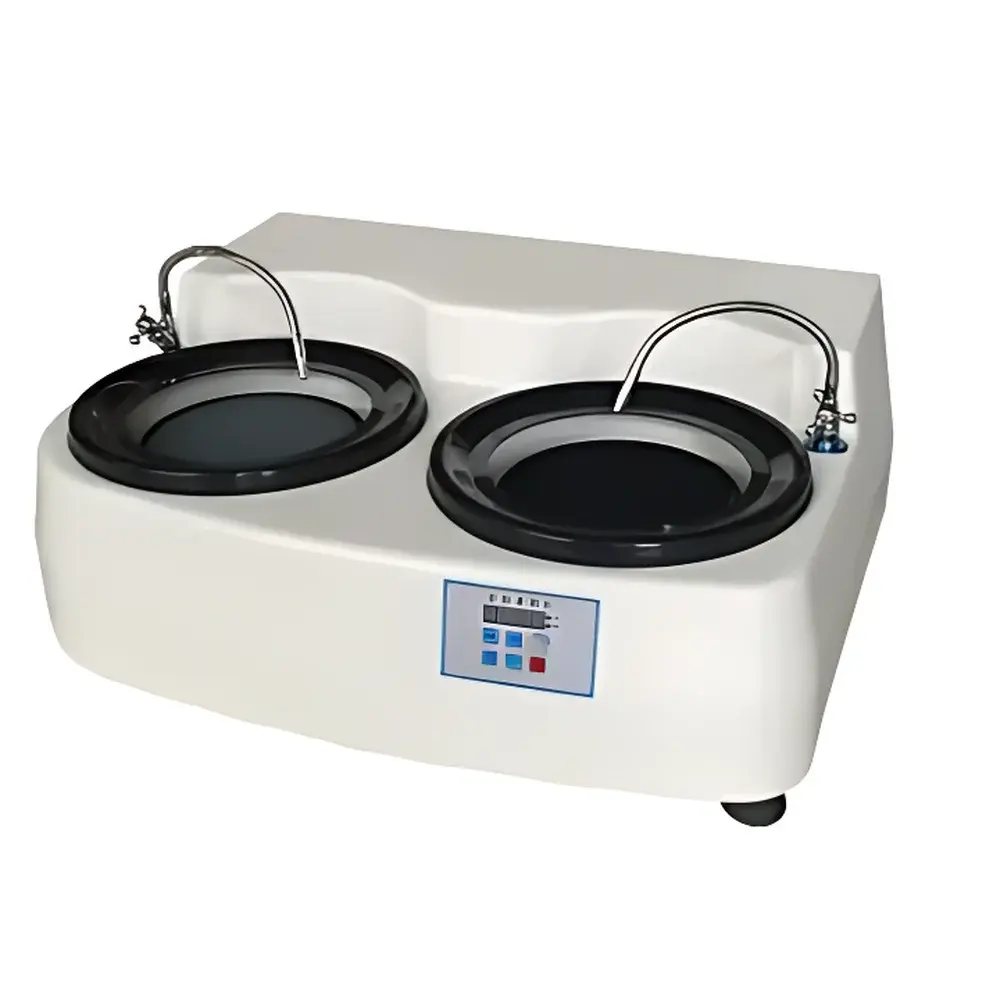
YANRUN MPD-2W Dual-Station Metallographic Grinding and Polishing Machine
| Brand | YANRUN |
|---|---|
| Origin | Shanghai, China |
| Manufacturer Type | Direct Manufacturer |
| Country of Origin | China |
| Model | MPD-2W |
| Price | USD 1,250 (FOB Shanghai) |
| Speed Control | Dual-mode — Stepless (200–1500 rpm) + Fixed-speed (600 rpm low / 1200 rpm high) |
| Platen Diameter | Standard 230 mm (Optional: 200 mm, 250 mm, 300 mm) |
| Number of Platens | 2 |
| Motor Power | 500 W × 2 |
| Dimensions (W×D×H) | 680 × 570 × 320 mm |
| Voltage | 220 V AC, 50 Hz |
| Rotation Direction | Bidirectional (forward/reverse selectable) |
| Water Delivery | 360° swivel faucet with sealed inlet/outlet system |
| Housing Material | Structural ABS polymer injection-molded chassis |
Overview
The YANRUN MPD-2W is a dual-platen, benchtop metallographic grinding and polishing machine engineered for precision sample preparation in metallurgical, materials science, and failure analysis laboratories. It operates on the principle of controlled mechanical abrasion—using sequential abrasive media (silicon carbide papers, diamond suspensions, and cloth-based polishing cloths) mounted on rotating platens to progressively reduce surface topography, eliminate deformation layers, and achieve optically flat, scratch-free cross-sections suitable for optical microscopy, SEM imaging, and microhardness testing. Designed for reproducible, operator-independent results, the MPD-2W integrates dual independent platen control, sealed fluid management, and structural polymer housing to ensure long-term stability under continuous laboratory use—particularly critical when preparing samples from heterogeneous alloys, brittle ceramics, composite laminates, or semiconductor substrates.
Key Features
- Dual independent platen control: Each 230 mm platen (configurable to 200/250/300 mm) operates with separate speed regulation—enabling simultaneous coarse grinding on one station and fine polishing on the other without cross-contamination.
- Hybrid speed architecture: Combines stepless speed adjustment (200–1500 rpm) with two preset fixed speeds (600 rpm for gentle grinding; 1200 rpm for efficient polishing), optimized for consistent material removal rates across diverse specimen hardnesses (e.g., aluminum alloys vs. tungsten carbide).
- Sealed hydraulic interface: Fully isolated water inlet/outlet pathways prevent electrolytic contact between coolant flow and electrical components—meeting IEC 61000-6-3 EMC immunity requirements and extending PCB service life in humid lab environments.
- Structural ABS chassis: Injection-molded housing provides impact resistance (IK07 rating), chemical resistance to common polishing lubricants (e.g., ethanol-based suspensions, colloidal silica), and thermal stability across ambient temperatures of 15–35 °C.
- Bidirectional rotation programming: Enables reversal of platen direction during polishing cycles to minimize directional artifact formation and improve surface uniformity—especially beneficial for anisotropic materials such as rolled steels or textured thin films.
- Ergonomic 360° swivel faucet: Facilitates precise coolant delivery directly onto the specimen–abrasive interface, minimizing splashing and ensuring optimal slurry formation without manual repositioning.
Sample Compatibility & Compliance
The MPD-2W accommodates specimens up to 40 mm in height within its deep-draw grinding chamber (depth: 95 mm), supporting standard metallographic mounts (30 mm and 40 mm diameter phenolic/resin mounts) as well as unmounted irregular geometries (e.g., fracture surfaces, geological thin sections, PCB cross-cuts). It complies with ASTM E3-22 (Standard Guide for Preparation of Metallographic Specimens) and ISO 15510:2021 (Metallic materials — Metallographic specimen preparation). While not certified to GLP or GMP out-of-the-box, its dual-platen isolation, speed traceability (via analog dial indicators), and absence of software-based data logging make it suitable for ISO/IEC 17025-accredited labs performing routine QC metallography—provided procedural documentation (e.g., SOPs referencing speed/time/abrasive grade per step) is maintained per clause 7.2.2.
Software & Data Management
The MPD-2W is a hardware-only instrument with no embedded firmware, touchscreen interface, or digital connectivity. All operational parameters—including speed selection, rotation direction, and runtime—are manually set via front-panel dials and toggle switches. This analog architecture eliminates cybersecurity risks, ensures deterministic response timing, and avoids validation overhead associated with FDA 21 CFR Part 11 compliance. For laboratories requiring audit-ready records, external timers and calibrated tachometers are recommended to document process parameters per test batch—consistent with ASTM E407-21 Annex A1 guidelines for manual preparation traceability.
Applications
- Preparation of ferrous and non-ferrous alloy specimens for grain size analysis (ASTM E112), inclusion rating (ASTM E45), and phase identification.
- Sectioning and polishing of sintered ceramics (Al₂O₃, SiC), geological samples (granite, basalt), and cementitious composites for porosity quantification (ISO 4527).
- Failure analysis of electronic packaging: delamination assessment in solder joints, intermetallic growth evaluation at Cu/Sn interfaces.
- Routine QC in foundries and heat-treatment facilities—verifying case depth (carburized/induction-hardened steels) and decarburization layers per ISO 3887.
- Academic research involving novel additive-manufactured metals, where layer boundary integrity and powder fusion quality must be assessed microscopically.
FAQ
Is the MPD-2W compatible with automatic dispensing systems for diamond suspension?
No—the unit lacks integrated fluid dosing ports or solenoid valve interfaces. Manual application via dropper or syringe is required per ASTM E1558 protocols.
Can the 230 mm platen be replaced with a 300 mm version without modification?
Yes—YANRUN offers factory-calibrated 300 mm platen kits including matched motor couplings and guard ring assemblies; field retrofit requires torque calibration verification.
Does the machine support vacuum chuck mounting for thin wafers?
Not natively—the standard platen uses adhesive-backed abrasive paper. Vacuum chucks are available as optional accessories but require separate pneumatic supply and are not supplied with the base configuration.
What maintenance intervals are recommended for the dual 500 W motors?
Brush inspection every 1,200 operating hours; bearing lubrication (NLGI #2 lithium grease) every 2,500 hours—per manufacturer’s Technical Bulletin TB-MPD2W-Rev.3.
Is CE marking applicable to this model?
The MPD-2W meets EN 61000-6-2 (immunity) and EN 61000-6-4 (emissions) when operated with grounded 220 V supply; full CE certification requires end-user responsibility for local installation compliance per Machinery Directive 2006/42/EC.



