
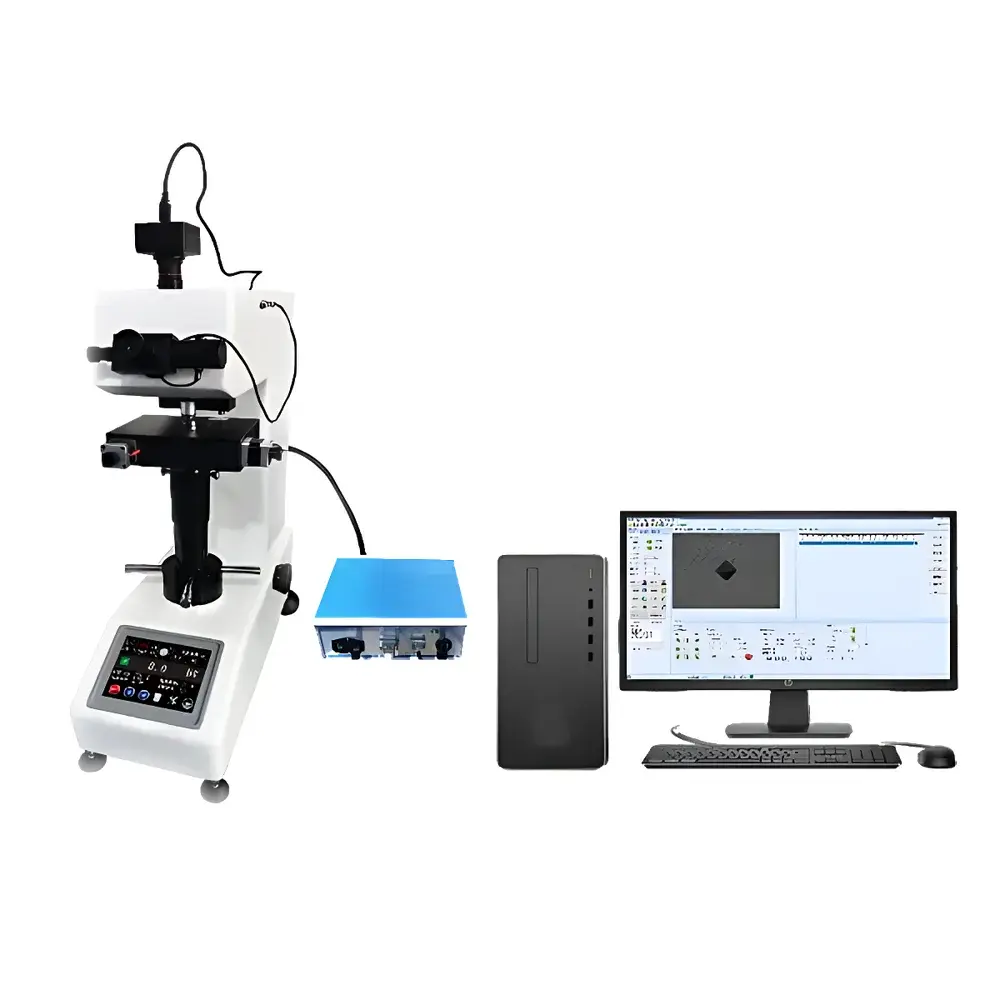
YANRUN HMAS-D10SMZB Semi-Automatic Micro-Vickers Hardness Testing & Analysis System
| Brand | YANRUN |
|---|---|
| Origin | Shanghai, China |
| Manufacturer Type | Manufacturer |
| Product Category | Domestic |
| Model | HMAS-D10SMZB |
| Instrument Type | Microhardness Tester |
| Measurement Range | 0–3000 HV |
| Test Forces (6-level) | 0.3, 0.5, 1, 3, 5, 10 kgf |
| Objective Lenses | 10×, 20× |
| Total Optical Magnification | 100×, 200× (digital display up to ~400×–800×) |
| X-Y Motorized Stage | 50 mm × 50 mm travel, 185 mm × 140 mm platform, 50 kg load capacity |
| Dwell Time | 1–60 s (adjustable in 1 s increments) |
| Specimen Max Height | 180 mm |
| Indenter-to-Chamber Distance | 130 mm |
| Compliance | GB/T 4340.2, JJG 151 |
| Software | Multi-language (English, Chinese, German, Spanish, Russian), ASTM E384-compliant curvature correction, GLP/GMP-ready audit trail & user permission management |
Overview
The YANRUN HMAS-D10SMZB Semi-Automatic Micro-Vickers Hardness Testing & Analysis System is an integrated metrology platform engineered for precision microhardness characterization of metallic, ceramic, thin-film, and coated materials. It operates on the fundamental principle of Vickers indentation—applying a precisely controlled diamond pyramid indenter (136° apex angle) under defined static load, followed by optical measurement of the resulting diagonal impressions in the specimen surface. The system combines high-stability mechanical architecture, calibrated optical path design, motorized stage automation, and ISO/ASTM-aligned software algorithms to deliver repeatable, traceable hardness data across the full 0–3000 HV range. Designed for laboratory QA/QC, R&D metallurgy, failure analysis, and heat treatment validation, the HMAS-D10SMZB supports both single-point verification and systematic depth profiling—including case depth mapping per ASTM E384 and ISO 6507-1.
Key Features
- Precision-engineered semi-automatic workflow: fully automated load application, dwell, unloading, and indentation imaging—minimizing operator-induced variability.
- Motorized X-Y stage with 50 × 50 mm travel range and 0.1 µm positioning resolution enables programmable multi-point testing, edge scanning, and panoramic tiling.
- Dual objective turret (10× and 20×) with auto-switching capability ensures optimal magnification for both coarse navigation and fine-diameter indentation measurement.
- High-resolution 5 MP CCD imaging system coupled with real-time digital enhancement delivers high-contrast, low-noise indentation images—even on reflective or etched surfaces.
- Advanced image recognition engine with adaptive thresholding and sub-pixel edge detection achieves >99.2% automatic identification accuracy for Vickers diagonals under standardized lighting conditions.
- Comprehensive calibration framework: dual-mode calibration (optical pixel scaling + certified reference block averaging), multi-block segmented calibration, and automatic coefficient selection based on lens/magnification/load configuration.
- Real-time hardware status monitoring: software displays active indenter, objective, applied load, dwell time, and system readiness—enabling full procedural transparency.
Sample Compatibility & Compliance
The HMAS-D10SMZB accommodates specimens up to 180 mm in height and 50 kg in mass, with a minimum clearance of 130 mm from indenter center to chamber interior wall—supporting large cross-sections, forged components, and mounted metallographic samples. Curvature correction algorithms comply with ASTM E384 Table I and Table II for spherical and cylindrical test surfaces. All hardness calculations adhere to GB/T 4340.2 (equivalent to ISO 6507-2) and are traceable to national metrological standards per JJG 151 verification protocol. The system supports GLP and GMP environments through role-based access control, electronic signatures, audit-trail logging of all measurements and parameter changes, and 21 CFR Part 11–compatible data export (CSV, XLSX, DOCX).
Software & Data Management
The embedded analysis suite provides bilingual interface support (English, Chinese, German, Spanish, Russian) and implements a modular architecture for scalability. Core capabilities include: automatic and manual measurement modes (four-corner, diagonal, four-point selection); dynamic pixel-to-micron conversion; real-time HV/HK calculation; cross-standard hardness conversion (HV ↔ HK ↔ HRC ↔ HRB ↔ HRA ↔ HBW ↔ HBS ↔ HRN/HRT series); and customizable reporting templates exportable to Word and Excel. Advanced functions encompass 17 configurable path planning modes (linear, radial, contour-following, matrix, ring, zigzag), multi-sample panoramic stitching, region-of-interest (ROI) masking to suppress adjacent indentations, and curvature-compensated depth profiling. All raw images, coordinate metadata, and measurement logs are stored with timestamped provenance and immutable revision history.
Applications
This system serves critical roles in materials science laboratories, aerospace component certification, automotive powertrain QA, semiconductor packaging validation, biomedical implant coating assessment, and academic metallurgical research. Typical use cases include: quantifying case hardening depth in gear steels; evaluating diffusion barrier integrity in PVD-coated tools; measuring grain-boundary hardness gradients in nickel superalloys; validating thermal spray deposit homogeneity; and performing interfacial hardness mapping across dissimilar weld joints. Its reproducibility (≤±1.5% RSD at 500 HV, n=10) and linearity (R² ≥ 0.9998 over 50–2500 HV) make it suitable for ISO/IEC 17025-accredited testing facilities.
FAQ
Does the system support ASTM E384-compliant thin-section testing?
Yes—the software includes built-in curvature correction models for convex and concave surfaces per ASTM E384 Tables I and II, and supports minimum thickness verification logic.
Can measurement data be exported in machine-readable formats for LIMS integration?
Yes—CSV, XML, and Excel-compatible XLSX exports include full metadata (load, dwell, coordinates, image hash, operator ID, timestamp), enabling seamless LIMS or ELN ingestion.
Is remote operation or network deployment supported?
The system operates on standard Windows OS and supports TCP/IP-based remote desktop access; optional client-server mode allows centralized database management across multiple instruments.
What maintenance intervals are recommended for calibration verification?
Daily verification using certified reference blocks is advised; full recalibration per JJG 151 is recommended annually or after 5,000 test cycles—whichever occurs first.
How does the system handle overlapping or partially obscured indentations?
The ROI masking function allows users to define exclusion zones; combined with adaptive edge detection and manual vertex repositioning, it ensures robust measurement even in high-density arrays.



