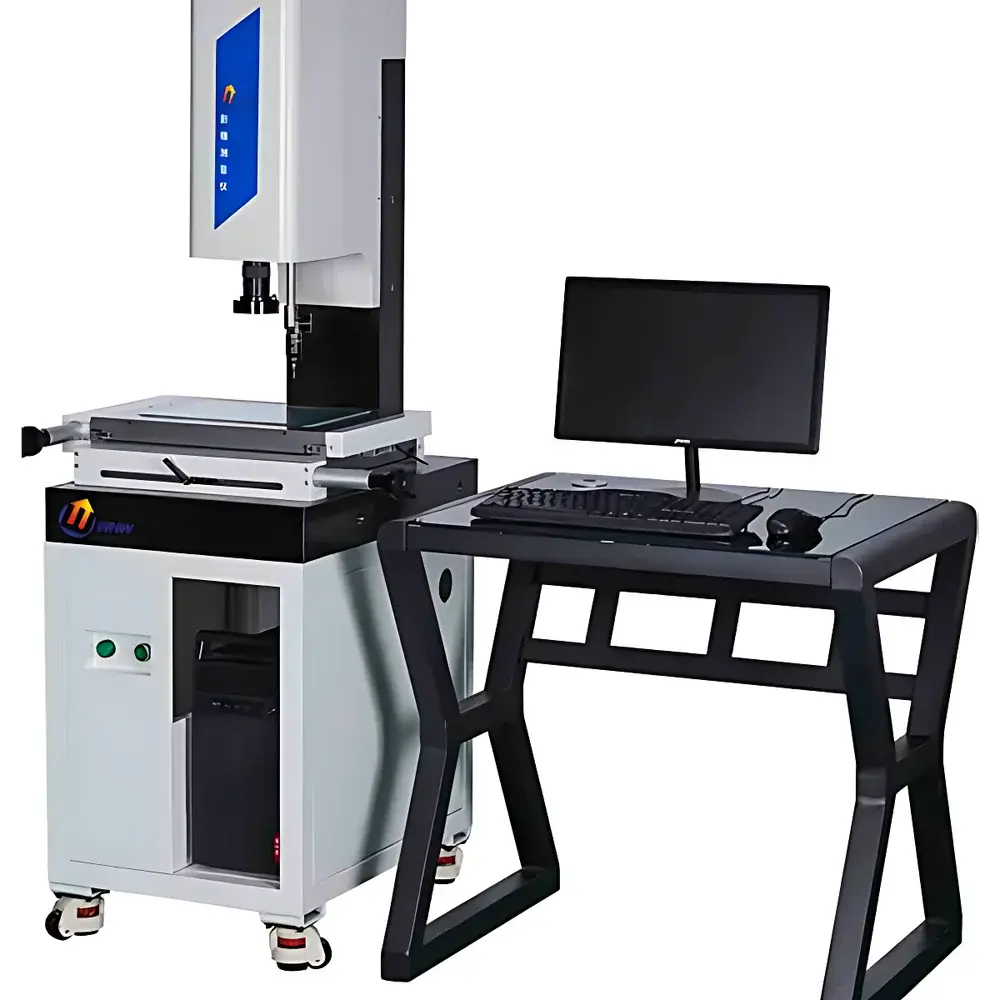
YANRUN YR5040CNC-T Probe-Integrated Automated 3D Vision Measuring Machine
| Brand | YANRUN |
|---|---|
| Origin | Shanghai, China |
| Manufacturer Type | OEM Manufacturer |
| Model | YR5040CNC-T |
| Operation Mode | Fully Automatic |
| XY-Axis Measurement Accuracy | (3 + L/200) µm |
| Z-Axis Measurement Accuracy | (5 + L/200) µm |
| Encoded Linear Scale Resolution | 1 µm (Closed-Loop) |
| XY-Axis Traverse Speed | 280 mm/s |
| Z-Axis Traverse Speed | 100 mm/s |
| Optical Magnification | 0.7×–4.5× |
| System Magnification | 21×–200× |
| Camera | Hikvision GigE Color Industrial CMOS Camera |
| Surface Illumination | 5-Ring 8-Zone LED Cold Light Source, 256-Step Intensity Control |
| Edge Illumination | LED Cold Light Source, 256-Step Intensity Control |
| Probe System | Renishaw MCP 3D Touch Probe |
| Probe Tips | Renishaw Ruby Spheres (1 mm & 2 mm) |
| Base & Column Material | Grade-0 Granite (Flatness ≤ 3 µm) |
| Motion System | DC Servo Motors with Precision Crossed-Roller Bearings |
| Software Platform | CNC4000 Intelligent Metrology Suite |
Overview
The YANRUN YR5040CNC-T is a high-precision, probe-integrated automated 3D vision measuring machine engineered for metrology-grade geometric inspection in quality control laboratories and precision manufacturing environments. It combines non-contact optical imaging with tactile probing in a single platform—enabling comprehensive dimensional verification of complex parts across X, Y, and Z axes. The system operates on the principle of coordinate metrology: optical edge detection via sub-pixel centroid algorithms and calibrated lens projection geometry, augmented by mechanical probing for features inaccessible to vision (e.g., blind holes, recessed surfaces, or matte/reflective geometries). Its granite base (Grade-0, flatness ≤ 3 µm) provides thermal stability and vibration damping essential for repeatable measurements under ISO 10360-2 and VDI/VDE 2617 compliance frameworks. Designed for operation at 20 °C ± 2 °C, the instrument incorporates real-time temperature compensation—applying material-specific thermal expansion coefficients to correct dimensional deviations arising from ambient drift.
Key Features
- Fully automated CNC motion control across three orthogonal axes with closed-loop 1 µm resolution linear encoders, ensuring traceable positioning repeatability.
- Hybrid measurement architecture: simultaneous optical imaging (Hikvision GigE color camera, 6.5:1 zoom lens) and tactile probing (Renishaw MCP 3D probe with ruby-tipped styli) for multi-modal feature capture.
- Intelligent illumination system featuring independently controllable 5-ring 8-zone surface lighting and edge backlighting—both adjustable in 256 intensity steps to optimize contrast for diverse surface finishes and geometries.
- Auto-focus functionality with Z-axis servo feedback enables rapid, repeatable height measurement and depth-of-field optimization without manual intervention.
- Robust mechanical design: precision crossed-roller bearings, DC servo drives, and 00-grade granite structure ensure long-term stability and resistance to mechanical hysteresis.
- Real-time edge extraction, texture segmentation, and contour tracing algorithms support reliable measurement of low-contrast, irregular, or partially occluded features.
Sample Compatibility & Compliance
The YR5040CNC-T accommodates workpieces up to 500 mm × 400 mm × 180 mm (L × W × H) and supports loads up to 25 kg. Its dual-mode sensing capability allows reliable measurement of metallic, plastic, ceramic, and composite components—including machined surfaces, stamped parts, PCBs, and injection-molded housings. The system meets foundational requirements for ISO/IEC 17025 accredited labs when operated within specified environmental conditions (humidity: 30–80 % RH; vibration < 0.002 g below 15 Hz). While not pre-certified to FDA 21 CFR Part 11, its software architecture supports audit-trail-enabled user authentication, electronic signatures, and immutable .rst task logging—facilitating GMP/GLP-aligned deployment upon site-specific validation.
Software & Data Management
The CNC4000 metrology software suite delivers full workflow automation—from program creation and execution to statistical analysis and reporting. It supports CAD-based alignment (DXF import/export), image-to-drawing overlay comparison, panoramic stitching of large-area scans, and SPC-compliant data export (CSV, Excel, PDF, Word, DXF). All measurement tasks are saved in encrypted .rst format with timestamped operator ID, machine configuration, and environmental metadata. The system provides configurable report templates compliant with ASME Y14.5 and ISO 1101 GD&T standards. Multi-language UI (English, Simplified/Traditional Chinese, Japanese, Korean) ensures global operational consistency. Lens auto-calibration eliminates routine recalibration overhead, while thermal compensation parameters are user-configurable per material class.
Applications
This instrument serves as a primary dimensional verification tool in automotive Tier-1 suppliers (e.g., gear housing, brake caliper inspection), medical device manufacturers (catheter hubs, surgical instrument dimensions), electronics contract manufacturers (SMT stencil alignment, connector pitch verification), and aerospace subcontractors (turbine blade root geometry, bracket hole patterns). It is routinely deployed for first-article inspection (FAI), in-process checks, final acceptance testing, and supplier quality audits. Specific use cases include radius and chamfer verification, positional tolerance assessment (true position, concentricity), profile deviation analysis (form error mapping), and multi-feature batch measurement with pass/fail classification and outlier flagging.
FAQ
Does the YR5040CNC-T support GD&T evaluation per ISO 1101 and ASME Y14.5?
Yes—the software includes dedicated modules for straightness, flatness, circularity, cylindricity, parallelism, perpendicularity, angularity, position, concentricity, symmetry, and profile of a surface or line.
Can measurement programs be exported and reused across multiple machines?
Yes—CNC4000 supports standardized .prg file export with embedded calibration and illumination settings, enabling cross-machine reproducibility when hardware configurations match.
Is the Renishaw probe system compatible with third-party calibration artifacts?
Yes—the MCP probe interface adheres to standard I++ DME communication protocols and accepts certified sphere stacks, step gauges, and ring gauges traceable to NIST or PTB.
What level of environmental control is required for ISO 10360-2 compliance?
Stable temperature (20 °C ± 0.5 °C recommended for highest accuracy), humidity 30–60 % RH, and vibration isolation meeting ISO 25319 Class A specifications are advised for certification-grade operation.
Does the software support automated SPC chart generation and process capability analysis (Cp/Cpk)?
Yes—integrated SPC tools allow import of .rst datasets, automatic subgrouping, control limit calculation (X̄-R, X̄-S, I-MR), and capability indices aligned with AIAG MSA guidelines.