
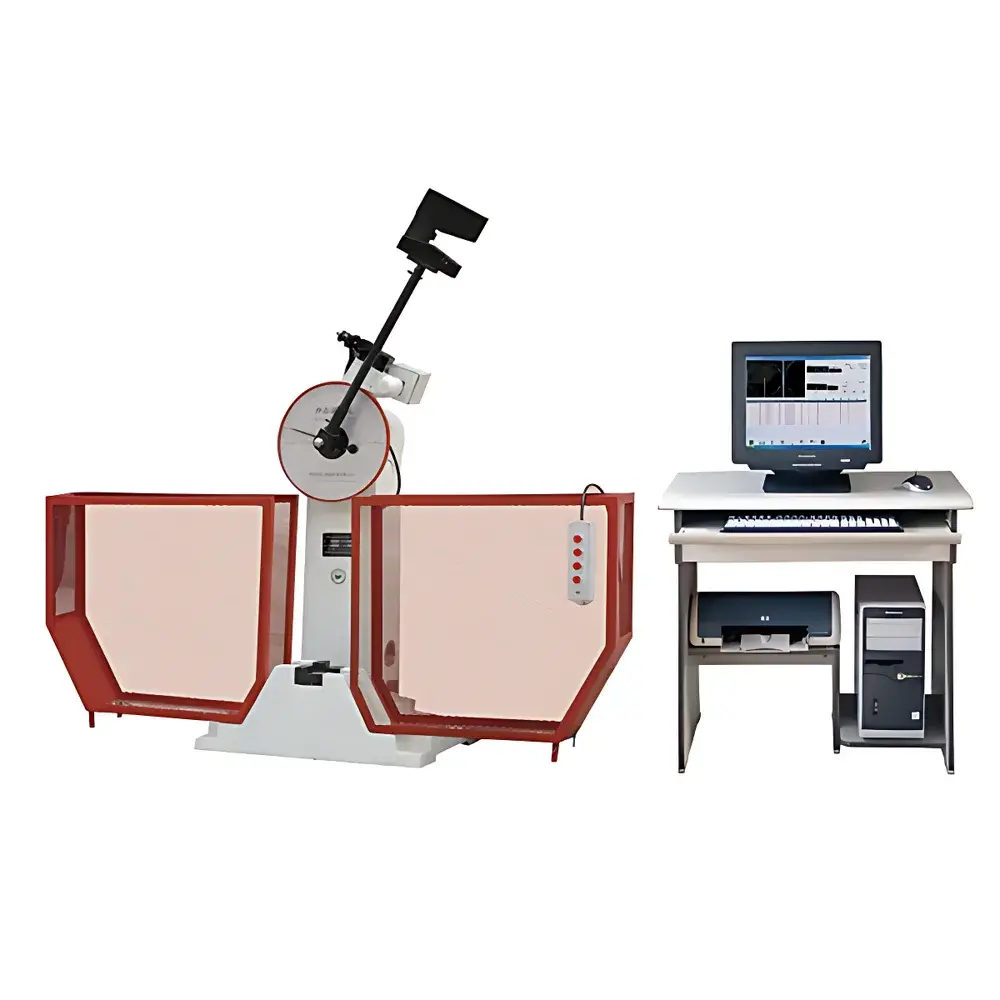
YANRUN JBW-300B Semi-Automatic Computer-Controlled Charpy Impact Testing Machine
| Brand | YANRUN |
|---|---|
| Origin | Shanghai, China |
| Manufacturer Type | Direct Manufacturer |
| Region of Origin | Domestic (China) |
| Model | JBW-300B |
| Instrument Category | Pendulum-Type Charpy Impact Tester |
| Nominal Impact Energy | 150 J / 300 J |
| Impact Velocity | 5.2 m/s |
| Pendulum Axis to Impact Point Distance | 750 mm |
| Pre-Lift Angle | 150° |
| Support Span | 40.0 ± 0.2 mm |
| Anvil Radius (Clamp Corner) | R1–R1.5 mm |
| Striking Edge Radius | R2–R2.5 mm and R8 ± 0.05 mm |
| Specimen Dimensions | 10 mm × 10 mm × 55 mm (also compatible with 7.5 mm, 5 mm, and 2.5 mm widths) |
| Compliance | GB/T 229–2007, GB/T 3803–2002 |
Overview
The YANRUN JBW-300B Semi-Automatic Computer-Controlled Charpy Impact Testing Machine is a precision-engineered pendulum impact system designed for standardized Charpy V-notch and U-notch impact testing of metallic materials in accordance with ISO 148-1, ASTM E23, and national standards GB/T 229–2007 and GB/T 3803–2002. It operates on the principle of gravitational potential energy conversion: a calibrated pendulum is raised to a defined pre-lift angle (150°), released, and allowed to strike a notched specimen supported in a three-point bending configuration. The energy absorbed during fracture—calculated from the difference between initial and residual pendulum height—is measured with high reproducibility using an optical encoder-based angular displacement sensor and real-time microprocessor computation. The system’s single-column, cantilevered pendulum architecture ensures mechanical rigidity and minimal energy loss during impact, while its semi-automatic operation sequence—electromechanically controlled lifting, latching, release, and post-fracture auto-recock—enables consistent throughput in high-volume metallurgical QA/QC environments.
Key Features
- Integrated PC-based control and data acquisition system with Windows-compatible software for real-time display, calculation, and storage of impact energy (J), absorbed energy (J), notch toughness (J/cm²), pendulum lift angle, and batch-averaged results.
- Cantilever-mounted U-shaped pendulum with dual-range calibrated hammer mass, supporting nominal impact energies of 150 J and 300 J—switchable via mechanical reconfiguration per test requirement.
- Modular striking edge assembly secured by precision-threaded fasteners; interchangeable blades with certified radii (R2–R2.5 mm for standard Charpy V, R8 ± 0.05 mm for ISO-compliant calibration verification) ensure traceable geometry compliance.
- Fixed-span anvil base with 40.0 ± 0.2 mm support distance and hardened steel clamping surfaces featuring R1–R1.5 mm corner radius to prevent premature specimen yielding outside the notch zone.
- Dual-layer safety architecture: mechanical interlock pin prevents unintended pendulum release, while a fully enclosed polycarbonate safety shield and stainless-steel mesh guard meet EN ISO 13857 clearance requirements for operator protection.
- Energy recovery functionality leverages residual pendulum kinetic energy after specimen fracture to automatically reposition the hammer to the 150° start angle—eliminating manual resetting and reducing cycle time between consecutive tests.
Sample Compatibility & Compliance
The JBW-300B accommodates standard Charpy specimens per GB/T 229–2007 and ISO 148-1: rectangular cross-sections of 10 mm × 10 mm × 55 mm, with optional adaptability for reduced-width variants (7.5 mm, 5 mm, and 2.5 mm) using auxiliary supports. Notch geometry (V-type or U-type) is prepared externally using certified milling fixtures prior to testing. All mechanical dimensions—including pendulum axis-to-impact-point distance (750 mm), anvil span tolerance (±0.2 mm), and blade radius certification—are verified against GB/T 3803–2002 verification procedures. The instrument is suitable for routine use in GLP-compliant metallurgical laboratories and manufacturing QA departments requiring audit-ready documentation per ISO/IEC 17025:2017 clause 6.4.10 (equipment verification records).
Software & Data Management
The embedded Windows application provides full test lifecycle management: specimen ID entry, test parameter configuration (energy range, notch type, specimen width), automated result calculation (absorbed energy, lateral expansion if integrated sensor-equipped), statistical summary (mean, SD, CV%), and export to CSV or PDF. Audit trails record operator login, test timestamp, parameter changes, and calibration events—supporting alignment with FDA 21 CFR Part 11 principles where electronic records are governed by organizational SOPs. Raw angular position data is logged at ≥1 kHz sampling rate, enabling post-hoc waveform analysis for failure mode correlation.
Applications
- Quality conformance testing of structural steels, alloy castings, and weldments per ASTM A370, EN 10045-1, and GB/T 229.
- Low-temperature impact assessment of pipeline steels and cryogenic alloys using environmental chambers (externally coupled).
- Material development labs evaluating ductile-to-brittle transition temperature (DBTT) curves through sequential testing across temperature gradients.
- Third-party inspection agencies performing accredited impact verification under CNAS or ILAC-MRA signatory scopes.
- Technical training facilities demonstrating fundamental fracture mechanics concepts including notch sensitivity and energy absorption capacity.
FAQ
What standards does the JBW-300B comply with for verification and testing?
It conforms to GB/T 3803–2002 for machine verification and GB/T 229–2007 for test execution; it is also mechanically compatible with ISO 148-1 and ASTM E23 test protocols when configured with certified accessories.
Can the system be integrated into a laboratory information management system (LIMS)?
Yes—via TCP/IP or RS-232 serial interface, the software supports structured data export (CSV/Excel) and can be scripted for automated transfer to LIMS platforms using industry-standard middleware.
Is operator certification required to perform valid tests?
Per ISO/IEC 17025, personnel must demonstrate documented competence in specimen preparation, machine operation, and result interpretation; formal training on this model is recommended prior to accreditation audits.
How often does the pendulum require recalibration?
Annual verification against traceable reference pendulums is recommended; interim checks using certified reference specimens (e.g., NIST SRM 2822) should be performed daily or per shift in regulated environments.
Does the system support both Charpy V-notch and U-notch testing?
Yes—by installing the appropriate striker blade (R2–R2.5 mm for V-notch, R8 ± 0.05 mm for U-notch) and selecting the corresponding test mode in software, the unit meets both geometries as defined in GB/T 229–2007.



