
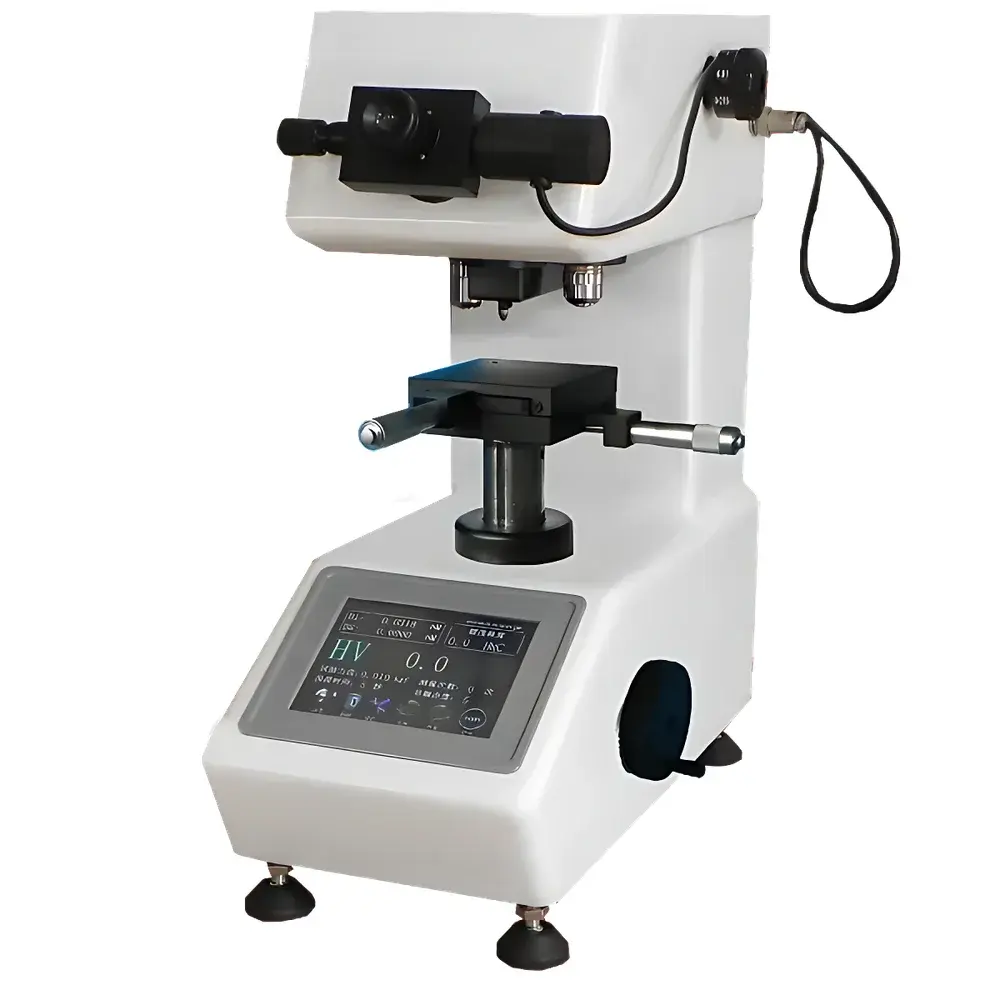
YANRUN HVS-1000BM Touchscreen Digital Microhardness Tester
| Brand | YANRUN |
|---|---|
| Origin | Shanghai, China |
| Manufacturer Type | Original Equipment Manufacturer (OEM) |
| Instrument Type | Microhardness Tester |
| Measurement Range | 0.001–6000 HV |
| Total Test Forces | 10, 25, 50, 100, 200, 300, 500, 1000 gf |
| Standards Compliance | GB/T 4340 |
| Optical Magnifications | 100× and 400× (dual-scale measurement) |
| Minimum Detectable Indentation Resolution | ~0.013 µm at 400× |
| X-Y Stage Travel | 25 × 25 mm |
| Maximum Specimen Height | 80 mm |
| Data Storage Capacity | Up to 60 test records onboard |
| Integrated Thermal Printer | Yes |
| Power Supply | AC 220 V / 50 Hz |
Overview
The YANRUN HVS-1000BM Touchscreen Digital Microhardness Tester is a precision-engineered instrument designed for quantitative microscale hardness evaluation of metallic, ceramic, thin-film, and composite materials using the Vickers and Knoop indentation methods. It operates on the principle of optical indentation metrology: a diamond pyramid indenter (Vickers) or rhombic-based pyramidal indenter (Knoop) is applied under controlled static load to the specimen surface; after unloading, the diagonal lengths of the residual impression are measured via high-resolution optical microscopy and converted into hardness values using standardized algorithms per ISO 6507-1 and ASTM E384. The system integrates a rigid aluminum alloy cast frame, coaxial optical path alignment (objective–turret–illumination–imaging), and fully automated force application (load–hold–unload), ensuring mechanical stability and repeatability across low-load regimes (0.098–9.807 N). Its dual-magnification capability (100× and 400×) enables both rapid screening and high-precision measurement of sub-10 µm indentations—critical for evaluating case-hardened layers, PVD/CVD coatings, brittle intermetallic phases, and microelectronic interconnects.
Key Features
- 5.6-inch true-color resistive touchscreen interface with intuitive icon-driven navigation, inspired by industrial human-machine interaction (HMI) design principles for reduced operator training time and minimized input error.
- Dual-scale optical measurement system: 10× and 40× objectives provide nominal magnifications of 100× and 400×, respectively—both calibrated for direct indentation length acquisition without intermediate ocular micrometer adjustment.
- Integrated digital encoder-based stage positioning and indentation measurement, delivering linear resolution of 0.01 mm (X-Y translation) and sub-pixel indentation detection (~0.013 µm at 400×).
- Coaxial optical architecture ensures near-perfect illumination uniformity and minimal parallax—achieving >98% optical throughput efficiency and eliminating focus drift during sequential testing.
- Automated load application cycle with programmable dwell time (0–60 s in 1-s increments), precise force selection via external rotary selector (eight discrete levels), and closed-loop mechanical loading via gear-driven actuator.
- Onboard thermal printer and internal memory storage (up to 60 test records) support GLP-compliant documentation without external PC dependency.
Sample Compatibility & Compliance
The HVS-1000BM accommodates specimens up to 80 mm in height and 110 mm from column centerline to indentation zone—suitable for bulk metallurgical samples, cross-sectioned welds, polished wafer fragments, and miniature mechanical components. Its low-force range (10–1000 gf) enables reliable testing of thin coatings (<1 µm), heat-treated diffusion zones, and brittle ceramics where conventional macrohardness methods induce cracking or pile-up. The instrument conforms to GB/T 4340.1–2012 (equivalent to ISO 6507-1:2018) for Vickers hardness testing and supports Knoop hardness conversion per ASTM E384–22. All hardness values are traceable to national metrological standards via factory calibration using certified reference blocks (NIST-traceable HV and HK scales). Optional accessories—including thin-sheet clamps, wire grippers, and universal fixtures—extend applicability to non-planar or irregular geometries under ISO 14577-1 mechanical testing guidelines.
Software & Data Management
While the HVS-1000BM operates autonomously via embedded firmware, it is fully compatible with the optional HMAS Professional Microhardness Analysis System—a Windows-based application enabling advanced image capture, multi-point grid mapping, statistical reporting (mean, SD, CV%), and compliance-ready audit trails. HMAS supports 21 CFR Part 11–compliant user authentication, electronic signatures, and immutable data logging when deployed in regulated environments (e.g., ISO 17025-accredited labs, medical device QA/QC). Raw image files (TIFF/BMP), measurement logs (CSV/Excel), and calibration certificates are exportable for third-party validation or LIMS integration. On-device data retention includes timestamp, operator ID (manual entry), test force, dwell time, magnification, and raw diagonal measurements—satisfying minimum record-keeping requirements per ISO/IEC 17025:2017 Clause 7.5.
Applications
- Quality control of surface-hardened steels (carburized, nitrided, induction-hardened) and case depth profiling via stepwise microhardness traverses.
- Thin-film hardness assessment in semiconductor packaging, MEMS devices, and optical coatings—where Knoop testing minimizes lateral cracking in amorphous or polycrystalline layers.
- Failure analysis of solder joints, brazed interfaces, and intermetallic compound (IMC) zones in power electronics assemblies.
- Research-grade characterization of nanocomposites, metal matrix composites (MMCs), and additive-manufactured microstructures.
- Educational use in materials science laboratories for teaching indentation plasticity theory, size effects, and hardness–strength correlations.
FAQ
Does the HVS-1000BM support automatic indentation measurement without manual calibration?
Yes—the integrated encoder-based measurement system performs real-time diagonal length acquisition and auto-calculates HV/HK values using pre-loaded scale factors; no ocular micrometer zeroing or manual scaling is required.
Can the instrument be used for Knoop hardness testing out-of-the-box?
A Knoop indenter is not included in standard configuration but is available as an optional accessory; once installed, the system automatically applies appropriate force ranges and calculation algorithms per ASTM E384.
Is remote data export possible without HMAS software?
Yes—test results and metadata can be printed locally or exported via USB flash drive in CSV format directly from the instrument’s embedded OS.
What maintenance intervals are recommended for long-term accuracy?
Annual verification using certified reference hardness blocks and optical alignment check of the turret–objective axis are advised; no routine lubrication or mechanical recalibration is required due to the gear-driven, backlash-free loading mechanism.
Does the unit meet electromagnetic compatibility (EMC) requirements for laboratory deployment?
It complies with GB/T 18268.1–2010 (equivalent to IEC 61326-1:2012) for Class A industrial environments, including conducted/radiated emissions and electrostatic discharge immunity testing.



