
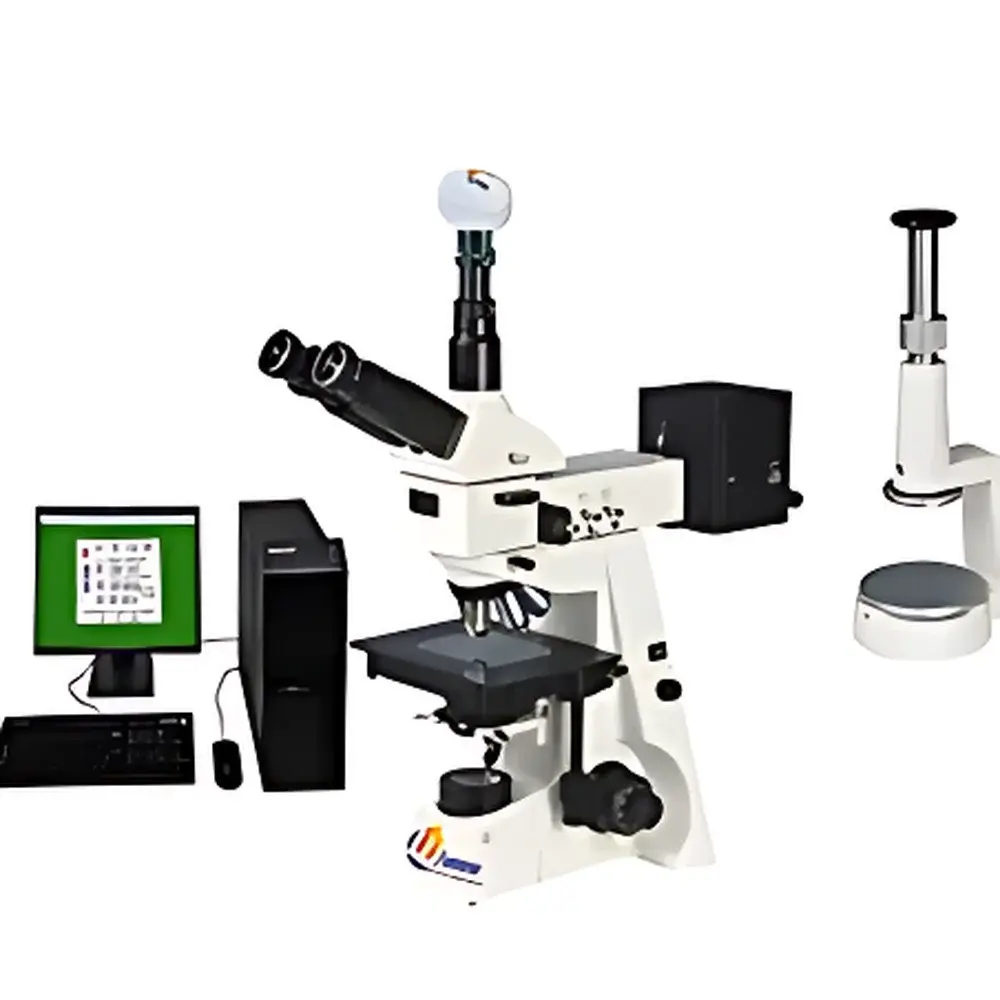
YANRUN 9XB-PC Upright Polarizing Metallurgical Microscope
| Brand | YANRUN |
|---|---|
| Origin | Shanghai, China |
| Manufacturer Type | Direct Manufacturer |
| Product Category | Domestic (China-made) |
| Model | 9XB-PC Upright Polarizing Metallurgical Microscope |
| Microscope Orientation | Upright |
| Image Analysis System | Not Included |
| Eyepieces | Widefield 10× (22 mm field number), Widefield 10× with 0.1 mm reticle scale |
| Objectives | 10×/0.25 (WD 16 mm), 20×/0.4 (WD 10.6 mm), 40×/0.6 (WD 5.4 mm) |
| Binocular Tube | 30° inclined hinge-type trinocular head (interpupillary adjustment 55–75 mm) |
| Nosepiece | Quadruple revolving nosepiece |
| Stage | Dual-layer mechanical stage (180 × 150 mm, 75 × 50 mm travel range) |
| Focus Mechanism | Coaxial coarse/fine focusing with rack-and-pinion drive |
| fine focus graduation | 2 µm |
| Condenser | N.A. 1.25 Abbe condenser with adjustable iris diaphragm and filter holder |
| Illumination | Reflected Köhler illumination with adjustable aperture and field diaphragms |
| transmitted illumination | 12 V / 30 W halogen lamp, AC 85–230 V, continuously variable brightness |
| Polarization System | Rotatable analyzer (0–360°), polarizer and analyzer both removable from optical path |
| Filter Holder | Slide-in green, blue, and neutral density filters |
| Calibration Tool | 0.01 mm stage micrometer |
Overview
The YANRUN 9XB-PC is an upright polarizing metallurgical microscope engineered for high-fidelity microstructural analysis of opaque, polished metallic and ceramic specimens. Designed around an infinity-corrected optical pathway, it delivers consistent contrast, resolution, and flat-field imaging across the full visual field—essential for quantitative metallographic evaluation. Its integrated polarization optics enable birefringence observation critical in phase identification, grain orientation mapping, and stress-induced anisotropy assessment in alloys, composites, and geological thin sections. Unlike inverted configurations optimized for bulk or coated samples, the 9XB-PC’s upright architecture provides direct access to large, flat specimens mounted on its robust 180 × 150 mm mechanical stage—ideal for routine QC inspections, failure analysis, and academic materials characterization labs where specimen handling flexibility and ergonomic observation are prioritized.
Key Features
- Infinity-corrected optical system with plan-apochromatic-compatible objectives ensuring minimal chromatic and spherical aberration across magnifications.
- Trinocular viewing head (30° inclination) with interpupillary adjustment (55–75 mm) and dedicated C-mount port for optional camera integration (0.5× adapter included).
- Quadruple nosepiece accommodating four parfocal, parcentric objectives: 10×/0.25, 20×/0.4, and 40×/0.6—with working distances optimized for standard metallographic sample preparation (e.g., 5.4 mm at 40× supports cover-slip-free observation of etched surfaces).
- Precision coaxial focusing mechanism featuring dual-range control: coarse motion for rapid positioning and fine focus with 2 µm graduation for reproducible depth-of-field adjustments during serial sectioning or layer-thickness estimation.
- Dual-illumination capability: Reflected Köhler illumination with independently adjustable aperture and field diaphragms ensures uniform brightness and optimal contrast control for brightfield, darkfield, and differential interference contrast (DIC) modalities; transmitted base illumination (12 V / 30 W halogen) supports transparent reference standards or dual-mode verification.
- Full polarization suite: Removable linear polarizer and rotatable analyzer (0–360°) facilitate extinction angle measurement, conoscopic analysis, and retardation-based qualitative assessment per ASTM E3–22 and ISO 22825 guidelines.
Sample Compatibility & Compliance
The 9XB-PC accommodates standard metallographic specimens up to 40 mm in height and 75 × 50 mm in lateral travel range—compatible with ASTM E3 specimen mounting protocols and ISO 1463 coating thickness reference geometries. Its N.A. 1.25 Abbe condenser supports high-resolution transmitted-light validation when used with semi-transparent calibration targets or inclusion standards. All optical components meet RoHS-compliant material specifications. The instrument’s mechanical stability, thermal management (halogen lamp heat sink design), and repeatable focusing architecture support GLP-aligned documentation workflows. While the base configuration does not include FDA 21 CFR Part 11–compliant audit trail software, the trinocular port enables seamless integration with third-party image acquisition platforms validated for GMP-regulated environments.
Software & Data Management
The 9XB-PC ships without embedded image analysis software; however, its C-mount interface and standardized 0.5× reduction adapter ensure compatibility with industry-standard digital imaging systems—including USB 3.0 CMOS cameras (2–12 MP), industrial frame grabbers, and DICOM-compliant acquisition modules. Users may deploy validated third-party packages such as Olympus Stream, Zeiss ZEN Core, or open-source alternatives like ImageJ/Fiji with calibrated pixel-to-micron scaling via the supplied 0.01 mm stage micrometer. Metadata capture (objective ID, magnification, illumination mode, date/time stamp) is supported through camera firmware or host PC logging—enabling traceable reporting per ISO/IEC 17025 clause 7.8.2.
Applications
- Quantitative grain size determination (ASTM E112, ISO 643) using reticle-equipped eyepieces and manual point-count methods.
- Phase constitution analysis in ferrous/non-ferrous alloys (e.g., ferrite–pearlite ratios, carbide morphology in tool steels) under cross-polarized light.
- Porosity and inclusion rating per ASTM E45 and ISO 4967 using standardized comparison charts.
- Heat-affected zone (HAZ) evaluation in welded joints, including martensite quantification and intergranular cracking assessment.
- Thin-film and coating delamination studies via controlled reflected-light contrast modulation.
- Geological mineral identification (e.g., quartz vs. feldspar birefringence patterns) in polished thin sections.
FAQ
Is the 9XB-PC compatible with digital imaging systems?
Yes—the trinocular port accepts standard C-mount cameras via the included 0.5× adapter. Resolution-limited performance begins at ~2 MP for routine documentation; higher-resolution cameras (5–12 MP) require external focus calibration.
Can I upgrade to higher-magnification objectives?
Yes—optional infinity-corrected objectives (50×, 80×, 100×) are available and maintain parfocality and telecentricity within the same optical tube lens specification.
Does the microscope support darkfield or DIC observation?
Darkfield is achievable using optional darkfield condensers; DIC requires a separate Nomarski prism set and strain-free objectives—not included in standard configuration.
What electrical safety certifications does the unit meet?
The instrument complies with GB 4793.1–2007 (Chinese equivalent of IEC 61010-1) for laboratory electrical equipment, including double-insulation design and overvoltage category II rating.
Is technical documentation available in English?
Yes—English-language operation manuals, calibration certificates, and CE/GB conformity declarations are provided with each unit upon request prior to shipment.



